
The Career Growth Reset of June 2026: What the New Jobs Data Says About Getting Ahead
The Labor Department dropped fresh hiring numbers this morning, and they reshape what career growth looks like right now. I read through the data so you don’t have to. Here’s what the June 2 release means for your next move, your paycheck, and the skills that matter most in 2026.
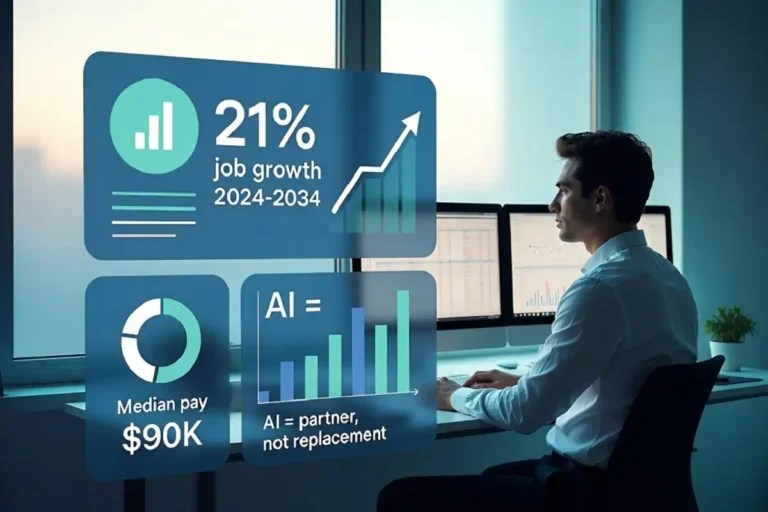
Career growth in mid-2026 favors workers who pair human judgment with AI fluency. Job openings sit near 6.9 million, hiring is steady but lean, and roles tied to AI skills are growing fastest while broad headcount stays flat.
What Today’s Jobs Data Actually Shows
The Bureau of Labor Statistics released its Job Openings and Labor Turnover Survey for April 2026 at 10:00 a.m. Eastern this morning. The report tracks openings, hires, quits, and layoffs across the country.
The trend heading into today was clear. Job openings held at 6.9 million in March, hires rose to 5.6 million, and total separations stayed around 5.4 million. Quits sat near 3.2 million, a sign that fewer workers feel confident jumping ship.
That last number matters for career growth. When quits stay low, internal moves and raises slow down too. Workers are staying put, and employers know it.
The picture is a cooler market than the hiring boom of a few years back. Companies are producing more with smaller teams. That changes when and how new roles get added, especially at the entry level.
Why Career Growth Looks Different in 2026
Career growth in 2026 rewards skill stacking over job hopping. The old playbook of switching companies every two years for a 20% bump has lost steam. Openings are fewer, and recruiters are pickier.
Here’s the shift I keep seeing. Employers want proof you can do the work, not just a degree that says you might. Skills-based evaluation has moved from a buzzword to a hiring standard. If you want to understand how this rewires the promotion ladder, the move toward skills-based hiring and internal mobility is the single biggest factor right now.
Lean teams create a hidden opportunity. In a recent Robert Half survey, only 6% of hiring managers said their organizations have the talent needed to finish high-priority projects this year. That gap is where ambitious workers get promoted fast.
The Skills Driving the Fastest Career Growth
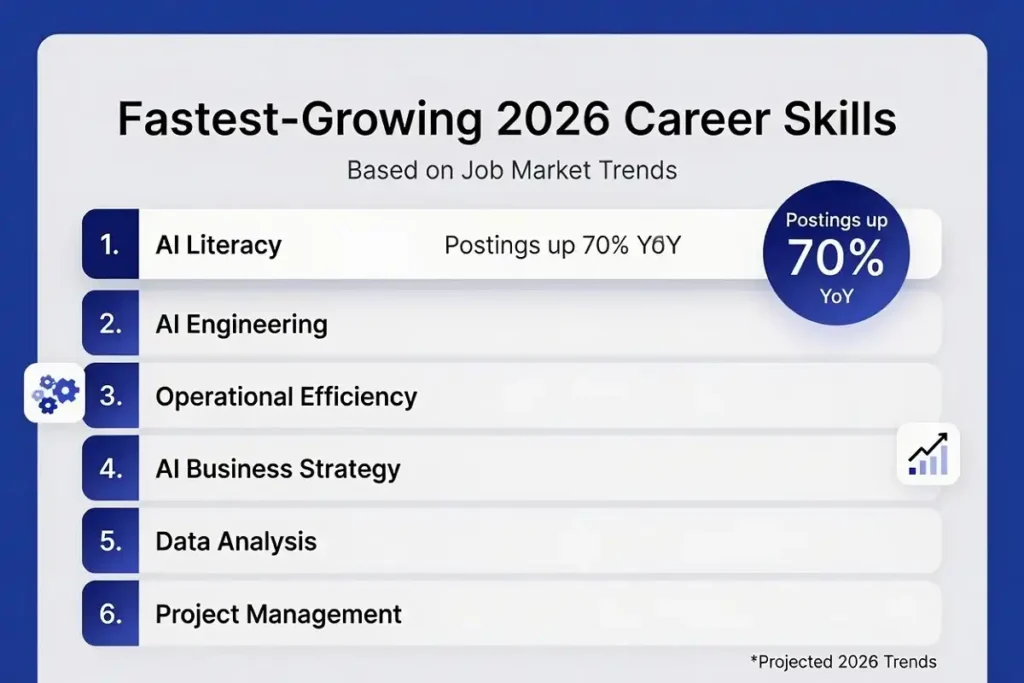
AI fluency is the clearest path to faster career growth in 2026. The data is not subtle.
LinkedIn found that job postings requiring AI literacy skills grew more than 70% year over year, while prompt engineering, model training, and data annotation are drawing rising interest. AI engineering, operational efficiency, and AI business strategy now top the list of fastest-growing skills.
This is not only a tech-team story. LinkedIn data points to AI creating demand at scale, including more than 600,000 new AI-enabled data center jobs and 1.3 million new roles like AI engineers, forward-deployed engineers, and data annotators.
The catch is preparation. Two-thirds of executives expect employees to build AI skills within six months, yet fewer than half of U.S. professionals say they feel supported in doing so. That gap between expectation and support is where you can stand out. The fact that AI skills are now the fastest route to career growth is no longer a prediction. It is the market.
If you want the practical version, career growth steps that actually work start with picking one AI tool relevant to your role and getting genuinely good at it.
Where the Jobs Are Headed Next
Five sectors are pulling ahead in 2026, and your career growth odds climb if you aim at one of them. Based on federal projections, health care and social assistance, AI and cybersecurity roles, clean energy and electric vehicles, construction and infrastructure, and advanced manufacturing are expected to stand out.
The Bureau of Labor Statistics projects health care and social assistance will drive the largest share of U.S. job gains this decade, pushed by an aging population and demand for home-based care.
Leadership matters too. As AI takes over routine tasks, human skills move up in value. Executives are now under real pressure to lead through this shift, and the rising demand for AI leadership skills shows up at every level, not just the C-suite.
What Workers Want From Employers Now
Workers are clear about what keeps them in a job. The top employer attributes in the What Talent Wants 2026 report were flexible or remote work at 67%, competitive pay at 47%, job stability at 42%, clear career growth paths at 36%, and learning and upskilling opportunities at 23%.
Notice that career growth paths beat mission and purpose. The data shows a talent pool in survival mode, with 21% of employed respondents actively looking to leave and fewer than 10% describing themselves as thriving and growing.
For workers, that restlessness is a signal. If your employer cannot show you a path forward, plenty of others are looking too. The companies that win talent in 2026 make the next step visible early.
My Read on This
The June 2 jobs data confirms what the past few months hinted at. Career growth has stopped being about luck or tenure. It is about skills you can prove and an AI fluency you can demonstrate on day one.
The market is lean, not dead. Openings near 6.9 million still mean millions of moves happen every month. The workers who win are the ones who treat upskilling as the job, not a side project. Pick one in-demand skill, get good at it, and make your growth path your employer’s problem to solve, not yours alone.