
Skills-Based Hiring Is Reshaping How You Move Up in 2026
The way you get promoted, hired, and recognized at work has quietly shifted. Across industries right now, employers are paying less attention to your degree and job title history, and much more attention to what you can actually do.
This is not a trend that is still developing. It is already here, and if you are trying to grow your career in 2026, knowing how to position yourself inside this system matters more than almost anything else.
What Skills-Based Hiring Actually Means for You
Skills-based hiring means employers evaluate candidates on demonstrated competencies rather than credentials or years of experience. More employers are dropping degree requirements and adopting competency-based hiring frameworks, with skills-first job postings and growth in micro-credentials becoming standard practice.
This shift has real consequences. If your resume leads with your education and tenure, it may not be speaking the language hiring managers are reading in 2026.
The better move right now is to lead with what you have built and what you can do. Certifications, project outcomes, tools you have used, measurable results. That is what is getting attention.
According to LinkedIn, nearly half of recruiters explicitly use skills data to help fill their roles, and companies are prioritizing adaptable skills over linear resumes or traditional degrees.
For a closer look at how business leadership decisions are responding to these hiring shifts, the patterns are consistent across industries.
The Eight Skill Categories Employers Want Right Now
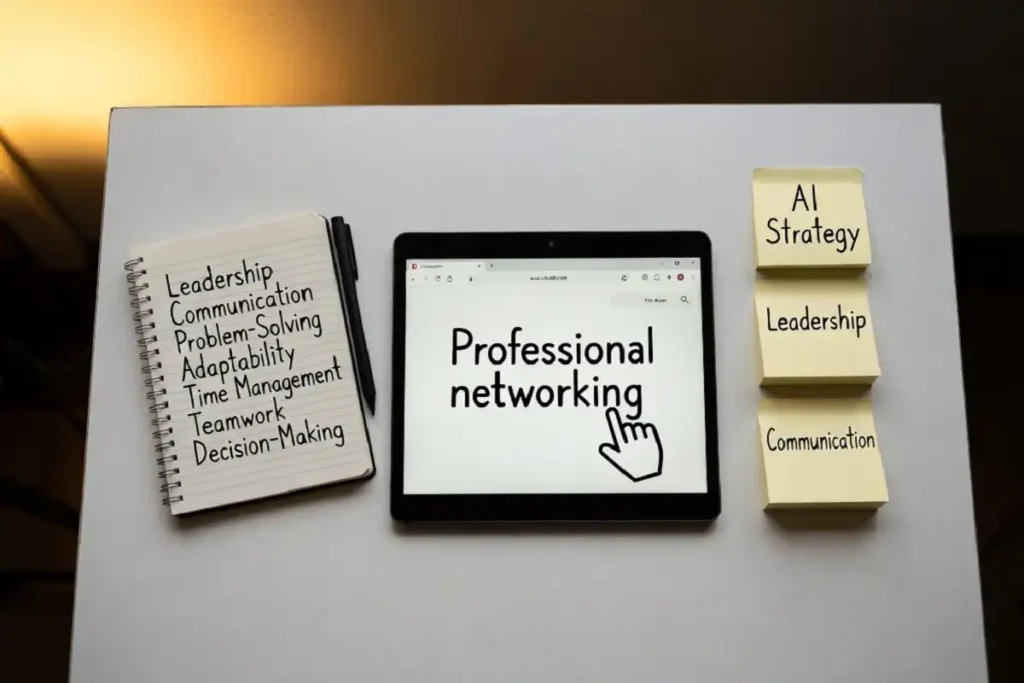
LinkedIn’s 2026 Skills on the Rise report identified the fastest-growing skill categories in the U.S., covering AI engineering and implementation, operational efficiency, AI business strategy, executive and stakeholder communications, financial operations and reporting, leadership and people management, business revenue growth, and risk compliance management.
What stands out here is the mix. It is not all technical.
Leadership, communication, and stakeholder management sit right alongside prompt engineering and data governance. That tells you something important: pure technical skill is not enough on its own anymore.
One finding that surprised many observers was mentorship and coaching appearing on the list. It signals that organizations are investing in team growth beyond just task performance, looking for people who help others develop as well.
If you are trying to figure out where to focus your learning time, pick something from both sides of that list. One technical skill and one human skill. That combination is what employers are actually rewarding.
The Work Style Shift Nobody Talks About Enough
The idea of a person following one career path in their lifetime has largely gone away, acknowledged by 82% of senior executives in a recent Gi Group Holding survey. Jobs have become transient, and employees continuously seek situations that work better for them.
This is not a problem. It is actually an opportunity if you treat your career as a skills portfolio rather than a linear ladder.
Younger workers especially are embracing this. Multiple income streams and project-based engagement are becoming normal, with the appetite for flexible work arrangements continuing to grow.
What this means practically: your next career move may not be a straight vertical promotion. It could be a lateral move that adds a critical skill, a short-term project that builds visibility, or a certification that opens a new earning category. All of those count as career growth right now.
You can follow how technology forces are reshaping enterprise career paths across sectors here at Tomaro Group.
Micro-Credentials Are Punching Above Their Weight
One of the clearest signals from the May 2026 workforce data is that micro-credentials and short certifications are working.
There is meaningful growth in micro-credentials and certifications, with increased employer investment in on-the-job training accompanying the skills-first shift.
The benefit is speed. A full degree takes years and significant money. A focused certification in a high-demand area can take weeks and often costs far less. And right now, employers are treating credentialed skills as meaningful signals.
Organizations that invest early in AI and focus on skill-based hiring are better positioned to attract and retain top talent, foster innovation, and boost productivity and growth.
If your employer offers any kind of learning budget, this is the moment to use it. Many companies have budget for upskilling that employees never ask about. The ask itself often creates positive visibility with managers.
For context on how salary benchmarks are shifting alongside these credential trends, the income gap between skilled and unskilled roles is widening steadily in 2026.
The Entry-Level Gap Is Real, but Closeable
Moving from college to a professional career is now more like a marathon than a sprint, requiring young job seekers to focus on building skills in high-demand fields and refining their job search tactics to navigate an increasingly selective environment.
NACE’s 2026 job outlook reports that 45% of employers view the overall job market for the 2026 class of graduates as “fair,” the lowest sentiment in several years.
That is a tough reading for anyone entering the workforce right now. But the same data that shows a tight job market also points to a clear path through it: skills differentiation.
Employers may be selective, but they are actively hiring in healthcare, logistics, IT, and skilled trades. Demand remains strong in healthcare, skilled trades, logistics, and IT even as the broader job market has cooled from its historic highs.
If you are early in your career, target your skill-building toward those sectors. They are hiring, and the skills-first approach works in your favor when you have current, demonstrable capability even without years of experience.

What To Do This Week
I want to give you something practical rather than vague advice.
Audit your current skills first. Write down the five things you do best in your current role. Then cross-reference them against the eight skill categories LinkedIn identified this year. Look for gaps you can close with a short course or certification in the next 90 days.
Update how you describe yourself. If your LinkedIn summary still opens with your job title and years of experience, rewrite it to open with what you can do and what outcomes you have produced.
Find one credentialed skill to add this quarter. It does not have to be advanced. A Google certification, a short Coursera course with a credential, or a recognized platform certification in your industry all count. Getting one done creates momentum.
Have a conversation with your manager. Ask what skills they see as most critical for someone in your role over the next 12 months. That single conversation often surfaces opportunities and budget that were never formally communicated to you.
The career growth window in 2026 is real for people who are proactive about it. Recognizing these trends is essential for successfully navigating the rapidly changing labor market and maintaining competitiveness.
The professionals pulling ahead right now are not necessarily the most experienced or the most credentialed. They are the most intentional about building skills the market actually needs.
For the latest updates on workforce trends and career strategies, follow Tomaro Group’s news coverage updated daily.