Data Analyst Future: What the Job Looks Like Through 2034
Wondering if the data analyst future still holds up in an AI-first economy? It does, and the numbers back it. The role is growing, pay is climbing, and AI is reshaping the work rather than erasing it.
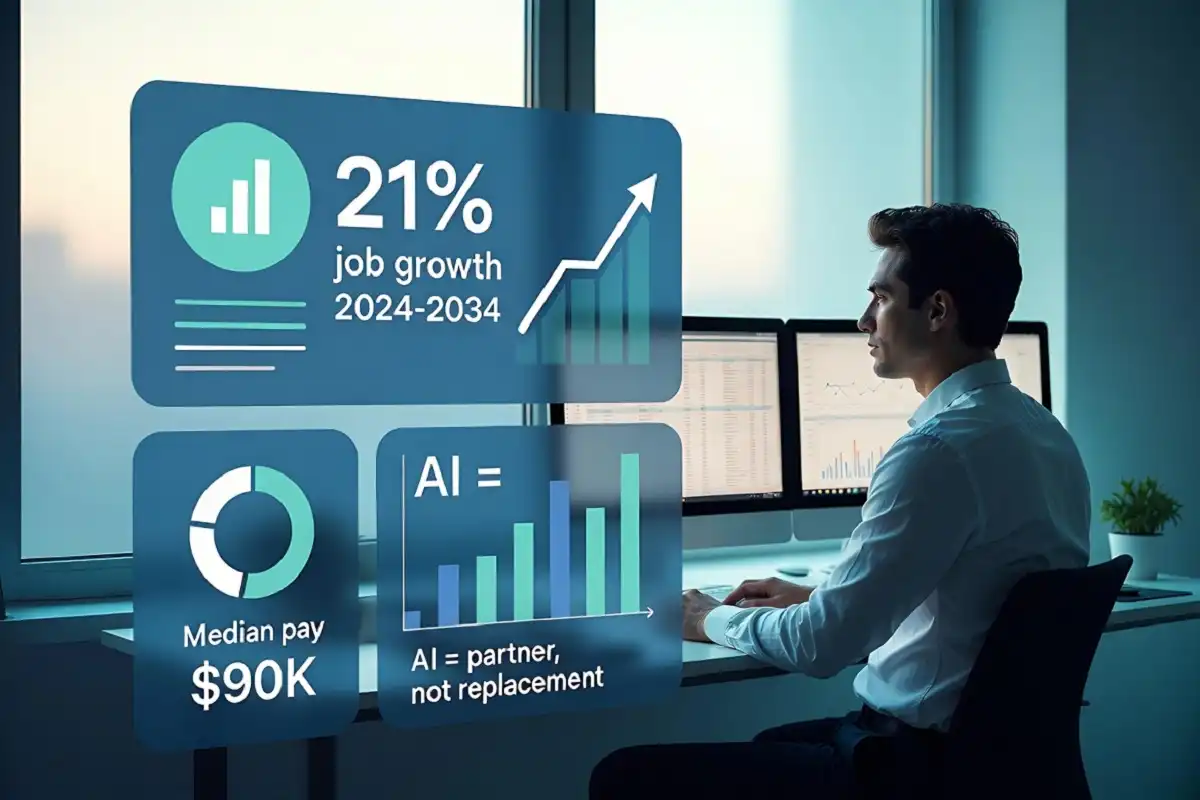
The data analyst future is strong through 2026 and past 2030. Federal projections show 21% growth for the closest tracked role, with median pay near $90,000. AI automates routine tasks but raises demand for analysts who interpret and communicate.
Is the Data Analyst Future Safe From AI?
Yes. AI is changing the work, not replacing the worker. AI lacks judgment, context, and human understanding. It cleans data fast, flags outliers, and runs basic analysis in seconds. But it does not sit in a strategy meeting or weigh a risky trade-off.
The evidence is clear. According to Alteryx’s report, 70% of analysts say that AI automation enhances their work effectiveness, while 87% feel more strategically valuable than ever before. Analysts feel more useful, not less.
Coursera’s 2026 analysis reaches the same read. Most data analyst roles are unlikely to be replaced by generative AI. However, in the future, many data analysts will likely use AI in their day-to-day work. The tool speeds up the grind. The human still owns the meaning.
So the fear misreads the job. A number alone explains nothing. A chart alone tells no story. Analysts ask the right questions and know what the business is trying to do. That part stays human.
How Fast Is the Data Analyst Future Growing?
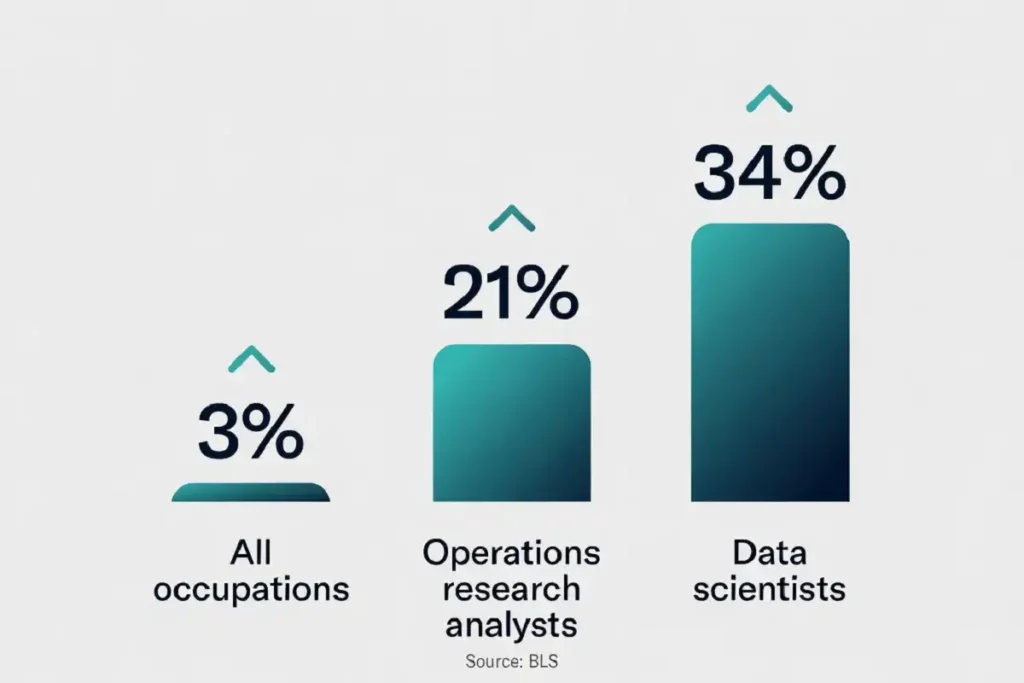
Fast, and well above the national average. The Bureau of Labor Statistics does not track a single “data analyst” title. It files most of this work under operations research analysts. The median annual wage for operations research analysts was $91,290 in May 2024. Employment of operations research analysts is projected to grow 21 percent from 2024 to 2034, much faster than the average for all occupations.
The related data scientist track grows even faster. Total employment is projected to expand from 245,900 in 2024 to 328,300 in 2034 — an absolute gain of 82,500 jobs at a 34% growth rate, against a 3% average across all occupations.
The market picture is just as large. The global data analytics market is projected to reach $104.39 billion by the end of 2026, growing at a massive annual rate of 21.5%. More data means more people needed to read it.
What the Data Analyst Future Pays in 2026
Pay sits in a wide band, and experience moves it more than any other factor. As of the May 2024 BLS data (its most recent), the median for operations research analysts lands near $90,000, with a broad spread.
Here is the range analysts actually see in 2026, drawn from BLS benchmarks and current market reporting:
| Level | Typical pay (2026) | Source basis |
|---|---|---|
| Entry-level | $58,000 – $75,000 | Glassdoor / market data, Q1–Q2 2026 |
| Mid-level | $85,000 – $105,000 | BLS OEWS median $91,290 (May 2024) |
| Senior (major metro) | $130,000+ base | Built In / KORE1 placement data, 2026 |
| Director-level | $160,000+ | Careery composite, Feb 2026 |
Location still matters, but less each year. The remote work shift has compressed geographic pay differences materially since 2022. Secondary markets are catching up fast. Austin, Denver, and Atlanta added $8,000 to $12,000 to median base for this role in the past 24 months.
Skills move the offer too. Three lift pay the most: SQL, a BI tool like Tableau or Power BI, and Python.
Which Industries Drive the Data Analyst Future?
Healthcare, finance, tech, and logistics lead the hiring. Each sector runs on data now, which spreads the risk across the economy.
Healthcare is the standout. Healthcare is projected to be the fastest-growing vertical. The demand for analysts to handle genomic data and predictive patient outcomes is currently outstripping the supply of qualified talent.
Finance keeps pace through fraud and risk work. The Financial Risk and Fraud sector is growing as financial crimes become more sophisticated, requiring analysts who specialise in security-focused data mining.
Regulation adds another pull. Laws like GDPR and CCPA heighten the need for analysts knowledgeable in data privacy, compliance, and ethical handling. Compliance is now part of the job description.
This breadth is why the career holds steady. When one sector cools, another hires. That mix mirrors the wider shift in how businesses are folding AI into everyday operations, which keeps analyst demand spread across the map.
Skills That Define the Data Analyst Future
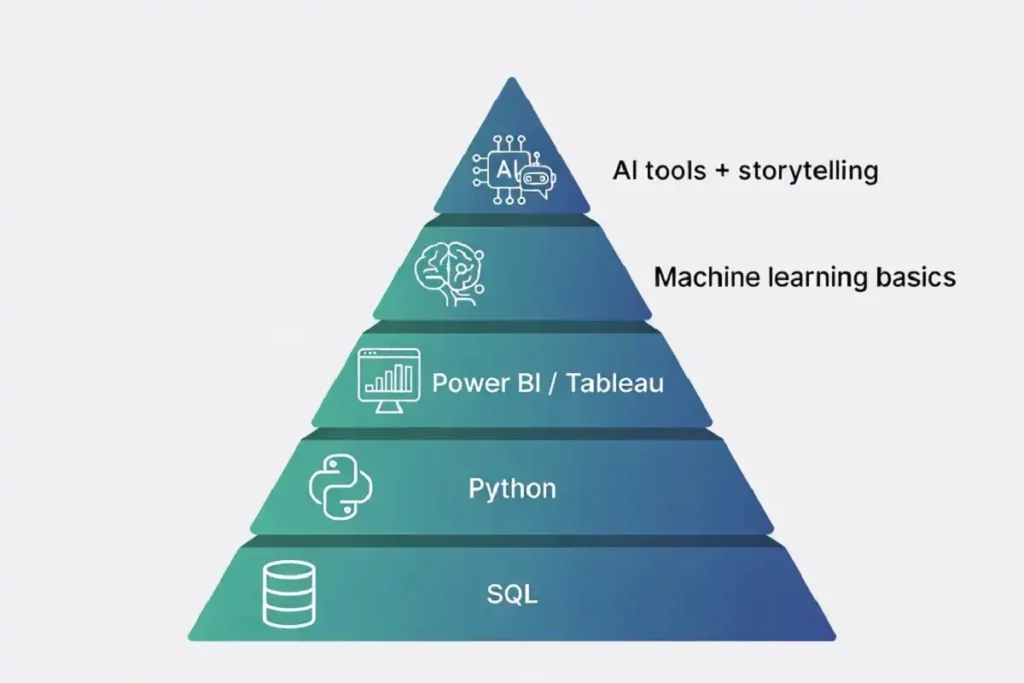
The baseline moved up. Tools that once set you apart now just get you in the door.
Here is the current stack employers expect in 2026:
- SQL, at depth. In 2026, SQL and advanced concepts like window functions and CTEs will be needed.
- Python for automation. It handles the repetitive coding and speeds routine work.
- A BI tool. Power BI or Tableau, for turning tables into dashboards stakeholders read.
- Basic machine learning literacy. Machine learning mentions in job postings have doubled from 7% last year to 14% in 2026.
- Cloud basics. Analysts who understand cloud basics have a competitive advantage in the job market.
- AI-tool fluency. Using copilots to draft code, then auditing the output for accuracy.
Soft skills carry more weight than ever. Critical thinking, stakeholder communication, and data storytelling remain irreplaceable by machines. These decide who moves up.
One shift matters most. Tool proficiency is no longer the differentiator. This means that tool proficiency alone (e.g., SQL, Python, Tableau) is now baseline; differentiation comes from showing how your analysis influenced decisions. Show impact, not just output.
That impact-first hiring pattern lines up with the broader move toward hiring built around proven skills rather than resumes, where a portfolio often beats a degree.
How AI Is Reshaping the Data Analyst Future Day to Day

AI takes the grind, and hands back the thinking. The daily rhythm of the job is changing in specific ways.
Routine work is going first. AI handles repetitive duties like data cleaning and basic reporting, freeing analysts to focus on strategic problem-solving and insights that add greater value to organizations.
New roles are appearing alongside it. New positions such as AI model overseers, data engineers for machine learning systems, and experts in ethical data governance are becoming vital, requiring more advanced technical expertise.
The hiring process itself is adapting. Some interviews now assume AI in the room. Candidates get a dataset and an AI assistant, then explain how they would validate and interpret the results. The test shifts from writing SQL by hand to orchestrating and checking AI output.
Building this kind of AI fluency is quickly becoming the fastest route to moving up a career ladder, and analysts sit right at the center of that trend.
The Catch in the Data Analyst Future
Entry is getting harder, even as demand grows. This is the honest tension in the field right now.
Junior candidates feel it first. One notable pattern in 2026 is that many entry-level candidates report difficulty landing analyst roles, even with relevant skills like SQL and Power BI. The bar to enter has risen with the tools.
Employers now want proof of work. Companies that two years ago would have hired a junior analyst with a coursework portfolio now want at least one internship plus a public GitHub or a published Kaggle notebook plus a real recommendation.
The pure dashboard role is also under pressure. Self-service BI tools handle simple reporting. Analytics engineers take the technical end. The safe ground is the middle: analysts who do both the technical work and the storytelling. That is where pay is rising fastest.
What to Watch Next
The data analyst future rewards people who adapt, not people who coast. Demand is real and growing near 21% for the decade, but the role you enter in 2026 is not the one from five years ago. Build the modern stack. Add Python to your SQL. Learn to work with AI and audit what it produces. Then show, with real projects, how your analysis changed a decision. Do that, and the career stays one of the strongest bets in the economy.