Trump’s Top AI Adviser Sriram Krishnan Is Leaving the White House
I’ve been watching the White House’s AI team closely for a while now, and this week brought a significant shift. Sriram Krishnan, the senior White House AI adviser, announced he will leave the administration at the end of June 2026. This is a big deal for anyone following how the U.S. government is handling artificial intelligence policy.
He joined the Trump administration in late 2024 as one of the most prominent tech industry voices in government. Now, after roughly 18 months, he’s heading out on his own terms.
If you’ve been following the latest AI leadership developments or the broader push around AI skills in the workforce, this story matters to you. It signals how U.S. AI policy is evolving and who’s steering it.
Who Is Sriram Krishnan?
Born in January 1984 in Chennai, Tamil Nadu, India, Krishnan is a tech executive, entrepreneur, and investor. He holds a B.Tech from SRM University and is married to Aarthi Ramamurthy.
Krishnan has led product teams at Microsoft, Twitter, Yahoo, Facebook, and Snap, and was most recently a partner at Andreessen Horowitz, a firm whose founders threw their support behind Trump during the 2024 election.
He and his wife Aarthi rose to additional prominence in 2021 as hosts of the podcast “The Aarthi and Sriram Show,” and he has a close relationship with Elon Musk, having worked with him to rebuild Twitter following Musk’s acquisition of the company in 2022.
When Trump picked him, it was a clear sign the administration wanted serious tech talent inside the building, not just outside advising from a distance.
How He Got the Role
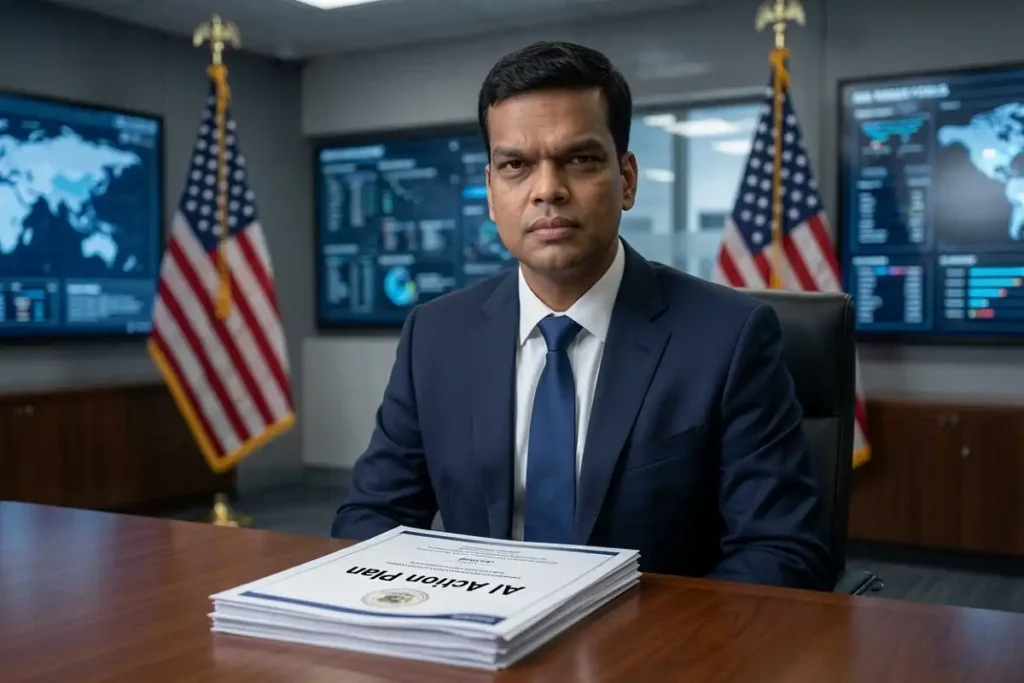
President-elect Trump confirmed that Krishnan would serve as senior policy advisor for AI at the White House Office of Science and Technology Policy, stating that Krishnan would “help shape and coordinate AI policy across government, working with the president’s council of advisors on science and technology.”
A former Andreessen Horowitz partner, Krishnan was tapped by President Donald Trump to help shape AI policy during his second term. He was a key partner in the administration’s AI action plan, including policy initiatives and international diplomacy, as part of efforts to ensure “American AI dominance,” White House AI and crypto czar David Sacks noted.
He worked closely alongside David Sacks, who holds the broader “AI and crypto czar” title in the White House.
What Krishnan Actually Built in 18 Months
This is where it gets interesting. His tenure wasn’t just a title on a business card.
Among the accomplishments he highlighted were helping develop and publish the American AI Action Plan, advancing AI acceleration partnerships designed to strengthen the U.S. AI technology ecosystem globally, and contributing to the National AI Policy Framework for Artificial Intelligence executive order.
The Stargate initiative, a joint venture between OpenAI, SoftBank, and Oracle announced in January 2025 with Trump present at the announcement, represented the administration’s most visible early commitment to maintaining U.S. leadership in frontier AI development. Krishnan’s role in building the policy architecture around it was central to his value to the White House.
He also pointed to his role in promoting American AI interests internationally through engagements with allies, including participation in AI summits in France and India, as well as state visits to the United Kingdom and the Middle East.
That’s a lot of ground covered in a relatively short time. The American AI Action Plan alone reshaped how companies and policymakers approach AI regulation, prioritizing data center expansion and easing regulatory friction on emerging technology.
For context, this kind of international AI diplomacy work matters because competition with China over AI dominance is a core part of the current U.S. strategy. We covered some of that tension when looking at the startup funding surge in AI and quantum technologies.
Why He’s Leaving
Krishnan has informed administration officials that he plans to leave his post as the White House senior policy adviser for AI to start an outside institution that will influence technology policy, according to a person familiar with his plans.
He didn’t spell out every detail publicly. Krishnan posted on social media that he intends to help “tackle some of the large challenges facing America” related to AI, though he did not give a specific reason for leaving his current post.
The White House didn’t treat this as bad news. White House spokesman Kush Desai said that Krishnan’s role has been vital, calling him “a critical asset for the White House and President Trump’s push to cement American dominance in technology and innovation,” and adding that “We look forward to continuing to work with Sriram in his new venture.”
That’s a warm goodbye by Washington standards.
What This Means for U.S. AI Policy
He also moved into a focused position at the National Economic Council in early 2026, signaling a maturation of the administration’s approach to AI from a collection of discrete technology initiatives into a more structured economic framework.
The groundwork he laid isn’t going anywhere. The American AI Action Plan, the executive order framework, and the international partnerships he helped build are all active. His departure creates an opening, but Reuters reported that Krishnan is expected to remain an influential voice outside government.
David Sacks continues to hold the senior AI and crypto czar role inside the White House, so there’s still a dedicated seat at the table for AI policy. But Krishnan was the one doing much of the detailed technical and diplomatic legwork.
This also fits a pattern. His exit follows a string of high-profile resignations this year, including Director of National Intelligence Tulsi Gabbard, Labor Secretary Lori Chavez-DeRemer, and National Counterterrorism Center Director Joe Kent.
It’s worth watching whether the administration moves quickly to fill his specific role or consolidates it under Sacks.
What Krishnan Said on His Way Out
In a post on X, Krishnan said, “I’ll be leaving my role at the White House at the end of this month. After a break, I’ll be working on helping tackle some of the large challenges facing America on AI. It is hard to express how big a privilege it has been to serve the American people and how grateful I am to have had the opportunity to do so.”
He called his government service “the privilege of a lifetime” and credited David Sacks, saying: “His continuing advocacy for America winning on AI has been and continues to be crucial.”
Krishnan also noted broader challenges ahead: “Whether it is energy, data centers, or a clear path for Americans to experience the benefits of AI, there are many tough issues we all need to navigate together.”
That’s a fair summary of what’s still ahead. The policy foundation is there. The hard execution work is just beginning, whether inside government or from the outside.
If you’re following how AI is changing career paths and workplace expectations, you’ll also want to read about how hiring managers are now weighing AI skills against traditional degrees. The policy Krishnan helped build has real ripple effects on the job market.