
Startup Funding 2026: AI and Quantum Lead a Big Week
Startup funding in 2026 is loud again, but it is not loose. On June 3, a small group of companies pulled in most of the disclosed capital. I broke down the biggest rounds, what investors are actually paying for, and what it signals for founders raising right now.
Startup funding in 2026 is concentrated. On June 3, AlphaSense raised $350 million at a $7.5 billion valuation and Oxford Quantum Circuits raised $350 million, with capital clustering around AI, compute, and companies that already show real revenue.
What Happened With Startup Funding This Week?
The biggest checks went to companies sitting close to AI, compute, and enterprise workflows. June 3, 2026 was not a broad-based funding day. It was a concentrated one, with the largest checks going to companies near the infrastructure of decision-making, compute, and operational bottlenecks.
Two names led the day. AlphaSense in New York and Oxford Quantum Circuits in the UK each closed $350 million. Both deals tell the same story. Investors are still writing huge checks, but they want proof, not a pitch. This is the pattern shaping the whole startup scene heading into the second half of the year.
AlphaSense Raised $350 Million at a $7.5 Billion Valuation
AlphaSense closed the headline round of the day. The AI market intelligence platform announced a $350 million funding round valuing the company at $7.5 billion, nearly double its most recent $4 billion valuation, and bringing total funding to well over $1 billion.
The numbers behind the valuation matter more than the valuation itself. AlphaSense exceeded $600 million of annual recurring revenue in Q1 2026, up from $500 million in October 2025. That is real scale, not a story. It is the difference between a speculative bet and a platform investors can underwrite.
The investor list reads like a Wall Street roster. The round was led by Vitruvian Partners, Accenture Ventures, and J.P. Morgan Asset Management, with participation from D. E. Shaw Ventures, Pinegrove Opportunity Partners, CapitalG, Goldman Sachs Alternatives, and Viking Global Investors. Accenture’s role stands out. Through Accenture Ventures, Accenture becomes AlphaSense’s first strategic channel partner to build AI market intelligence and workflow automations.
Why Investors Are Paying Up for AlphaSense
The product is embedded in serious workflows, and that is the moat. AlphaSense says its platform spans more than 500 million business documents and serves more than 7,000 global enterprises, including over 70% of the S&P 500. Founded in 2011 by Jack Kokko, the company helps financial professionals analyze companies and markets across research reports, regulatory filings, and earnings call transcripts.
There is also an exit signal here. CEO Jack Kokko told Reuters the company cannot comment on exact IPO timing, but believes public markets represent a natural path for AlphaSense’s growth. The company paired the raise with a new product, an always-on AI agent called SuperAnalyst, leaning into the rush toward AI agents that handle real analytical work.
You can see the full announcement in the company’s official funding release.
Oxford Quantum Circuits Pulled Off Europe’s Biggest Quantum Round
Quantum computing got its own megaround the same day. Oxford Quantum Circuits raised £260 million, about $350 million, in an oversubscribed Series C, which the company calls the largest fundraise ever completed by a quantum computing company in Europe.
The deal had heavy institutional backing. The round was led by Bullhound Capital, with participation from the British Business Bank, Oxford Science Enterprises, and Chevron. The cash funds a specific build. OQC plans to use the capital to expand deployments and accelerate development of superconducting quantum computers for enterprise and government customers in finance, defense, and security.
This is not a one-off spike for the sector. The Series C is the fourth megaround above $100 million raised by a European quantum company since the start of the year, already surpassing the three announced across all of 2025. The pattern mirrors the broader money rush into hard infrastructure, the same logic behind moves like a $5 billion AI infrastructure deal earlier this spring.
How Selective Is Startup Funding in 2026?
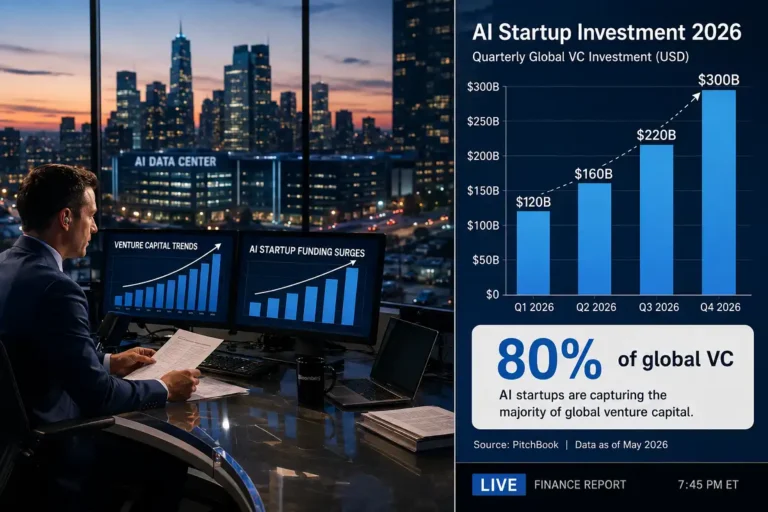
Very selective, and the headline numbers hide it. The market is up, but the money is going to fewer companies. Global venture funding hit $425 billion in 2025, up 30% from $328 billion the year before, with the U.S. capturing 64% and AI pulling in roughly half of all venture funding, according to Crunchbase.
That concentration is the real story for founders. The June 2026 funding market is stronger, but money is flowing to a narrower group of startups, with investors asking harder questions about margins, distribution, compliance, and time to revenue. Big AI rounds also distort the averages. Series A rounds for AI startups now average $51.9 million, but those numbers mostly reflect concentrated capital, not easy fundraising for everyone.
So the takeaway is not “raising is back.” It is “raising is back for proof.” A strong category, real traction, and a clean revenue path beat hype every time in this market.
What This Means for Founders Raising Now
If you are fundraising, treat June 3 as a map, not a celebration. The companies that closed money this week shared three traits: clear category, real demand, and a story investors can defend in public. AlphaSense had $600 million in recurring revenue. Oxford Quantum Circuits had a hard technology lead and government demand. Neither raised on vision alone.
The mood at the top is mixed, which makes proof matter more. Even as public markets keep hitting record highs, CEO confidence slipped this quarter, and cautious leaders write more careful checks. Build the smallest real proof you can, protect your edge early, and frame your round around traction. That is how you get funded in a market that rewards clarity and punishes vague stories. For more on this shift, I keep tracking the startup and business landscape as it moves.
My Read on This
June 3 was a strong day for startup funding, but it confirmed the 2026 rulebook rather than rewriting it. Capital is plentiful and concentrated at the same time. AlphaSense and Oxford Quantum Circuits both won because they looked inevitable, not just promising. The headlines say money is flowing. The fine print says it is flowing to discipline. Read the structure under the numbers, and you will fundraise smarter than the founder who only reads the dollar figure.