Trump Farming Policies: The 2026 Playbook Farmers Need to Read
Farmers are watching Washington closely this season. Trump farming policies now shape everything from soybean prices to insurance premiums, and the money on the table is large. Here is what is actually happening in 2026 and what it means for your operation.
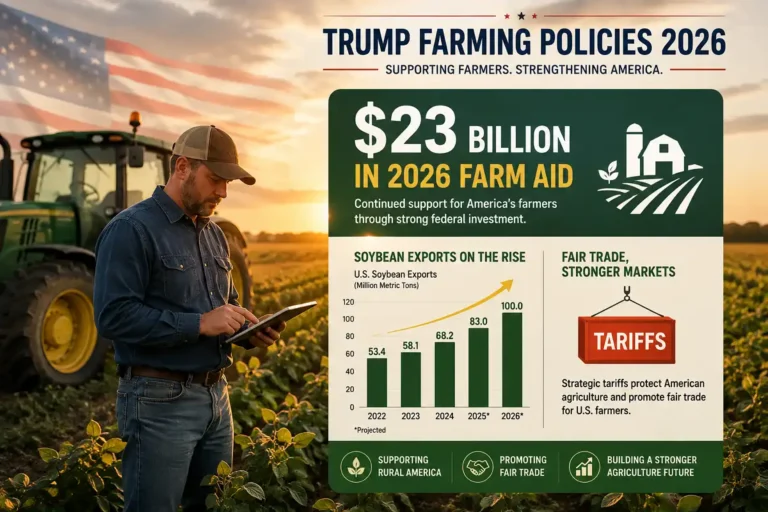
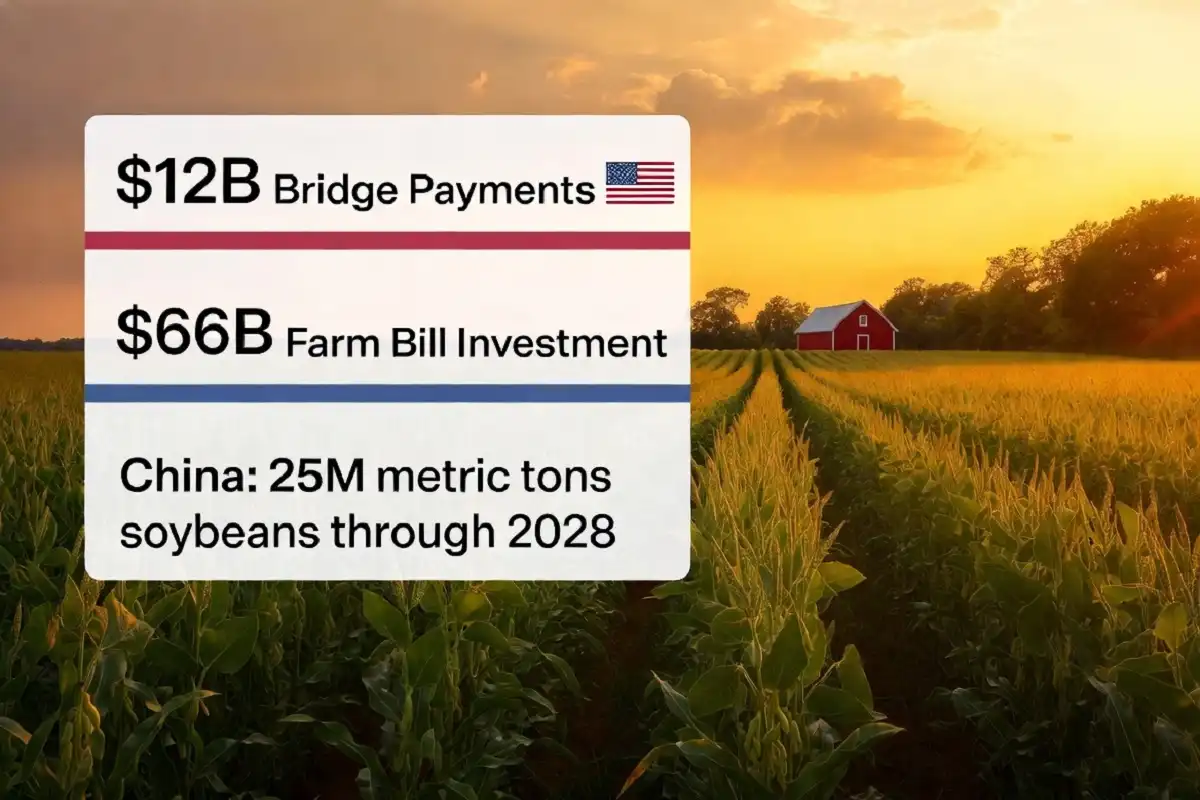
Trump farming policies in 2026 rest on three pillars: a $12 billion bridge payment for row crop farmers, roughly $66 billion in new farm bill spending through the One Big Beautiful Bill Act, and a China trade deal reopening soybean exports. Relief is flowing. Structural problems remain.
What Are the Main Trump Farming Policies in 2026?
The main Trump farming policies in 2026 combine direct cash aid, stronger safety net programs, and aggressive trade negotiation. The administration frames this as a “Farmers First” agenda. In my reporting on this sector, the strategy is clear: cushion the near-term pain from tariffs while pushing long-term structural changes through the farm safety net.
Three moving parts drive it. Direct payments give immediate cash. The One Big Beautiful Bill Act rewrites program formulas. Trade deals aim to rebuild export markets that tariffs disrupted. Each piece matters for a different reason.
The $12 Billion Farmer Bridge Payments
On December 8, 2025, President Trump and Agriculture Secretary Brooke Rollins announced $12 billion in one-time Farmer Bridge Payments. The goal was immediate relief for producers hit by market disruptions and high input costs.
Up to $11 billion runs through the Farmer Bridge Assistance (FBA) Program. It covers row crop producers growing corn, soybeans, wheat, cotton, sorghum, rice, peanuts, and more than a dozen other commodities. The USDA released these payments to qualifying farmers by February 28, 2026. The remaining $1 billion was set aside for specialty crops and sugar.
The FBA uses a uniform formula to cover a portion of modeled 2025 crop-year losses. Crop insurance linkage was not required. This is a large part of the broader Trump farming policies push, and it echoes the Market Facilitation Program from Trump’s first term.
Who Actually Gets the Money?
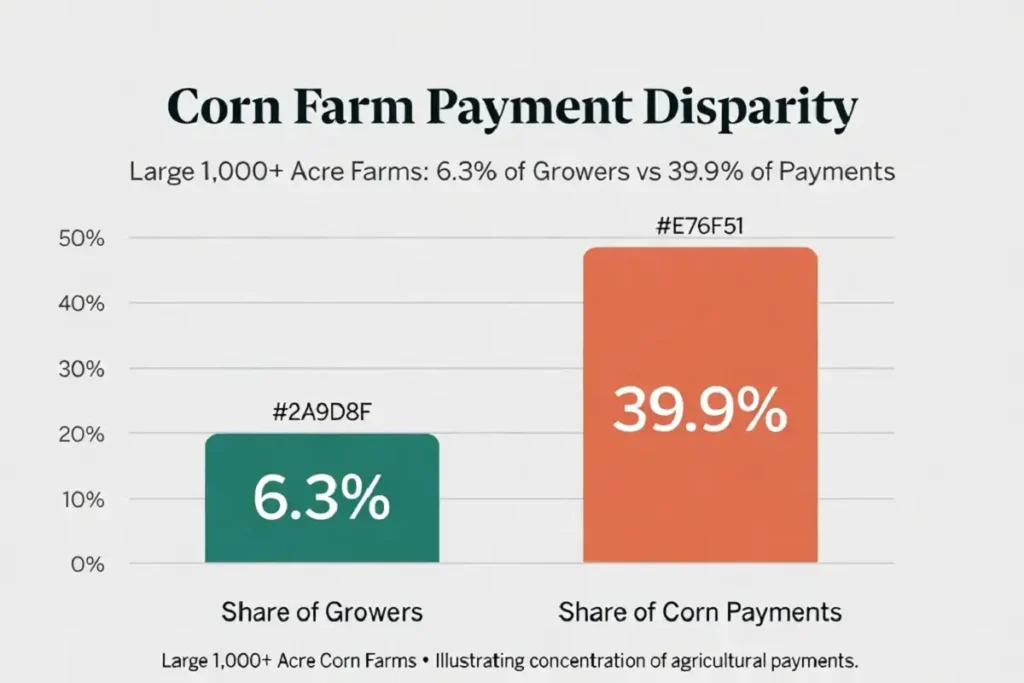
Most of the payment money flows to the largest farms. That is the pattern the data shows. An Environmental Working Group analysis projected that nearly 40% of the $11 billion bridge payment would go to farms growing more than 1,000 acres of commodity crops.
The imbalance is sharpest in corn. Farms growing more than 1,000 acres of corn make up just 6.3% of corn growers. EWG projects they will collect 39.9% of all corn payments. Critics argue this speeds up farm consolidation and squeezes small operators. The national average U.S. farm household income was $159,334 in 2024, well above the national mean, which fuels the debate over who deserves aid.
The One Big Beautiful Bill Act and the Farm Safety Net
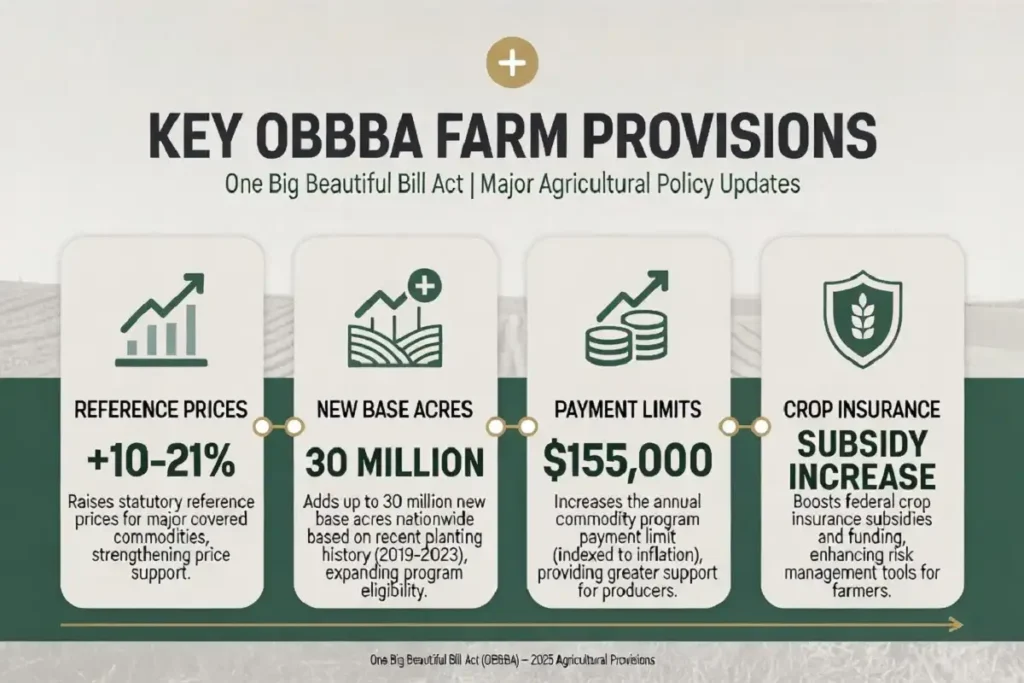
The One Big Beautiful Bill Act (OBBBA), signed July 4, 2025, is the biggest structural change in Trump farming policies. The Congressional Budget Office projects it adds about $65.6 billion in agriculture spending over ten years. That makes it the largest farm program investment since 2002.
Here is what changed for the 2026 crop year:
- Reference prices rose 10% to 21% for major commodities like corn, soybeans, and wheat under the ARC and PLC programs. Some crops, like cotton, peanuts, and rice, saw even larger gains.
- Base acres expanded. Up to 30 million new base acres can be added nationwide, based on 2019–2023 planting history. This raises total base acres from roughly 274 million to about 304 million.
- Payment limits increased from $125,000 to $155,000 per individual, indexed to inflation.
- Crop insurance subsidies grew by 3 to 5 percentage points across coverage levels.
- Dairy Margin Coverage Tier I eligibility rose from 5 million to 6 million pounds.
Farmers must make a new ARC or PLC election for the 2026 crop year through the Farm Service Agency. Miss the election, and the covered commodity loses payment eligibility for 2026. FSA began mailing Base Allocation Summaries on June 1, 2026.
How Do Tariffs Affect Farmers Under These Policies?
Tariffs cut both ways for farmers, and that tension sits at the center of Trump farming policies. Trump’s tariffs opened new leverage in trade talks. They also raised the cost of imported equipment, seed, and chemicals, and they triggered retaliation that closed export markets.
The clearest example is soybeans. China stopped buying U.S. soybeans in 2025 during tariff negotiations. It turned to South American suppliers instead. U.S. soybean exports to China fell 75% in 2025 compared to 2024, according to former USDA chief economist Joseph Glauber. That is why the bridge payments exist. The administration is compensating farmers partly for disruption its own trade actions helped create.
The China Trade Deal and Soybean Recovery
The China deal is the trade centerpiece of Trump farming policies. After the Trump-Xi summit in May 2026, the White House said China agreed to buy at least $17 billion in U.S. agricultural products annually for 2026, 2027, and 2028. That sits on top of a commitment to purchase at least 25 million metric tons of soybeans each year through 2028.
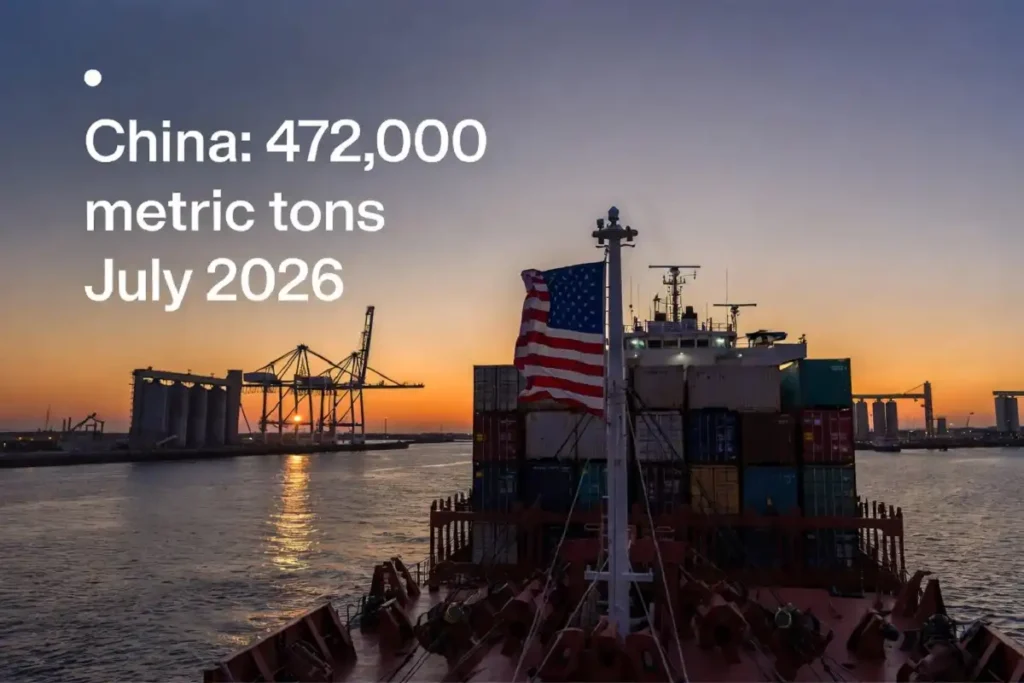
Buying has restarted. On July 8, 2026, the USDA reported China bought 472,000 metric tons of soybeans, the largest daily sale since November 2025. Exports to China from January through March were up 57% over the prior year.
Still, the recovery is partial. China accounted for less than 30% of U.S. soybean exports through March, roughly half its historical share. Beijing has not publicly confirmed the $17 billion figure. Analyst Naomi Blohm of Total Farm Marketing noted China is buying what it committed to, not new demand beyond that. These grain market swings tie directly into how China’s agricultural commitments move commodity prices for U.S. growers.
Biofuels and the Renewable Fuel Standard
Biofuel policy is a quieter but important piece of Trump farming policies. The administration backs the Renewable Fuel Standard as a demand driver for corn and soybeans. In September 2025, EPA Administrator Lee Zeldin proposed revised Renewable Fuel Standard RVOs for 2026 and 2027. The EPA also kept year-round E15 sales available, which supports corn demand at the pump.
Do These Policies Actually Help Farmers Break Even?
For many farmers, the answer is not yet. Prices improved in 2026, but University of Tennessee data predicts soybean prices at average yields still will not reach break-even levels. Input costs remain high. Fuel and fertilizer prices climbed partly on energy market pressure.
The result is real financial strain. In 2025, about 15,000 farms went out of business, most of them small. Farm bankruptcies in the second quarter of 2025 doubled the total for all of 2024. Total farm household income is forecast to rise in 2026, but that gain leans heavily on federal payments rather than market prices. That distinction matters for understanding the wider farm economy pressures now hitting small operators.
The Consolidation Concern
Farm consolidation is the structural risk tied to Trump farming policies. When most aid flows to the largest operations, small farms fall further behind. Higher payments to big farms raise land rental and purchase costs. That pressure pushes more small producers out. The OBBBA payment-limit changes, including new pass-through entity rules under Section 10306, drew criticism as a loophole that helps large operations capture more federal money.
The Numbers to Watch Next
Watch three figures through the rest of 2026. First, whether China hits its 25 million metric ton soybean commitment before the marketing period ends in September. Second, the actual per-acre payments from the new ARC and PLC reference prices. Third, the 2026 farm bankruptcy count. Trump farming policies have moved real money to farm country. Whether that money reaches the farmers who need it most, and whether trade recovery holds, will decide if this season stabilizes American agriculture or simply delays a deeper reckoning. My read: the cash is buying time, not solving the underlying price and cost squeeze.