
Global Heart Failure Experts Just Rewrote the Rules on Diagnosis
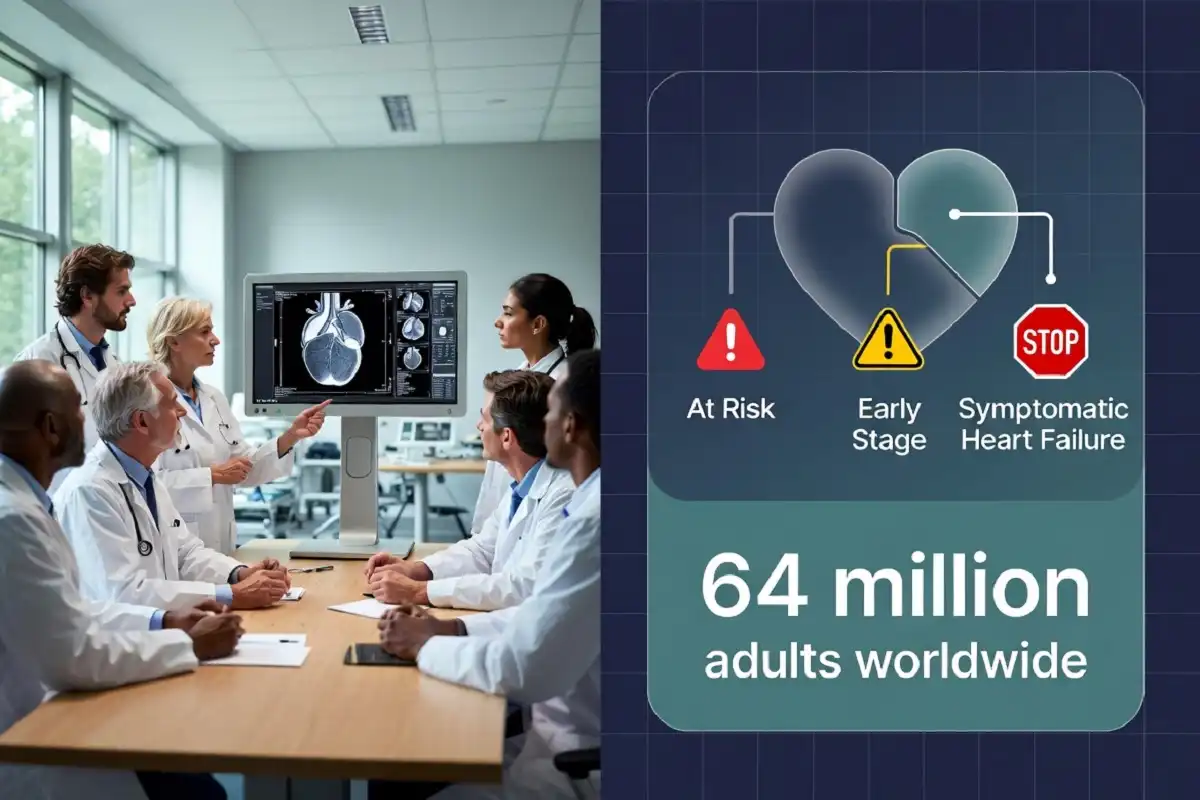
Global heart failure experts from four continents published a new diagnostic framework on June 29, 2026. It replaces rigid heart-scan cutoffs with a staged, personalized model. The change affects how 64 million adults worldwide get diagnosed and treated.
Global heart failure experts from the American Heart Association, American College of Cardiology, European Society of Cardiology, and World Heart Federation released the “Second Universal Definition of Heart Failure” on June 29, 2026. It replaces strict ejection-fraction thresholds with staged, individualized diagnosis criteria.
What the Global Heart Failure Experts Just Changed
The old definition, issued in 2021, leaned on fixed measurement cutoffs. A single number on an echocardiogram often decided whether a patient carried a heart failure diagnosis.
The new document drops that rigid approach. Instead, global heart failure experts built a framework around disease stages, root causes, and how a patient’s condition moves over time. The consensus paper published simultaneously in four major journals: Circulation, JACC, the European Heart Journal, and Global Heart.
Mary Norine Walsh, M.D., co-chair of the writing group and medical director of the heart failure program at Ascension St. Vincent Heart Center in Indianapolis, led the effort. She said inconsistent definitions had slowed research and treatment progress worldwide. The revised framework aims to fix that by giving clinicians, researchers, and health systems one shared language.
Moving Beyond Rigid Ejection Fraction Cutoffs
Question: does the new definition still use ejection fraction numbers to diagnose heart failure?
Yes, but differently. The 2026 update accounts for how left ventricular ejection fraction varies by sex, age, and ethnicity. Instead of one hard cutoff, it sorts patients into three clinically actionable categories: reduced, preserved, and improved ejection fraction. This gives physicians more room to judge each case individually rather than applying one number to every patient.
A New Classification System for Root Causes
The document also introduces a standard way to classify what causes heart failure in the first place. Trials and registries can now report causes using shared categories instead of inconsistent local labels. That matters for pharmaceutical research, because drug trials depend on comparable patient groups across countries.
Why the New Framework Matters for Patients and Clinicians
Heart failure now affects more than 64 million adults globally, driven by aging populations, rising obesity rates, and Type 2 diabetes. The updated definition pushes earlier detection, flagging people who are “at risk” or in early disease stages before symptoms even appear.
That shift matters because heart failure was historically treated as a fixed, late-stage diagnosis. Global heart failure experts designed the new model to treat the condition as dynamic instead. A patient can improve, go into remission, or progress, and the classification is built to track that movement instead of locking in a single label.
Karen Sliwa, M.D., Ph.D., who represented the World Heart Federation as a co-chair, and Lars Køber, M.D., D.M.Sc., who represented the European Society of Cardiology, both signed off on language addressing geographic and social disparities. The document explicitly notes that access to care and local health policy change outcomes depending on where a patient lives. That kind of geographic tracking sits alongside other global health monitoring stories I’ve followed this year, including how health authorities have tracked the Ebola outbreak in the Democratic Republic of Congo, where the same access-to-care gaps show up in a very different disease.
Who Are the Global Heart Failure Experts Behind This Update?
The consensus document came from a joint task force representing seven organizations:
- American Heart Association (AHA): coordinated the overall task force and published the paper in Circulation.
- American College of Cardiology (ACC): co-led the writing group and published the paper in JACC.
- European Society of Cardiology (ESC): contributed through the European Heart Journal and its Heart Failure Association branch.
- World Heart Federation (WHF): published the paper in its journal, Global Heart, and brought a global-equity lens through co-chair Karen Sliwa.
- Heart Failure Society of America (HFSA): added US clinical-practice input.
- Heart Failure Association of the ESC (HFA): contributed European clinical-trial and registry expertise.
- Japanese Heart Failure Society: represented Asia-Pacific clinical practice patterns.
This kind of seven-organization alignment is rare in cardiology. It signals that global heart failure experts want one shared clinical vocabulary rather than competing national guidelines.
How Global Heart Failure Experts Are Tracking the Numbers
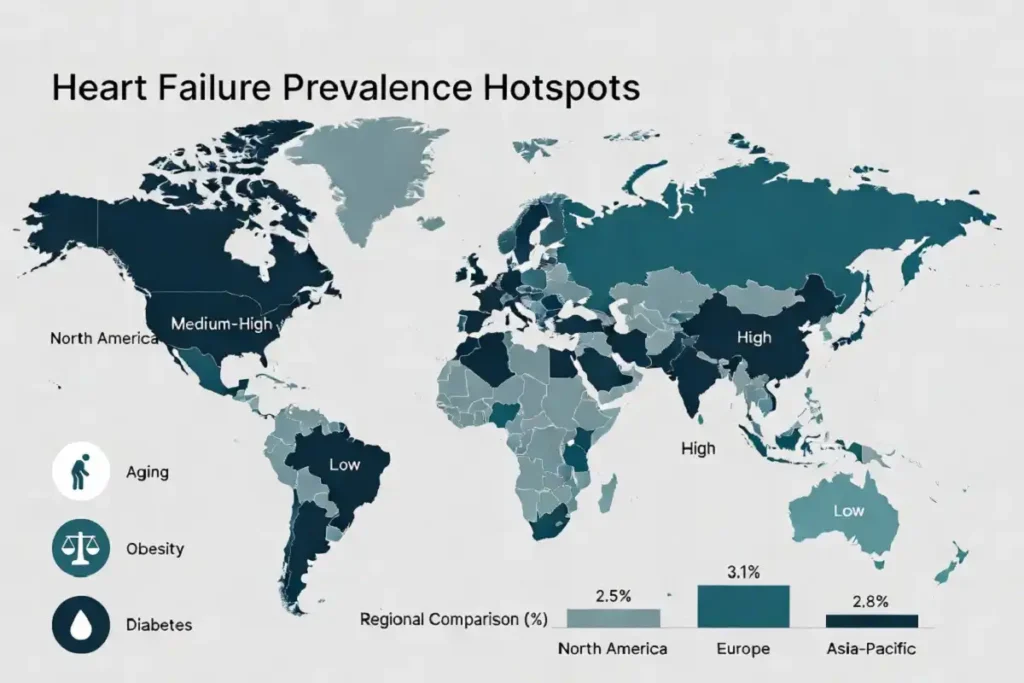
The 64-million-patient figure comes from global health data cited in the AHA’s June 2026 release. Separately, the heart failure drug market was valued near $8.9 billion in 2024 and is projected to reach roughly $31.5 billion by 2034, according to industry market research cited at the 2026 Technology and Heart Failure Therapeutics conference circuit. North America currently holds the largest share of cardiology spending, while the Asia-Pacific region is growing fastest, driven by urbanization and lifestyle-related disease increases.
Hospital accreditation is following the same global trend. The AHA’s Comprehensive Heart Failure Center certification program, once US-only, certified its first site outside the United States in January 2026 at the National Institute of Cardiology Ignacio Chávez in Mexico City. Two more international hospitals, one in Taiwan and one in the United Arab Emirates, have since earned the same certification. That kind of market growth sits in the same category as other 2026 finance stories I’ve covered, from startup funding trends in AI and quantum computing to shifts in corporate spending priorities.
What Role Does Technology Play in the New Framework?
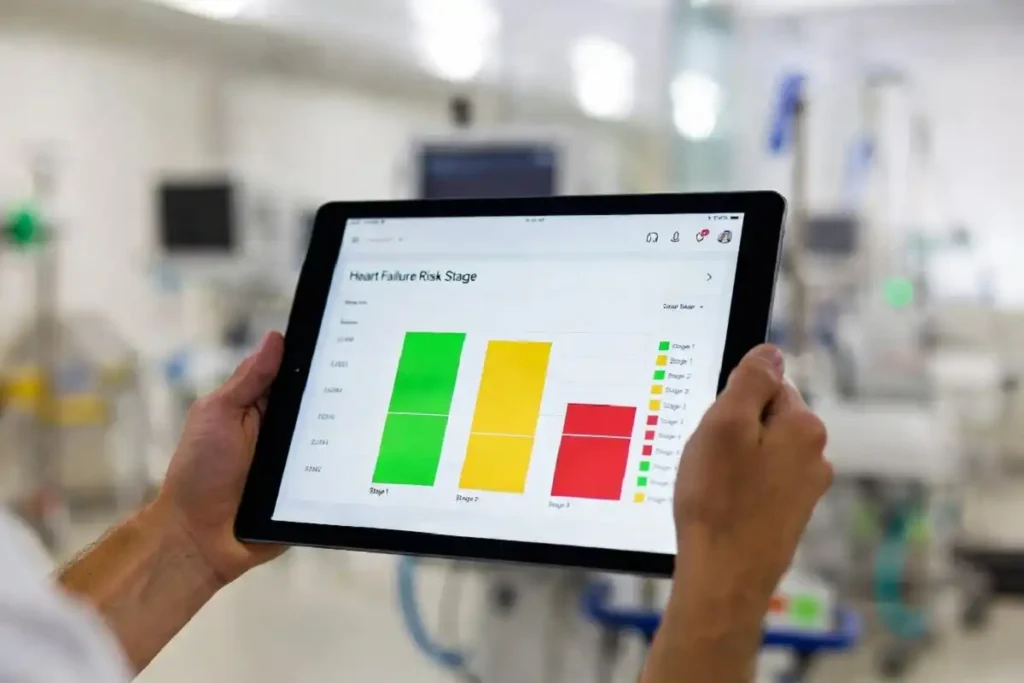
AI-assisted imaging and remote monitoring tools are becoming part of how clinicians apply the new staged model. Hospitals adopting these tools can flag at-risk patients earlier, before symptoms appear, which is exactly what the updated definition is designed to support. That mirrors a broader pattern I’ve tracked across industries: how AI adoption is reshaping frontline decision-making, not just in hospitals but in workplaces generally adopting AI tools for faster, earlier-stage decisions.
What Comes Next: The 2027 AHA/ACC Guideline
This consensus document is not a treatment guideline. It is the foundation for one, built by global heart failure experts who now share a common diagnostic language. The AHA and ACC plan to publish a full Heart Failure Guideline built on this new framework in late 2027. Until then, clinicians will use the updated staging and classification language, but treatment protocols stay under the current 2022 AHA/ACC/HFSA guideline.
Global heart failure experts are also watching how national health systems adopt the new terminology in registries like the AHA’s Get With The Guidelines-Heart Failure program and the ESC’s Heart Failure Long-Term Registry. Data consistency across these registries depends on hospitals actually switching over to the new categories, which typically takes one to two budget cycles.
Where This Leaves Us
The 2026 update replaces a rigid, one-size-fits-all diagnosis with a staged, personalized model. Global heart failure experts built it around three goals: catch disease earlier, standardize how causes get reported, and account for where a patient lives.
Watch for two things over the next 18 months. First, whether major hospital systems update their internal coding to match the new classification before the 2027 treatment guideline lands. Second, whether the geographic-equity language actually changes funding or accreditation decisions outside North America and Europe, where the first international certifications just started rolling out this year.