Trump Farming Policies 2026: What Farmers Need to Know About New Agricultural Changes
Trump farming policies 2026 have reshaped how producers plan their year, from tariffs and trade deals to a new $12 billion aid package. Farmers now weigh tighter labor rules against fresh crop insurance flexibility as they head into fall.
Trump farming policies 2026 center on tariff-funded farm aid, a China soybean deal, and the One Big Beautiful Bill Act’s higher reference prices. USDA also eased crop insurance deadlines and H-2A labor costs this year.
What Are the Trump Farming Policies 2026 Farmers Are Dealing With Right Now?
Farmers face four moving pieces this year. Tariffs on imports and exports. A multibillion-dollar aid program. New farm bill provisions from the One Big Beautiful Bill Act. And shifting rules on hiring foreign labor.
Trump farming policies 2026 tie these pieces together through USDA. Secretary of Agriculture Brooke Rollins has run point on nearly every announcement, from December’s bridge payments to August’s crop insurance extensions. The administration frames these moves as support for a sector squeezed by input costs and trade disruption. Critics, including watchdog groups like the Environmental Working Group, argue the benefits skew toward the largest farms.
Either way, the practical effect is the same. Producers now need to track tariff schedules, USDA payment deadlines, and labor rules at the same time, a load reflected across broader coverage of the farm economy this year.
Tariffs and Trade Deals Driving Trump Farming Policies 2026
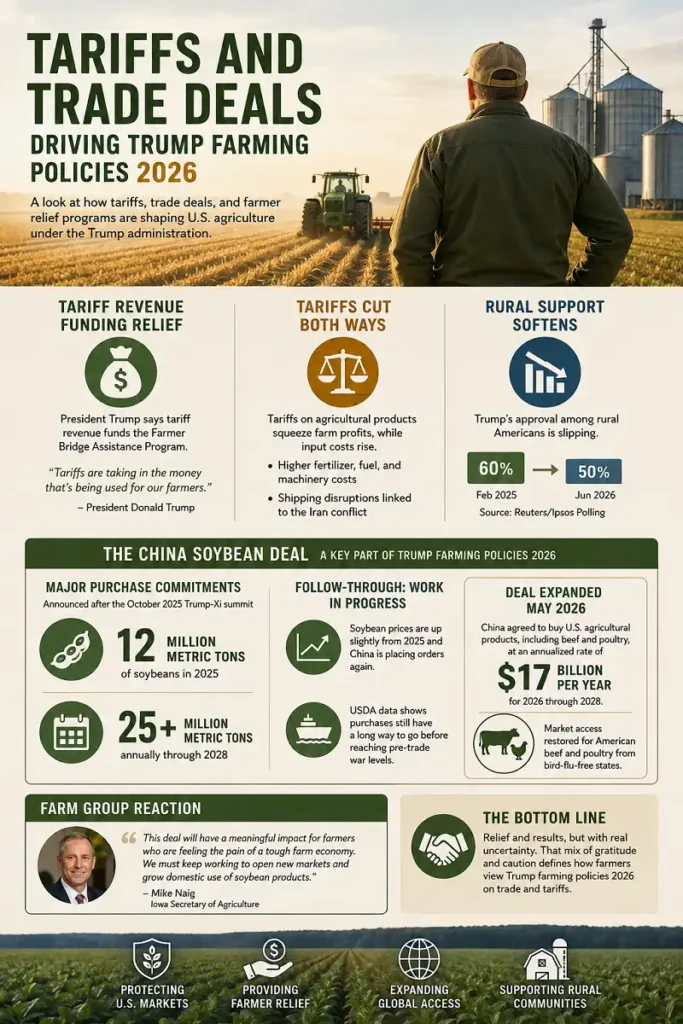
Tariffs sit at the center of Trump farming policies 2026. President Trump has used tariff revenue directly to fund farmer relief, telling reporters the money for the Farmer Bridge Assistance Program came from what “tariffs are taking in.”
The tariffs themselves cut both ways. Renewed tariffs on agricultural products have squeezed farm profits even as the administration argues they protect domestic markets long-term. Fertilizer, fuel, and machinery costs climbed through spring 2026, partly tied to shipping disruptions connected to the conflict with Iran.
Rural support for the president has softened as a result. Trump’s approval rating among rural Americans fell to 50% in June 2026, down from 60% in February 2025, according to Reuters/Ipsos polling. That decline shows up directly in how farm groups talk about Trump farming policies 2026: grateful for the aid, uneasy about the trade war that made the aid necessary.
The China Soybean Deal Inside Trump Farming Policies 2026
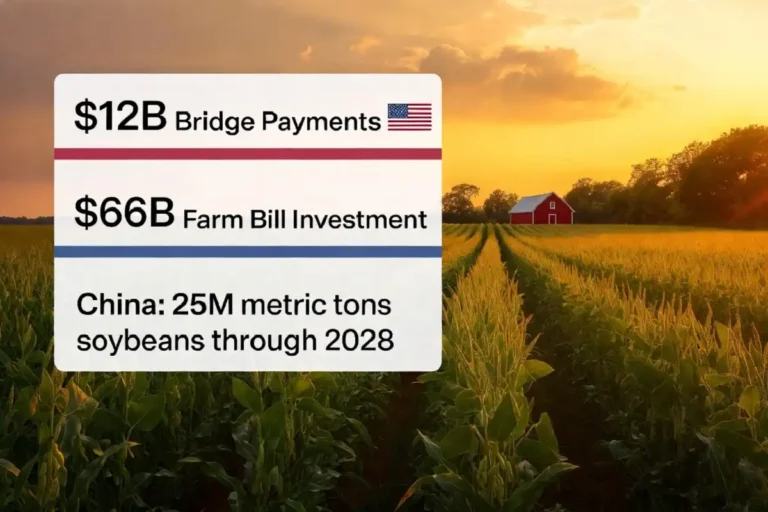
China’s soybean purchases are the clearest trade win inside Trump farming policies 2026. Following the October 2025 Trump-Xi summit, China agreed to purchase 12 million metric tons of soybeans in 2025 and at least 25 million metric tons annually through 2028.
Follow-through has been uneven. Soybean prices are up slightly from 2025 and China is placing orders again, but USDA data shows purchases still have a long way to go before reaching pre-trade war levels. By May 2026, the administration expanded the agreement further. China agreed to buy US agricultural products, including beef and poultry, at an annualized rate of $17 billion per year for 2026 through 2028, with market access restored for American beef and poultry from bird-flu-free states, part of a pattern in China’s renewed grain purchases that farm groups are still watching closely.
Farm groups welcomed the news with caveats. Iowa Secretary of Agriculture Mike Naig called the deal a meaningful impact for farmers “feeling the pain of a tough farm economy,” while urging continued work to open new markets and grow domestic use of soybean products. That mixed reaction, relief paired with wariness, defines how most producers now describe Trump farming policies 2026 around trade.
Farm Aid Payments Under Trump Farming Policies 2026
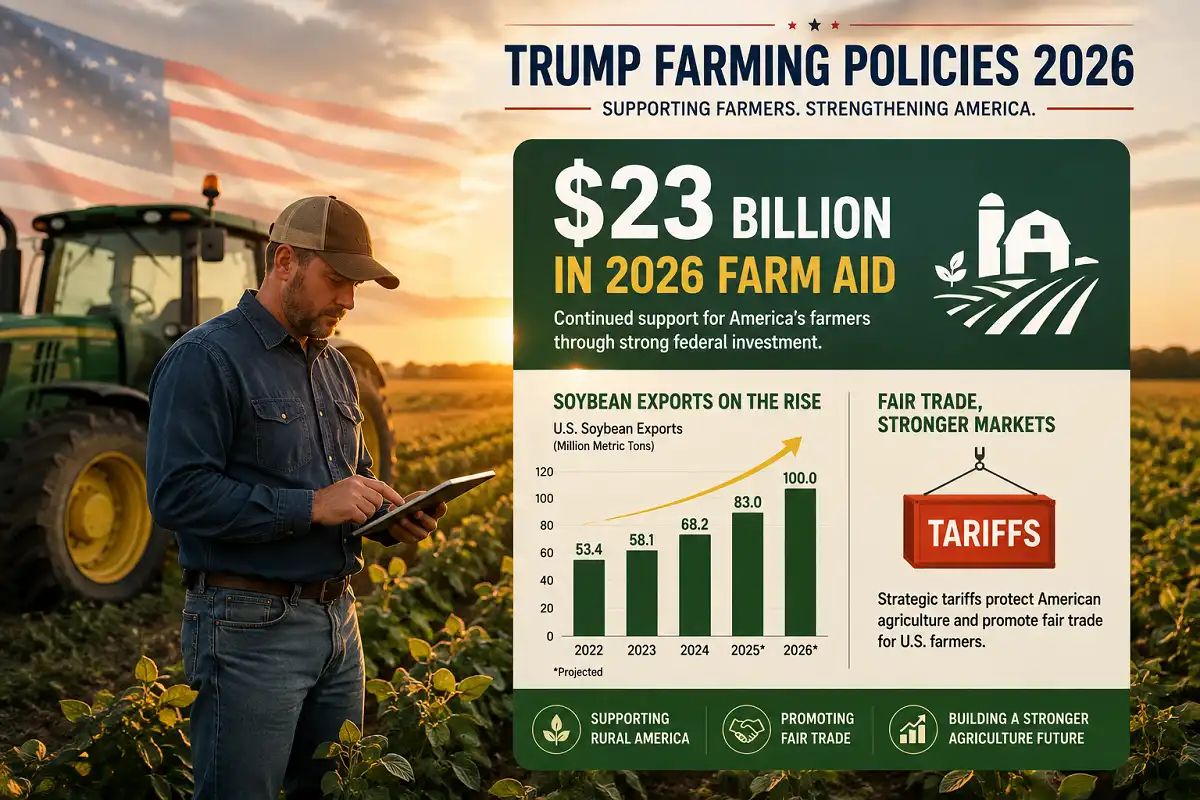
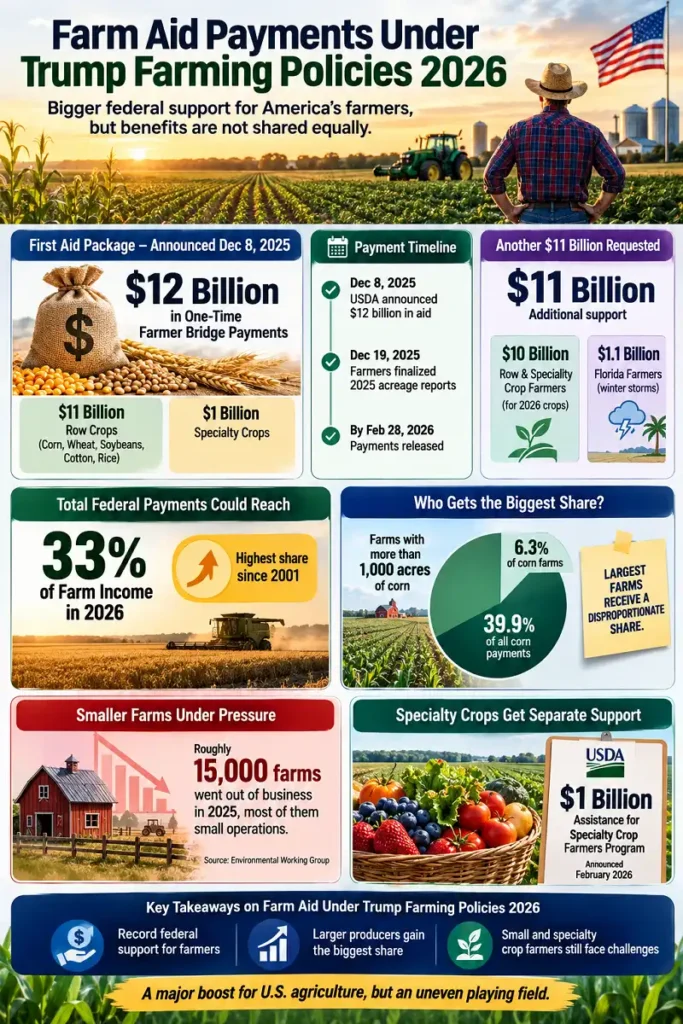
Direct payments are the most visible part of Trump farming policies 2026. On December 8, 2025, USDA announced $12 billion in one-time Farmer Bridge Payments, with $11 billion going to producers of crops like corn, wheat, soybeans, cotton, and rice, and $1 billion set aside for specialty crops. Payments were released by February 28, 2026, after farmers finalized their 2025 acreage reports by December 19.
That was not the end of it. The administration later requested another $11 billion, with $10 billion going to row and specialty crop farmers for crops planted in 2026 and $1.1 billion reserved for Florida farmers hit by winter storms. Combined with existing programs, total federal payments could reach roughly 33% of farm income in 2026, the highest share of direct payments since 2001, a shift that shows up clearly in this year’s farm income outlook for the Corn Belt.
Not everyone gets an equal share under Trump farming policies 2026. An Environmental Working Group analysis found that farms growing more than 1,000 acres of corn make up just 6.3% of corn farms but were projected to collect 39.9% of all corn payments. Smaller operations have felt the opposite pressure. Roughly 15,000 farms went out of business in 2025, most of them small operations, EWG reported, even as aid dollars flowed to the largest producers.
USDA has also targeted specialty crops separately. In February 2026, the department announced a $1 billion Assistance for Specialty Crop Farmers program covering crops and sugar not included in the broader row-crop payments.
The One Big Beautiful Bill Act and Trump Farming Policies 2026
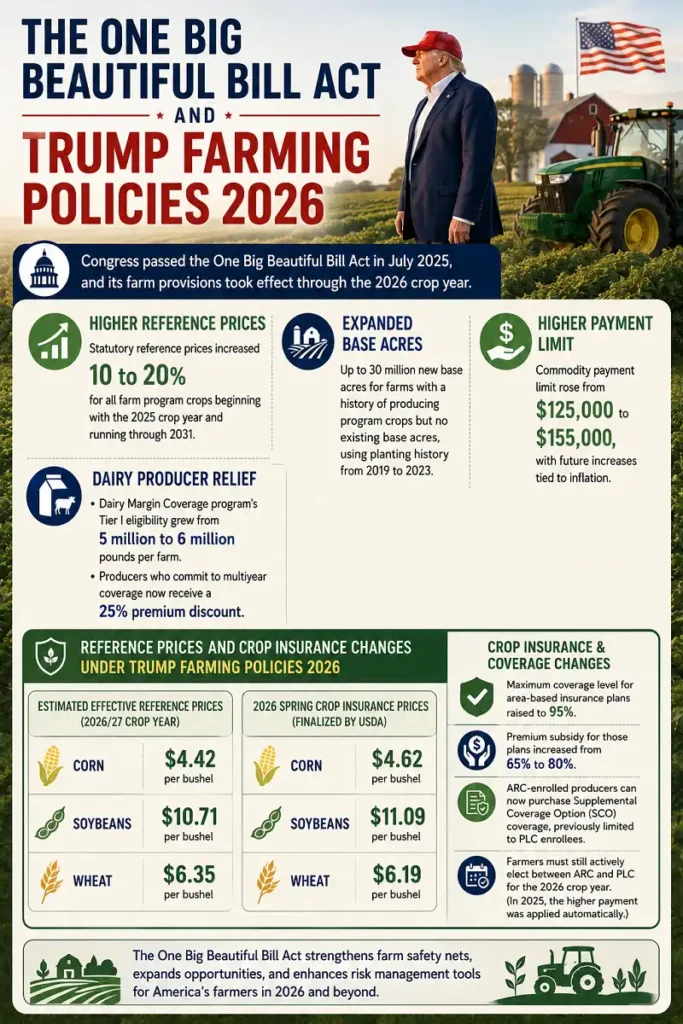
Legislation, not just executive action, underpins Trump farming policies 2026. Congress passed the One Big Beautiful Bill Act in July 2025, and its farm provisions took effect through the 2026 crop year. Statutory reference prices increased 10 to 20 percent for all farm program crops beginning with the 2025 crop year and running through 2031.
The bill reworked base acreage too. For the first time in over a decade, USDA is allowing up to 30 million new base acres for farms with a history of producing program crops but no existing base acres, using planting history from 2019 to 2023. The commodity payment limit also rose from $125,000 to $155,000, with future increases tied to inflation.
Dairy producers got specific relief as well. The Dairy Margin Coverage program’s Tier I eligibility grew from 5 million to 6 million pounds per farm, and producers who commit to multiyear coverage now receive a 25% premium discount.
Reference Prices and Crop Insurance Changes Under Trump Farming Policies 2026
Crop insurance sits at the technical core of Trump farming policies 2026. Estimated effective reference prices for the 2026/27 crop year run about $4.42 per bushel for corn, $10.71 for soybeans, and $6.35 for wheat. USDA finalized 2026 spring crop insurance prices at roughly $4.62 per bushel for corn, $11.09 for soybeans, and $6.19 for wheat.
Coverage options expanded too. The legislation raised the maximum coverage level for area-based insurance plans to 95% and increased the premium subsidy for those plans from 65% to 80%, while also letting ARC-enrolled producers purchase Supplemental Coverage Option coverage previously limited to PLC enrollees. Farmers must still actively elect between ARC and PLC for the 2026 crop year, unlike 2025 when the higher payment was applied automatically.
Labor and Immigration Rules Inside Trump Farming Policies 2026
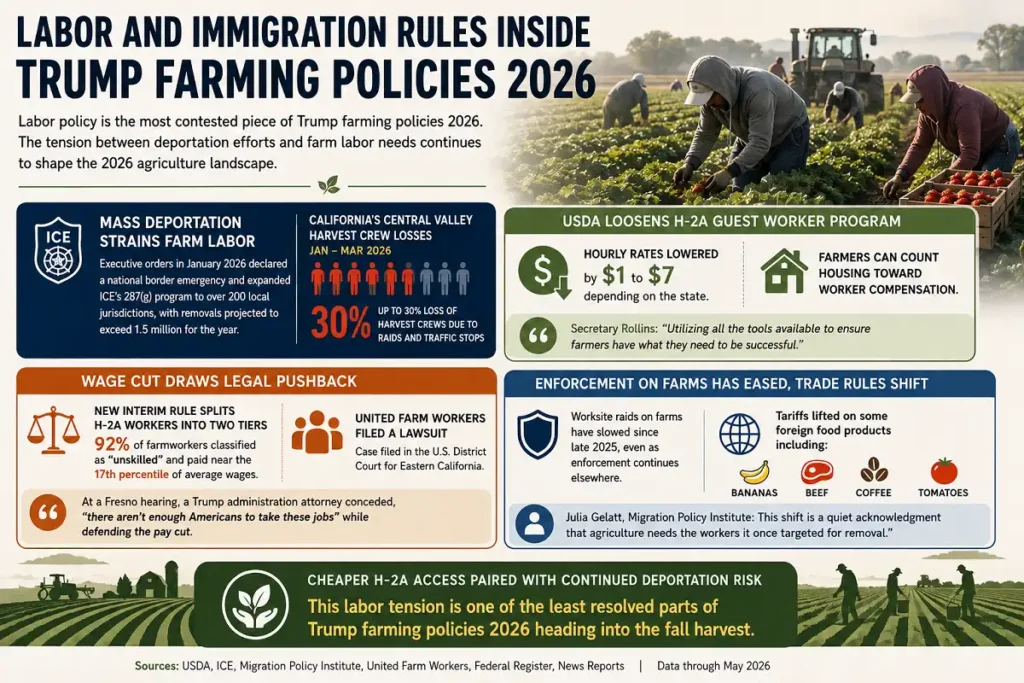
Labor policy is the most contested piece of Trump farming policies 2026. Mass deportation efforts strained harvest crews through early 2026. Executive orders issued in January 2026 declared a national border emergency and expanded ICE’s 287(g) program to over 200 local jurisdictions, with removals projected to exceed 1.5 million for the year. California’s Central Valley strawberry and almond growers lost up to 30% of their harvest crews between January and March 2026 due to workplace raids and traffic stops.
USDA responded by loosening the H-2A visa program, the decades-old channel that lets US employers bring in temporary foreign farmworkers. Hourly rates for H-2A workers were lowered by $1 to $7 depending on the state, and farmers gained the ability to count housing toward worker compensation. Secretary Rollins defended the shift directly, saying the administration was “utilizing all the tools available to ensure farmers have what they need to be successful.”
The wage cut drew legal pushback. A new interim rule split H-2A workers into two tiers, classifying 92% of farmworkers as “unskilled” and setting their pay near the 17th percentile of average wages. The United Farm Workers sued in the U.S. District Court for Eastern California, and a Trump administration attorney conceded at a Fresno hearing that “there aren’t enough Americans to take these jobs” while defending the pay cut.
ICE enforcement on farms itself has eased since late 2025. The administration lifted tariffs on some foreign food products, including bananas, beef, coffee, and tomatoes, while worksite raids on farms slowed even as enforcement continued elsewhere. Julia Gelatt of the Migration Policy Institute described the shift as a quiet acknowledgment that agriculture needs the workers it once targeted for removal. This labor tension, cheaper H-2A access paired with continued deportation risk, is one of the least resolved parts of Trump farming policies 2026 heading into the fall harvest.
What USDA’s August 2026 Moves Mean for Trump Farming Policies 2026
The newest chapter of Trump farming policies 2026 arrived at Minnesota Farmfest. On August 4, 2026, Secretary Rollins announced that USDA’s Risk Management Agency would give producers up to 60 additional days to pay crop insurance premiums for billing dates between July 1 and September 30, 2026, with interest waived during that window.
USDA also restored an option farmers had lost. Rollins said the agency is reinstating the buy-up coverage option for prevented planting, which lets producers pay a slightly higher premium to qualify for an indemnity payment 5% above the basic coverage level. USDA had eliminated that option the previous November, a decision that drew backlash from farmers in Arkansas and the Dakotas.
Rollins tied the announcement to a broader message. “When I travel across farm country, I hear the same message over and over: producers want a USDA that works for them,” she said, framing the changes as evidence that Trump farming policies 2026 are responsive to feedback from the field, even as the Senate Agriculture Committee separately works toward a full 2026 farm bill.
FAQs

What do Trump farming policies 2026 actually include?
How much farm aid has USDA paid out in 2026?
Is China still buying US soybeans under the 2026 trade deal?
Did H-2A visa costs go up or down in 2026?
What is the new crop insurance deadline extension?
Where This Leaves Us
Trump farming policies 2026 hand producers more federal support than any year since 2001, but with real strings attached. Tariffs created the pain the aid is meant to offset. Labor rules cut costs while inviting lawsuits. Watch the September 2026 China purchase deadline and the pending 2026 farm bill for the next signals on where this heads.