Executive Leadership Strategies That Drive Results in 2026
Executive leadership strategies decide whether a company scales or stalls. I’ve been tracking this across earnings calls, proxy filings, and boardroom shakeups since Q1 2026, and the pattern is clear. The leaders winning right now share a specific playbook.
The strongest executive leadership strategies in 2026 combine clear decision rights, data-backed prioritization, and disciplined talent development. Top performers pair long-term vision with fast operational feedback loops. They measure outcomes, not activity, and they build teams that execute without constant oversight.
What Are Executive Leadership Strategies?
Executive leadership strategies are the deliberate methods senior leaders use to set direction, allocate resources, and drive performance across an organization. They cover decision-making, communication, talent, and culture. Think of them as the operating system a CEO or C-suite runs the business on.
These methods differ from general management. Management keeps existing systems running. Leadership at the executive level sets the systems in the first place. In my reporting on this sector, the companies that separate these two functions cleanly tend to move faster.
A strong strategy answers three questions. Where are we going? How do we get there? Who owns what? Miss any one, and execution breaks down.
For readers who want the academic grounding, the broader field of leadership research traces how these approaches evolved from trait theory to modern situational models. That history explains why today’s methods focus on adaptability rather than fixed personality types.
Why Executive Leadership Strategies Matter More in 2026
Market conditions raised the stakes this year. CEO confidence dropped to 47 in Q2 2026, according to The Conference Board index. Interest rate pressure, AI disruption, and talent competition all compressed margins for error.
Boards now expect faster results. The average CEO tenure keeps shrinking, and proxy advisors like ISS scrutinize performance more aggressively. Weak executive leadership strategies get exposed quickly when growth slows.
There’s also the AI factor. In his warning to CEOs about AI leadership, Jamie Dimon told leaders in 2026 that those who ignore AI adoption fall behind fast. The tools reshape how teams work, which means leadership methods have to adapt too. What worked in 2020 does not automatically work now.
Core Executive Leadership Strategies for Modern Leaders
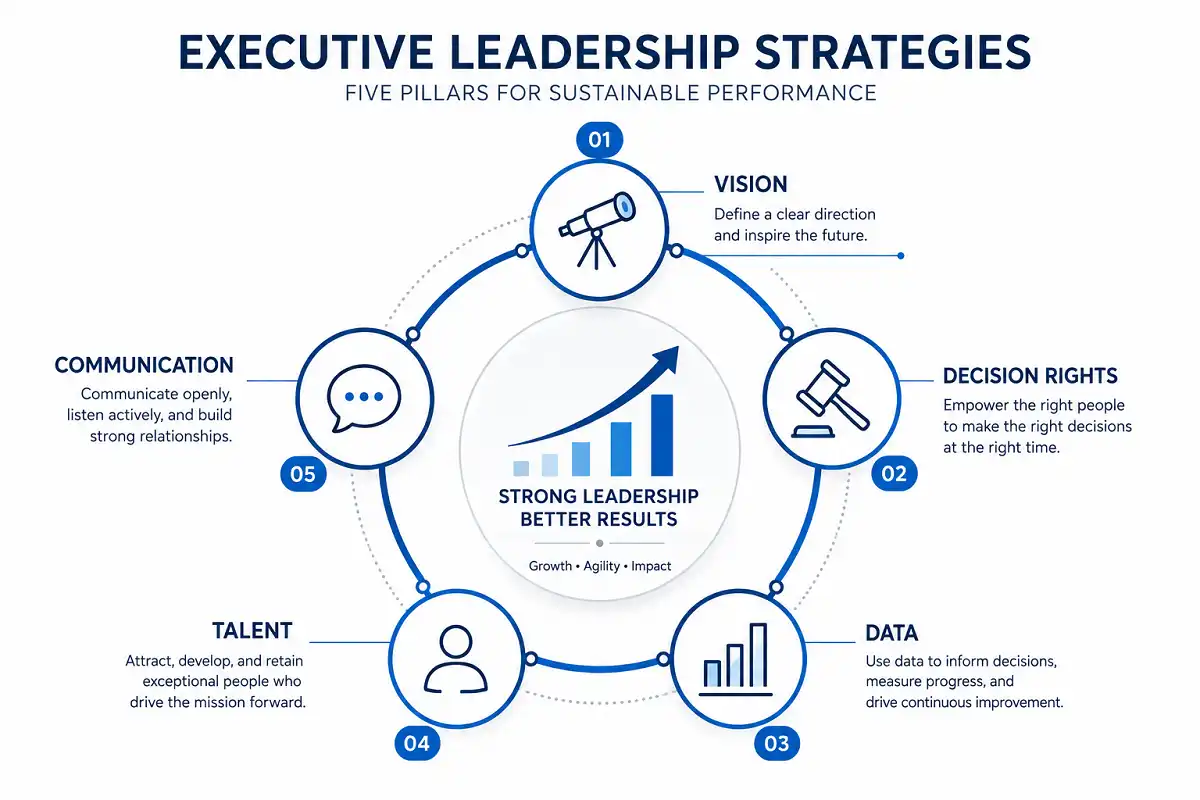
The best executive leadership strategies rest on a few durable pillars. Here’s what shows up repeatedly across the companies I’ve covered.
1. Set a Clear, Measurable Vision
Vision without metrics is a wish. Effective leaders translate direction into specific, trackable goals. Satya Nadella did this at Microsoft by tying the company’s mission to cloud and AI targets, then measuring progress every quarter.
Start with a three-year destination. Break it into annual milestones. Then define the metrics that prove you’re on track. Revenue, margin, market share, retention, whatever fits your business.
Communicate that vision constantly. People forget. Repeat it until every team can state where the company is headed and why.
2. Establish Clear Decision Rights
One of the most overlooked executive leadership strategies is defining who decides what. Ambiguity kills speed. When nobody knows who owns a call, decisions stall in endless meetings.
Amazon uses a “single-threaded owner” model. One person owns each major initiative and has authority to move. This removes the committee drag that slows most large organizations.
Map your major decisions. Assign a clear owner to each. Give that owner real authority, not just responsibility without power. Then hold them accountable for outcomes.
3. Build Data-Driven Decision Loops
Gut instinct has limits. The strongest executive leadership strategies pair judgment with real data. Leaders who build fast feedback loops catch problems early and adjust before small issues become expensive.
Set up dashboards that show leading indicators, not just lagging results. Review them on a regular cadence. Ask what the numbers are telling you, then act on the signal.
The goal is not more data. It’s faster, cleaner decisions. In my coverage of high-growth firms, the ones that win treat data as a decision tool, not a reporting formality.
4. Develop Talent Deliberately
Your team executes your strategy. If you don’t develop them, your ceiling is your own bandwidth. Great leadership approaches include a real plan for growing people.
This means more than annual reviews. It means stretch assignments, honest feedback, and clear paths to advancement. The rise of skills-based hiring reshaping how people advance means leaders now build capability by developing the skills their teams actually need, not just by chasing credentials.
Identify your high-potential people early. Give them harder problems. Coach them through the stretch. Companies that build leaders internally have deeper benches when they need to promote.
5. Communicate With Radical Clarity
Fuzzy communication creates fuzzy execution. The best leaders say exactly what they mean. No corporate fog, no buried messages.
Clarity applies up, down, and sideways. Your board needs the honest picture. Your teams need clear priorities. Your peers need to know where you stand. Vague direction produces confused organizations.
Write things down. Verbal-only direction gets distorted as it travels. A short written brief beats a long meeting most of the time.
How to Build Your Executive Leadership Strategy Step by Step
How do you actually build a leadership strategy from scratch? Start with your current reality, then design the system you need to reach your goals. Here’s the sequence that works.
Step 1: Audit Where You Stand
Before you change anything, know your baseline. Look at your decision speed, your team’s capability, your key metrics, and your culture. Be honest about the gaps.
Ask your direct reports what slows them down. The answers reveal where your current approach breaks. Most leaders discover their bottleneck is themselves.
Step 2: Define Your Priorities
You cannot chase everything. Pick the three to five priorities that matter most this year. Strong leaders concentrate resources on what moves the needle.
Write each priority as a specific outcome with a deadline. “Grow revenue” is not a priority. “Reach $50M ARR by December” is.
Step 3: Assign Ownership and Resources
Every priority needs an owner and a budget. Match your best people to your most important problems. Give them what they need to succeed.
This is where many plans die. Leaders set priorities, then starve them of resources. Fund your priorities properly or drop them.
Step 4: Build the Feedback System
Decide how you’ll track progress. Set your metrics, your review cadence, and your escalation path. When something goes off track, you want to know fast.
Weekly or biweekly reviews work for most priorities. Monthly is often too slow to catch problems while they’re cheap to fix.
Step 5: Adjust and Iterate
No plan survives contact with reality. The best leaders build in regular checkpoints to adapt. Review what’s working, kill what isn’t, and reallocate as conditions change.
Rigidity is a trap. The market shifts, competitors move, and your plan has to flex. Treat your strategy as a living document, not a stone tablet.

Common Executive Leadership Strategies That Backfire
Not every popular tactic works. Some widely used leadership tactics actually hurt performance. Here’s what to avoid.
Micromanagement disguised as attention. Watching every detail signals distrust and slows your team. Set clear expectations, then step back. Your job is outcomes, not keystrokes.
Consensus on everything. Some decisions need buy-in. Most don’t. Requiring consensus on every call grinds progress to a halt. Reserve consensus for the few decisions that truly need it.
Chasing every opportunity. Saying yes to everything dilutes focus. The discipline to say no protects your priorities. Leaders who chase every shiny option end up finishing nothing.
Ignoring culture until it breaks. Culture drives behavior when you’re not in the room. Weak leaders treat it as soft and optional. Strong ones shape it deliberately, because a broken culture undermines even the best strategy.
Executive Leadership Strategies for Leading Through Change
How do you lead when everything is shifting? Communicate more, decide faster, and give people stability where you can. Change tests leadership harder than any calm period.
During disruption, over-communicate. Uncertainty breeds anxiety, and silence makes it worse. Tell people what you know, what you don’t, and what happens next.
Speed matters more in a downturn. The four-day workweek adoption and AI-driven restructuring both forced leaders to make fast calls in 2026. Companies that hesitated lost ground to faster rivals.
Protect the essentials. People can handle change if their core stability holds. Signal what stays constant even as other things shift. The best leaders balance bold moves with a stable foundation.

How AI Is Reshaping Executive Leadership Strategies
AI changed the executive playbook in 2026. Leaders now use AI tools for forecasting, scenario planning, and faster analysis. The companies pulling ahead built AI into how they lead, not just what they sell.
South Korea leads the world in AI adoption, and its top firms show what’s possible when leaders embrace the tools early. Executives use AI to model decisions, surface patterns in data, and free their teams from repetitive work.
This creates a new leadership skill. You have to know what AI can and can’t do, then deploy it wisely. Modern leaders treat AI fluency as a core competency, not an IT problem. Leaders who understand the shift toward AI adoption at work make sharper bets than those who delegate it entirely.
The human side still matters most. AI handles analysis. Judgment, vision, and people leadership stay human. The best leaders combine both.
Measuring the Success of Your Executive Leadership Strategies
How do you know if your leadership approach is working? Track outcomes, team health, and your own decision quality over time. Good leadership produces measurable results, not just activity.
Watch your business metrics first. Revenue growth, margin, retention, and market position tell you whether the strategy delivers. If the numbers move the right way over several quarters, you’re on track.
Check your team’s health too. Engagement, retention of top performers, and internal promotion rates reveal whether you’re building capability or burning it. A strategy that hits numbers while destroying the team is not sustainable.
Finally, review your own decisions. Are they getting faster and better? Are you spending time on what matters? The quality of your leadership shows up in how well your organization runs without you in every room.
Executive Leadership Strategies for First-Time Executives
Stepping into a senior role for the first time is a different job entirely. First-time executives often fail because they keep doing their old job at a bigger scale. The executive leadership strategies that work at this level require letting go of the work that got you promoted.
Your first 90 days set the tone. Spend them listening before you act. Meet your team, your peers, and your board. Learn how decisions actually get made before you try to change them.
Resist the urge to prove yourself with fast, dramatic moves. New leaders who overhaul everything in month one often break things they didn’t understand. Diagnose first, then act with precision.
Delegation is the hardest shift. You cannot do it all anymore, and trying to will burn you out. Build a team you trust, then give them room to run. The strongest steps for career growth in business come from multiplying through others, not doing more yourself.
Find a mentor or coach who has held the role. Outside perspective helps you see blind spots you can’t spot alone. Even seasoned leaders benefit from someone who tells them the truth.
How Long Does It Take to See Results?
Most leadership changes show early signals within one to two quarters, but full results take a year or more. Cultural and talent shifts move slowest. Financial improvements often show faster if the strategy targets clear operational levers.
Set expectations accordingly. Boards want quick wins, but sustainable change takes time. Deliver a few visible early results while building the deeper systems that pay off later.
FAQs

What Is the Difference Between Leadership and Management?
Can Executive Leadership Strategies Be Learned?
What Is the Biggest Mistake New Executives Make?
How Do You Lead a Team You Inherited?
How Do Executive Leadership Strategies Differ Across Industries?
What to Watch Next
Executive leadership strategies keep evolving as AI, market pressure, and talent dynamics shift. The fundamentals hold: clear vision, sharp decision rights, honest data, strong talent, and direct communication. But the tools and speed keep changing.
Watch three things through the rest of 2026. How AI reshapes decision-making at the top. How boards respond to the pressure on CEO tenure. And how the strongest leaders adapt their methods without losing what makes them effective. The playbook that wins is the one that stays disciplined on fundamentals while adapting fast to new conditions.