US Iran Nuclear Deal Update: What’s Really Happening in 2026
If you’ve been trying to follow the back-and-forth between Washington and Tehran, you’re not alone. Between a war, a ceasefire, a naval blockade, and a memorandum that keeps almost falling apart, keeping track of every US Iran nuclear deal update has become a full-time job for anyone who isn’t a foreign policy analyst. This guide pulls the entire story together in one place where the original 2015 agreement came from, how it collapsed, what triggered the 2026 war, and where the current negotiations actually stand today.
Instead of jumping between old news alerts, think of this as one clear timeline you can bookmark. We’ll walk through the history, the war, the ceasefire, the new framework being negotiated, and the sticking points that could still blow the whole thing up plus what experts think happens next.
A Quick Recap: What Was the Original Iran Nuclear Deal?
To understand any US Iran nuclear deal update happening right now, it helps to know where this all started.
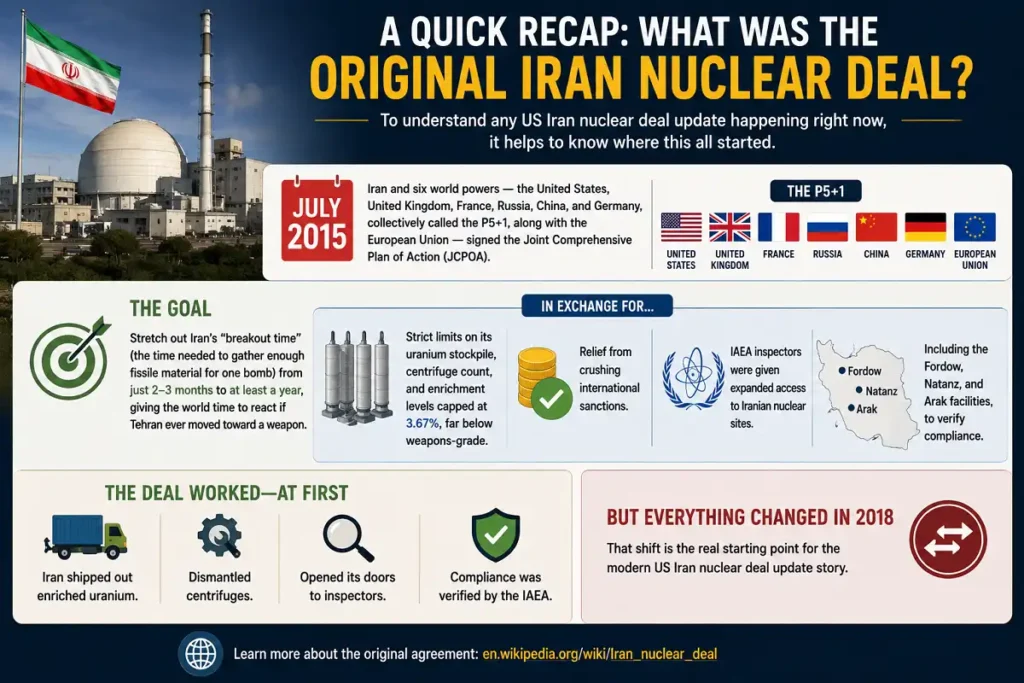
In July 2015, Iran and six world powers the United States, United Kingdom, France, Russia, China, and Germany, collectively called the P5+1, along with the European Union signed the Joint Comprehensive Plan of Action, better known as the JCPOA. The goal was simple on paper: stretch out Iran’s “breakout time” (the time needed to gather enough fissile material for one bomb) from just two to three months to at least a year, giving the world time to react if Tehran ever moved toward a weapon.
In exchange for accepting strict limits on its uranium stockpile, centrifuge count, and enrichment levels capped at 3.67%, far below weapons-grade Iran received relief from crushing international sanctions. International Atomic Energy Agency (IAEA) inspectors were given expanded access to Iranian nuclear sites, including the Fordow, Natanz, and Arak facilities, to verify compliance. You can read more background on the original agreement on Wikipedia.
The deal worked reasonably well at first. Iran shipped out enriched uranium, dismantled centrifuges, and opened its doors to inspectors. But everything changed in 2018, and that shift is the real starting point for the modern US Iran nuclear deal update story.
Why the Original Deal Collapsed
President Trump withdrew the United States from the JCPOA in 2018, arguing it failed to address Iran’s ballistic missile program and its influence across the region. Washington reimposed sweeping sanctions, and roughly a year later Iran began quietly abandoning its own commitments — exceeding uranium stockpile limits, enriching to higher purities, and restricting IAEA access.
By 2023, inspectors had detected uranium particles enriched to nearly weapons-grade levels at Fordow. Diplomacy sputtered along through years of stop-and-go talks in Vienna, but the gap between what Washington wanted and what Tehran was willing to give kept widening. This is the backdrop every US Iran nuclear deal update since 2023 has had to grapple with: a defunct agreement, an emboldened Iranian nuclear program, and almost no trust left between the two sides.
The Road to War: How Talks Broke Down in Early 2026
Fresh negotiations, mediated by Oman and Italy, restarted in April 2025, focused squarely on enrichment levels. The US pushed for deep cuts; Iran pushed for sanctions relief while stalling for time. Six rounds of talks later, Israeli airstrikes on Iranian nuclear and military sites brought the process to a complete halt.
Every US Iran nuclear deal update from that stretch of 2025 described the same pattern: cautious optimism from mediators, followed by another setback. Tensions kept climbing through late 2025 and into early 2026. Then, on February 28, 2026, the United States and Israel launched a coordinated military campaign against Iran, opening what’s now referred to as the 2026 Iran war. Weeks of strikes followed, including a US operation against Iran’s Fordow, Natanz, and Isfahan nuclear sites that a Pentagon assessment later said set Iran’s program back by roughly two years. Iran retaliated against US and regional targets, and the conflict spread into the Strait of Hormuz, disrupting oil traffic and rattling global markets. Any US Iran nuclear deal update from this period was really war news diplomacy was effectively frozen.
The Ceasefire and the Push Back to the Table
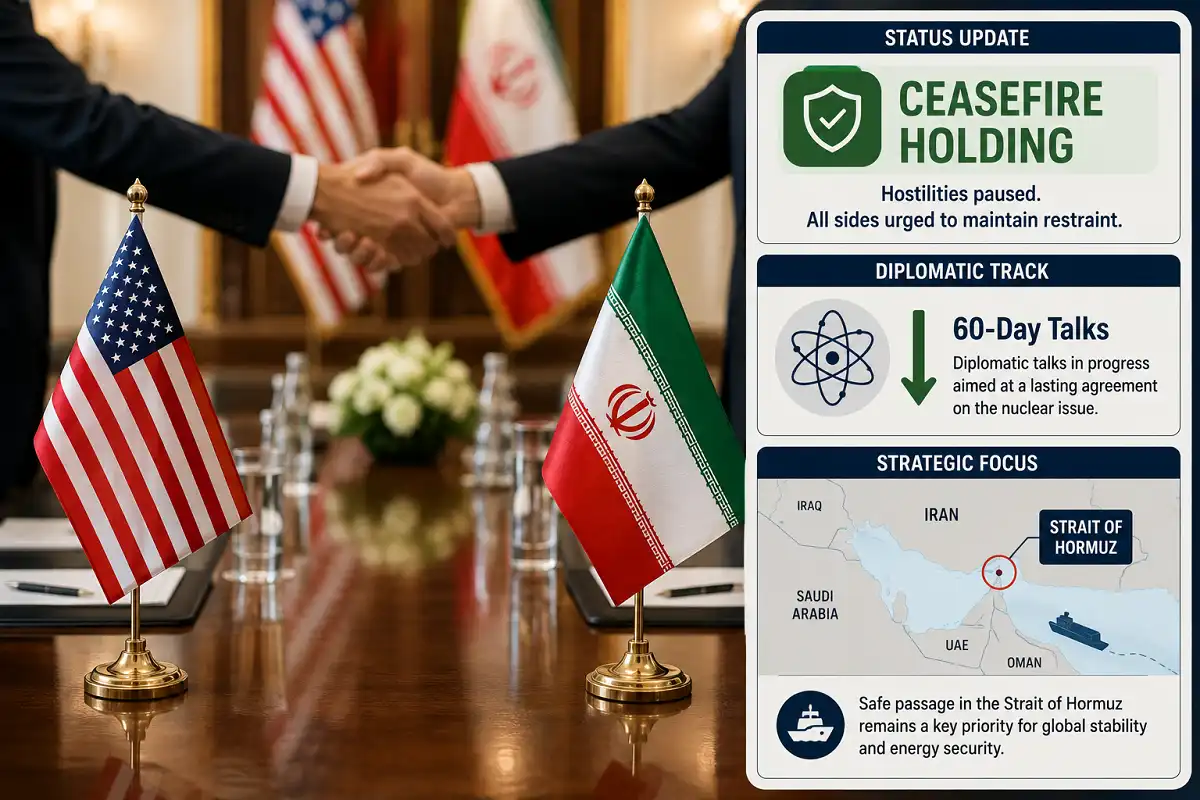
After more than five weeks of fighting, the United States and Iran with Israel included agreed to a ceasefire on April 7–8, 2026, mediated by Pakistan. It wasn’t an easy peace. Both sides accused the other of violations in the following weeks, and President Trump extended the ceasefire indefinitely on April 21 rather than let it lapse.
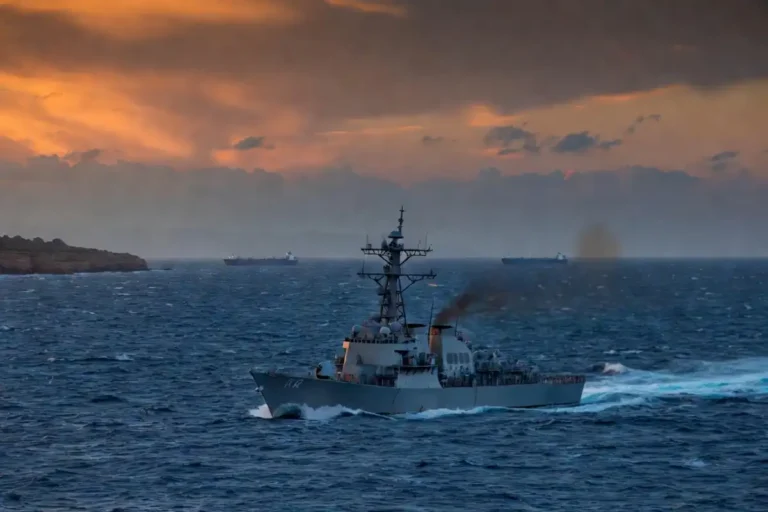
Once the guns fell quiet, every US Iran nuclear deal update pivoted from battlefield reports to shipping lanes. With the shooting largely paused, attention shifted to the Strait of Hormuz, which had become a flashpoint of its own after the US imposed a naval blockade on Iranian ports. Reopening that chokepoint — one of the world’s busiest oil corridors became just as urgent to negotiators as the nuclear question itself.
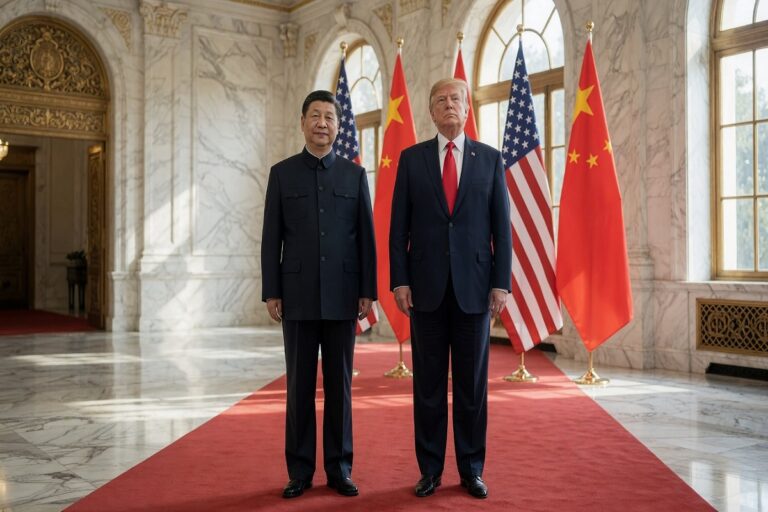
By June, mediators had a breakthrough. On June 12, Pakistani Prime Minister Shehbaz Sharif confirmed the US and Iran had agreed on final text for a deal to end the war. Vice President JD Vance announced the memorandum had been digitally signed on June 14, and on June 17, President Trump and Iranian President Masoud Pezeshkian signed it remotely Trump from the Palace of Versailles following the G7 summit, Pezeshkian from Tehran. Iran’s supreme leader, Mojtaba Khamenei, issued a statement backing the agreement, despite reportedly holding reservations of his own.
This 14-point memorandum of understanding, sometimes called the Islamabad Memorandum, became the biggest US Iran nuclear deal update of the year. It formalized the ceasefire, ended the naval blockade, reopened the Strait of Hormuz, and set a 60-day window for both sides to negotiate a final, comprehensive agreement.
What’s Actually in the New Framework
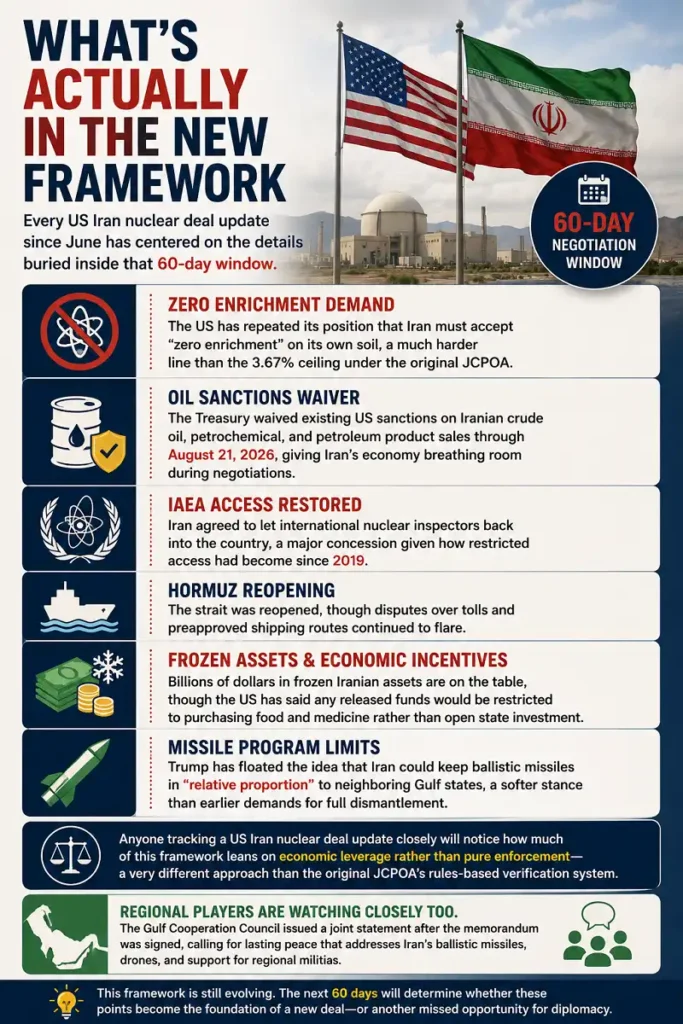
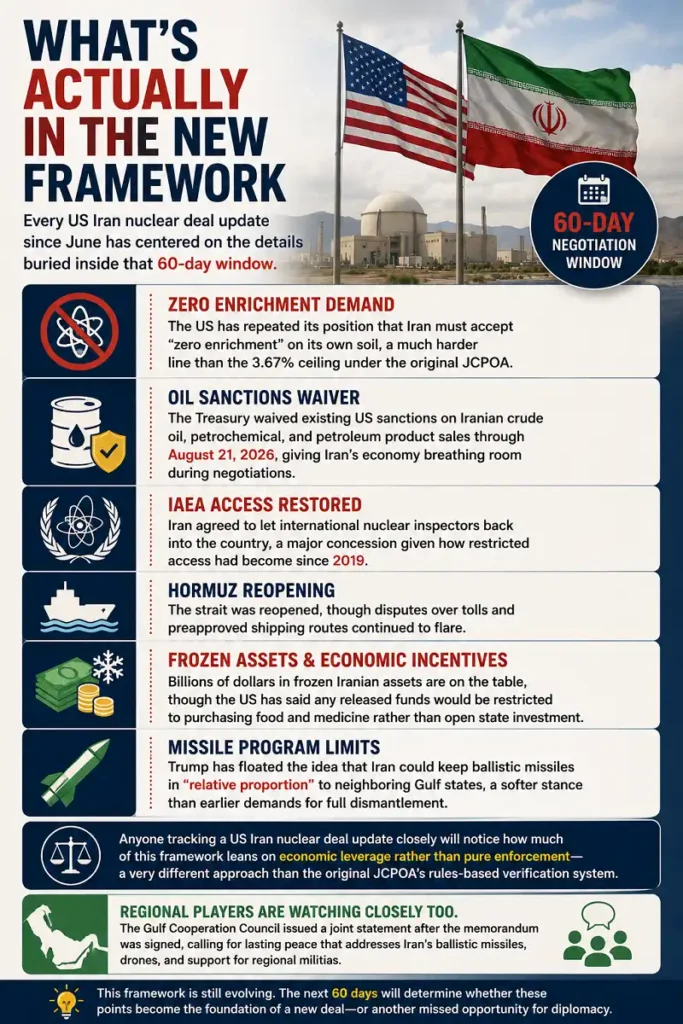
Every US Iran nuclear deal update since June has centered on the details buried inside that 60-day window. Here’s what’s been reported so far:
- Zero enrichment demand: The US has repeated its position that Iran must accept “zero enrichment” on its own soil, a much harder line than the 3.67% ceiling under the original JCPOA.
- Oil sanctions waiver: The Treasury waived existing US sanctions on Iranian crude oil, petrochemical, and petroleum product sales through August 21, 2026, giving Iran’s economy breathing room during negotiations.
- IAEA access restored: Iran agreed to let international nuclear inspectors back into the country, a major concession given how restricted access had become since 2019.
- Hormuz reopening: The strait was reopened, though disputes over tolls and preapproved shipping routes continued to flare.
- Frozen assets and economic incentives: Billions of dollars in frozen Iranian assets are on the table, though the US has said any released funds would be restricted to purchasing food and medicine rather than open state investment.
- Missile program limits: Trump has floated the idea that Iran could keep ballistic missiles in “relative proportion” to neighboring Gulf states, a softer stance than earlier demands for full dismantlement.
Anyone tracking a US Iran nuclear deal update closely will notice how much of this framework leans on economic leverage rather than pure enforcement a very different approach than the original JCPOA’s rules-based verification system. Regional players are watching closely too. The Gulf Cooperation Council issued a joint statement after the memorandum was signed, calling for lasting peace that addresses Iran’s ballistic missiles, drones, and support for armed groups abroad a signal that any final deal will need buy-in well beyond Washington and Tehran.
Why the Deal Almost Collapsed Again in July
If there’s one lesson from tracking every US Iran nuclear deal update this year, it’s that nothing here is settled until it’s signed, sealed, and tested. In July, the fragile peace cracked again after Iran struck three commercial vessels that had bypassed its preapproved shipping route through Hormuz on July 6–7. Iran had been pressing to assert control over the strait, even floating the idea of collecting tolls from passing ships something the US and Gulf states flatly rejected.
The strikes triggered a round of contained US and Israeli retaliation, threatening to unravel months of fragile diplomacy proof that any US Iran nuclear deal update can turn on a single incident at sea. Complicating things further, Iran continued to tie any lasting peace to a separate demand: an end to Israeli military operations in Lebanon, where fighting between Israel and Hezbollah has continued on and off despite the broader ceasefire.
Where Things Stand as of August 2026
The most recent US Iran nuclear deal update points to renewed movement, not collapse. In early August, US, Iranian, and Omani officials were reportedly closing in on an interim arrangement to stabilize shipping through the Strait of Hormuz for a 60-day period, with room to extend it further if it holds.
This is the part of the US Iran nuclear deal update that matters most for long-term stability. Technical negotiations on the harder nuclear questions how much of Iran’s enriched uranium stockpile gets shipped out, whether any domestic enrichment will be permitted at all, and how verification will actually work going forward remain the toughest part of the puzzle. Analysts note that reaching a comprehensive nuclear accord took nearly two years back in 2015, and Iran has shown little appetite for fast compromise, calculating that President Trump is unlikely to restart military action ahead of the November midterms.
For readers who want to keep pace with breaking developments beyond this recap, our global news coverage tracks these stories as they unfold, alongside our earlier reporting on the US-Iran peace deal and Strait of Hormuz update and how the US strikes shook Qatar peace talks earlier this year.
Every US Iran nuclear deal update over the next few months will likely reference this same table of unresolved issues, since none of them have a clear resolution date yet.
Comparing the Old Deal and the New Framework
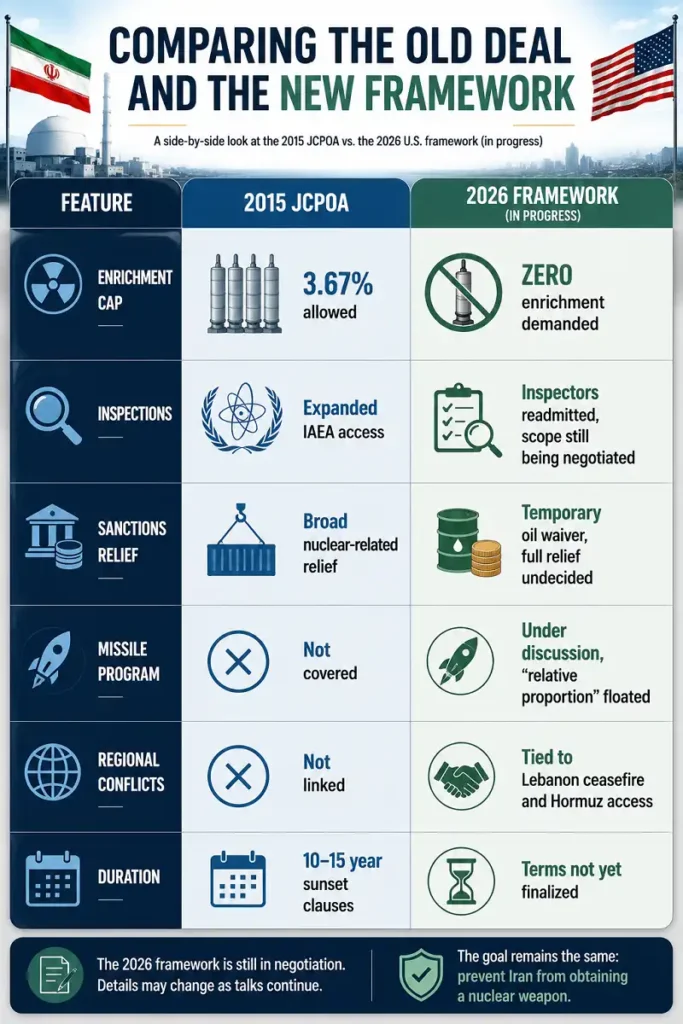
| Feature | 2015 JCPOA | 2026 Framework (in progress) |
|---|---|---|
| Enrichment cap | 3.67% allowed | US demanding zero enrichment |
| Inspections | Expanded IAEA access | Inspectors readmitted, scope still being negotiated |
| Sanctions relief | Broad nuclear-related relief | Temporary oil waiver, full relief undecided |
| Missile program | Not covered | Under discussion, “relative proportion” floated |
| Regional conflicts | Not linked | Tied to Lebanon ceasefire and Hormuz access |
| Duration | 10–15 year sunset clauses | Terms not yet finalized |
What Could Happen Next
Three broad outcomes are on the table for anyone following the next US Iran nuclear deal update:
- A narrower interim deal: Focused on Hormuz access and economic incentives, while the hardest nuclear questions get kicked further down the road.
- A comprehensive new accord: Unlikely in the short term given how far apart Washington’s “zero enrichment” stance and Tehran’s negotiating position remain, but not impossible if both sides see political benefit in a deal before the midterms.
- Another breakdown: Given the pattern of violations on both sides from ship strikes to disputed airstrikes a return to open conflict remains a real risk if trust keeps eroding.
Every US Iran nuclear deal update in the coming weeks will likely hinge on two things: whether the Strait of Hormuz arrangement holds, and whether Iran is willing to accept enrichment limits far stricter than what it agreed to back in 2015.
FAQs

Is there a new Iran nuclear deal in 2026?
What happened to the original 2015 Iran nuclear deal?
Why did the US and Israel attack Iran in 2026?
Is the Strait of Hormuz open right now?
What does "zero enrichment" mean in the current talks?
Will there be a lasting peace between the US and Iran?
Final Thoughts
The story of US and Iran nuclear diplomacy in 2026 has been anything but linear a war, a ceasefire, a signed memorandum, and a near-collapse, all within a matter of months. What’s clear is that both countries have strong incentives to avoid returning to open conflict, even as they disagree sharply on the terms of a lasting peace. Whether the current framework turns into a durable agreement or just another pause before the next crisis will depend on negotiations happening right now in Geneva, Islamabad, and Muscat so expect this story, and the next US Iran nuclear deal update, to keep evolving through the rest of 2026.