AI Startup Investment in 2026: Where the Money Is Going and What It Means for You
AI startup investment has pulled ahead of every other category of venture capital in 2026, and the gap keeps widening. Crunchbase data puts global startup funding at $510 billion for the first half of the year, with OpenAI and Anthropic alone absorbing $217 billion of that total. If you’re trying to understand where the money is flowing and whether it’s still smart to get involved, here’s what I’m seeing in the data.
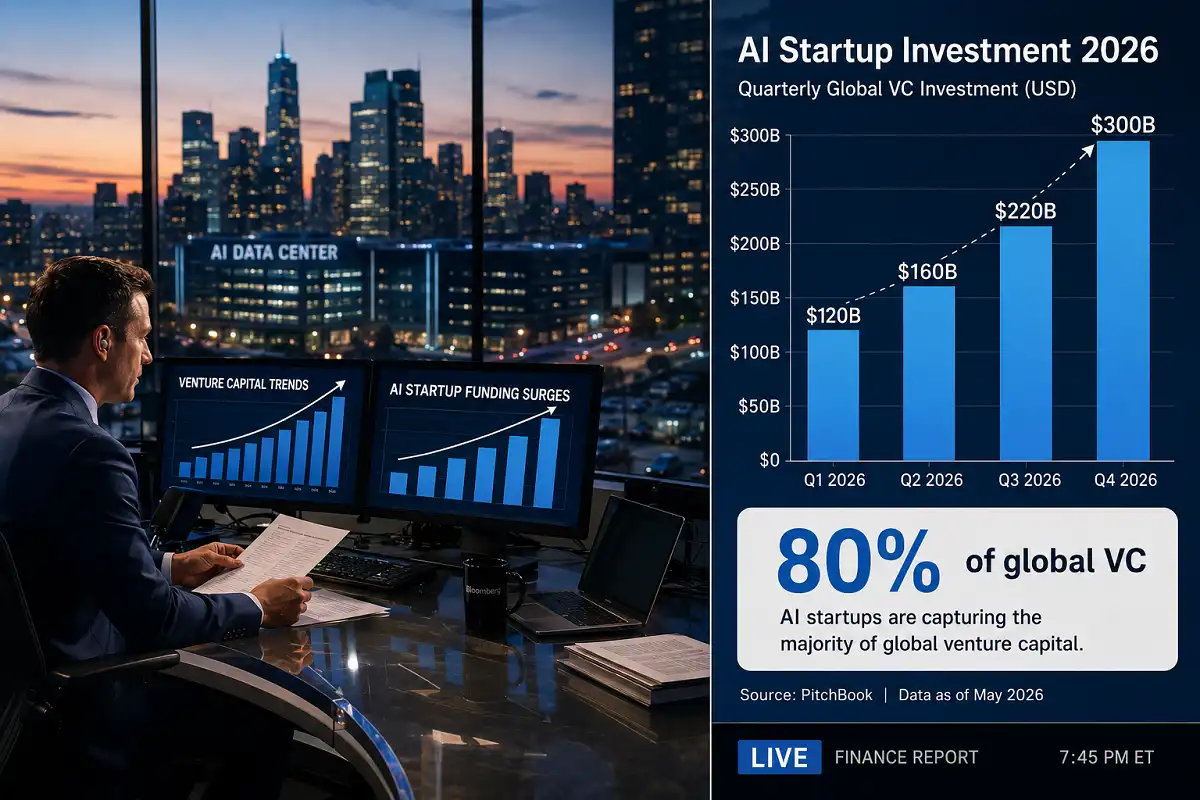
AI startup investment hit roughly $242 billion in Q1 2026 alone, about 80% of all global venture funding that quarter, according to Crunchbase. Four companies took nearly two-thirds of it. Retail investors get exposure mainly through AI-focused ETFs, not direct startup shares.
What Is AI Startup Investment in 2026?
AI startup investment means capital placed into privately held companies building artificial intelligence products, from foundation models to AI-powered enterprise software. It includes venture capital, private equity, and strategic corporate checks written by firms like Microsoft, Nvidia, and Google.
What makes 2026 different is concentration. In past cycles, venture dollars spread across hundreds of companies at similar valuations. This cycle, the money is stacking into a handful of frontier labs and infrastructure providers writing nine and ten-figure checks.
The scale of this capital also confuses comparisons. The OECD reported $258.7 billion in global AI venture capital for 2025, out of $427.1 billion in total venture funding. Stanford’s 2026 AI Index reported $285.9 billion in US private AI investment for the same year, a broader figure that includes corporate spending beyond pure VC. Both numbers are accurate. They measure different pools of capital, so cite the source when you quote a figure.
How Much Money Is Flowing Into AI Startup Investment Right Now
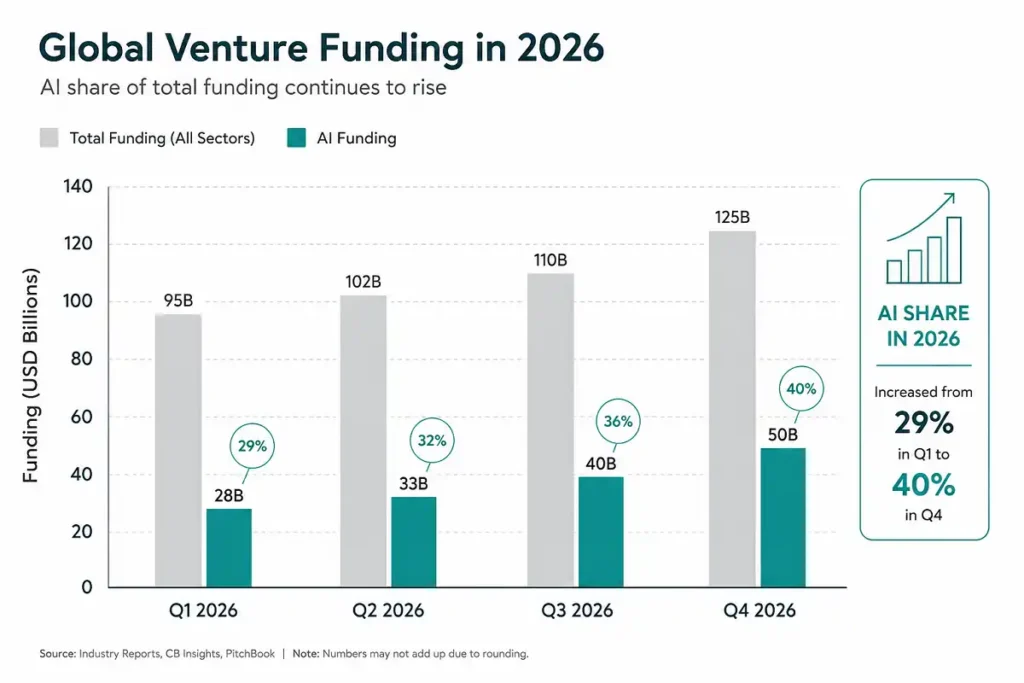
The first quarter of 2026 set the record. Crunchbase reported $300 billion poured into roughly 6,000 startups globally, up more than 150% quarter over quarter and year over year. That single quarter accounted for close to 70% of everything invested across all of 2025.
Late-stage rounds drove most of it. Funding at that stage reached about $246.6 billion in Q1 2026 across 584 deals, up 205% year over year, with $235 billion of that landing in rounds of $100 million or more. Early-stage AI startup investment grew too, but at a comparatively modest 41%.
By the second quarter, North American early-stage funding alone topped $31 billion, nearly double the year-ago level. A single Anthropic round accounted for roughly half of that quarter’s total tally, according to Crunchbase’s H1 2026 report published July 2, 2026. xAI, meanwhile, closed a $20 billion Series E in the first weeks of the year and has now raised $42.7 billion in total reported funding, ahead of an expected SpaceX IPO that will fold in xAI’s interests.
The money is not spread evenly by geography either. The San Francisco Bay Area alone raised $122 billion, about 76% of the total US figure, according to Crunchbase’s regional breakdown. That concentration shows up alongside a separate trend I’ve been tracking: corporate sentiment cooled even as AI budgets held firm. I broke down that split in my report on why CEO confidence slipped to 47 in the second quarter of 2026, which is worth reading if you use executive sentiment as a signal for where capital moves next.
Where AI Startup Investment Dollars Are Actually Going
Foundation model companies and AI infrastructure providers are pulling most of the capital. That includes the compute, data centers, and chips needed to train and run large models, not just the software layer on top.
Four sectors are seeing the sharpest inflows:
- Foundation models. OpenAI and Anthropic continue to raise the largest single rounds on record, with valuations tracking toward the $1 trillion range for Anthropic, per Crunchbase’s unicorn board.
- AI infrastructure and compute. Data center buildouts, chip supply deals, and cloud partnerships, including a $5 billion AI infrastructure agreement between Google and Blackstone, are drawing steady late-stage checks.
- Defense and physical AI. Venture funds put $12.3 billion into defense tech startups in the first half of 2026, nearly double the prior year, covering autonomous vessels, drones, and battlefield AI.
- Robotics. Physical AI startups like Generalist AI, which raised $400 million led by Radical Ventures at a reported $2 billion valuation, show private capital is no longer limited to software.
Enterprise software, cybersecurity, and marketplace startups, once the backbone of venture portfolios, now compete for a shrinking share of the pool. I mapped this same shift in a recent week-by-week look at how AI and quantum computing startups pulled in the bulk of new venture dollars, and the pattern has only gotten more pronounced since.

Is AI Startup Investment a Bubble Right Now?
Not in the way the dot-com crash worked, but pockets of it look stretched. The clearest tension is a mismatch between infrastructure spending and revenue. Global AI infrastructure investment approached $400 billion annually in 2026, while enterprise AI revenue stayed closer to $100 billion.
That gap is why analysts split into two camps. Ruchir Sharma has warned the buildout could unwind if interest rates rise and cheap capital dries up. Goldman Sachs and JPMorgan argue the growth is backed by real earnings, pointing out that Microsoft, Alphabet, Meta, and Amazon fund their data centers from cash flow instead of debt, unlike the dot-com era.
Valuations tell a similar story. Foundation model multiples have compressed from 60 to 100 times revenue down to 15 to 50 times, according to ValueAdd VC’s 2026 unicorn tracker, which is high but not unheard of for fast-growing tech. The real froth shows up further out on the risk curve: some AI robotics startups trade near 400 times revenue on demo momentum alone, and thin application “wrapper” companies without proprietary data or distribution face the steepest correction risk if growth slows.
If you’re weighing a stake in this space, treat foundation labs and thin wrapper apps as different risk categories entirely. They are not priced the same way, and they won’t fall the same way either.
How to Evaluate an AI Startup Investment Before You Commit
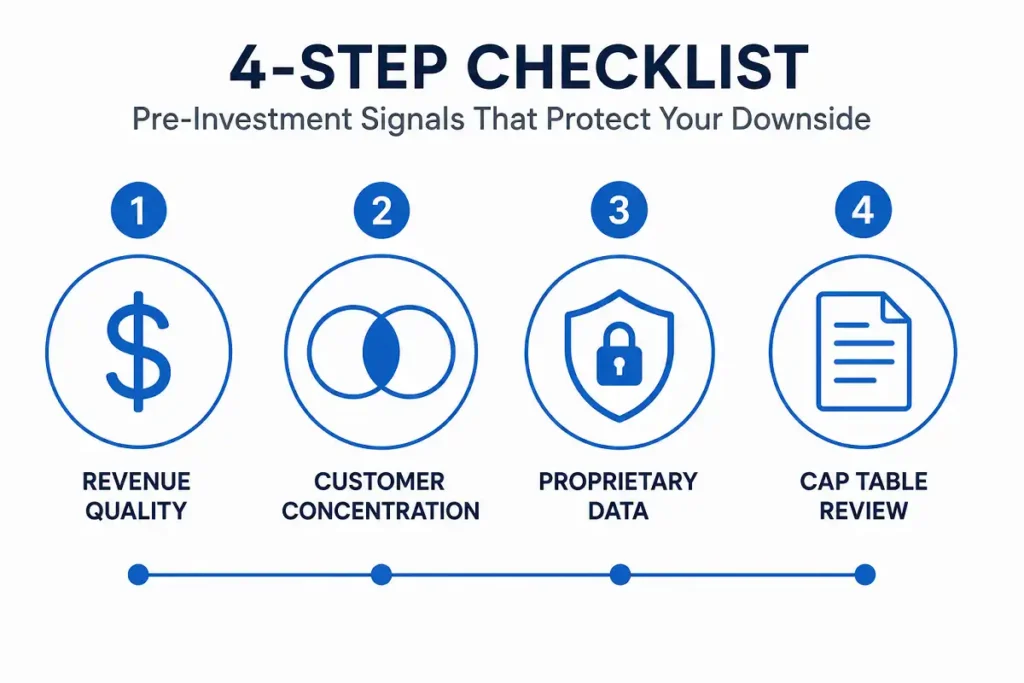
Check these four things before any AI startup investment, whether you’re an angel, a limited partner, or buying into a fund that holds pre-IPO shares. The underlying mechanics are still those of traditional venture capital, just compressed into faster rounds and bigger checks.
Revenue quality over model benchmarks
Ask what the company actually charges customers for, not which benchmark it topped last quarter. Investors in 2026 are demanding revenue metrics before writing checks, a shift from the benchmark-driven diligence common in 2023 and 2024.
Customer concentration
A startup with one or two enterprise clients generating most of its revenue carries real concentration risk. Ask for the percentage of revenue tied to the top three customers.
Proprietary data or distribution
Thin wrapper apps built entirely on top of someone else’s foundation model face the weakest moats. Favor companies with proprietary datasets, exclusive distribution deals, or workflows that are hard to copy.
Cap table and dilution history
Late-stage rounds often come with complex preference stacks. Review liquidation preferences before assuming a paper valuation reflects what you’d actually collect in a downside scenario.
How Retail Investors Can Get AI Startup Investment Exposure
Direct access to private AI companies is limited to accredited investors, defined by the SEC as those with $1 million in net worth or $200,000 or more in annual income. Most retail investors reach AI startup investment indirectly through three paths.
Public AI ETFs are the easiest entry point and carry no accreditation requirement. Broad funds like the Global X Artificial Intelligence and Technology ETF track dozens of AI-linked stocks, though most holdings are public companies rather than startups.
Hybrid public-private funds now exist specifically to bridge that gap. Some ETFs use special-purpose vehicles to hold stakes in private companies such as Anthropic, giving retail holders indirect pre-IPO exposure inside a normal brokerage account. The Fundrise Innovation Fund and ARK Venture Fund follow a similar model, holding positions in OpenAI, Anduril, and SpaceX alongside public securities.
Secondary marketplaces like EquityZen and Hiive let accredited investors buy pre-IPO shares directly from employees or early investors, though minimums and share availability vary by company and round.
If a fund or platform pitches direct access to a hot AI startup investment opportunity, verify accreditation requirements and fee layers before committing. Fund-of-funds structures often stack fees on top of the underlying fund’s own carry and management charges.
Risks That Come With AI Startup Investment
Every position in this space carries the standard venture risks: illiquidity, long hold periods, and a high failure rate among early-stage companies. 2026 adds a few sector-specific ones.
Concentration risk is historically high. A small number of companies, OpenAI, Anthropic, and xAI among them, are absorbing a majority of new capital. That means portfolio performance for many funds now hinges on just a few outcomes.
Monetization timelines remain uncertain. The gap between infrastructure spending and enterprise AI revenue means some companies could face down rounds if adoption slows or customers churn once introductory pricing ends.
Rate sensitivity cuts both ways. Cheaper capital fueled the 2025 and early 2026 funding surge. If the Federal Reserve holds rates higher for longer, growth-stage valuations that assume continued easy financing could compress quickly.
Litigation exposure is growing. Several AI companies, including music-generation startups, face active lawsuits over training data, and unresolved legal risk can sit on a cap table for years before it’s priced in.
None of this means AI startup investment is a bad idea. It means treating it as a high-risk, high-dispersion asset class rather than a guaranteed continuation of 2025’s returns.
FAQs

Which companies have raised the most in this cycle?
Does AI startup investment affect public stock prices?
Is now a good time to start an AI startup investment position?
What to Watch Next
Watch three signals through the rest of 2026. First, hyperscaler earnings calls: if Microsoft, Alphabet, or Amazon guide down AI capital expenditure, expect a fast repricing across the AI startup investment chain. Second, the Anthropic and OpenAI IPO timelines, which will convert some of the largest private valuations into public, daily-marked prices for the first time. Third, enterprise AI revenue growth relative to infrastructure spend. That $400 billion-to-$100 billion gap is the single number that will decide whether this cycle looks more like a durable buildout or a repeat of past technology overbuilds.