
Global News 2026: What’s Actually Happening Right Now
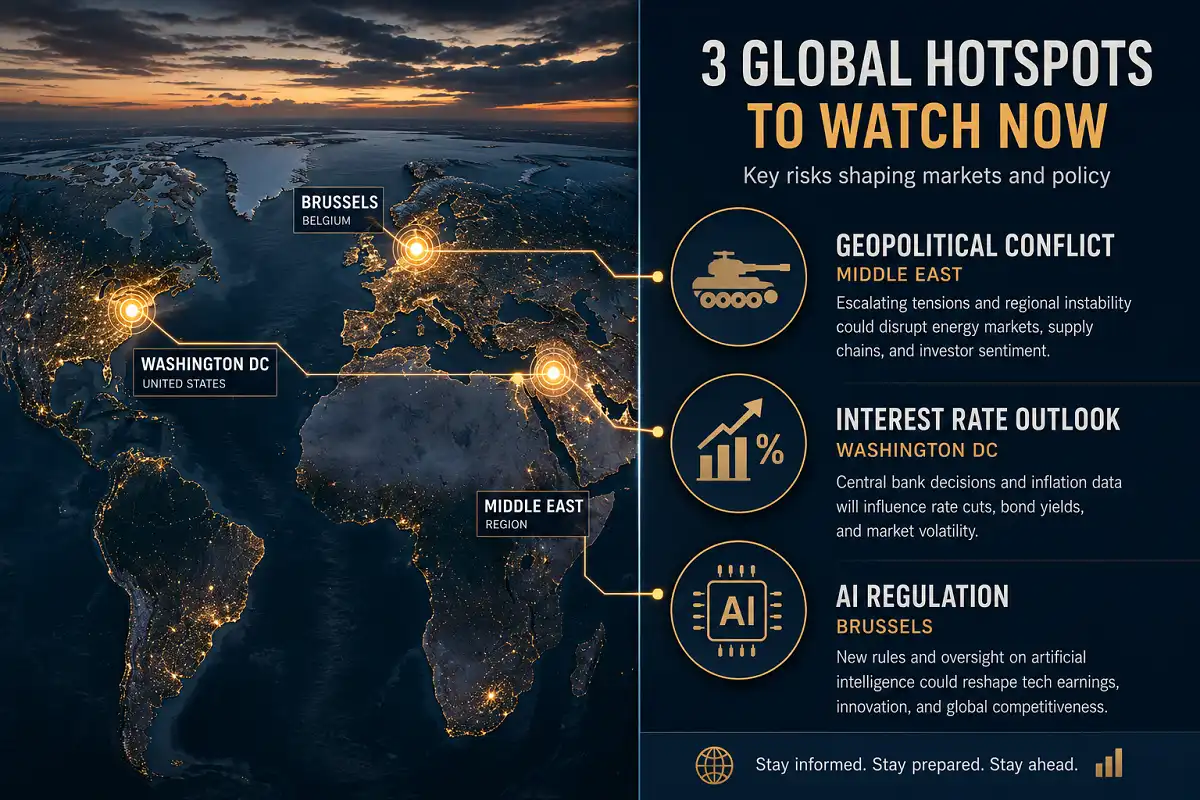
Global news 2026 has moved fast this year, and three stories are doing most of the driving: a collapsing Middle East ceasefire, a divided Federal Reserve, and a new AI rulebook out of Brussels. If you’ve felt behind, you’re not alone. I’ve been tracking these threads daily, and here’s where they stand.
Global news 2026 centers on the US-Iran conflict reigniting after an April ceasefire, the Fed holding rates at 3.5%-3.75% for a fifth straight meeting, and the EU AI Act’s high-risk rules taking partial effect August 2. Each is reshaping markets and policy.
The Middle East Conflict Anchoring Global News 2026
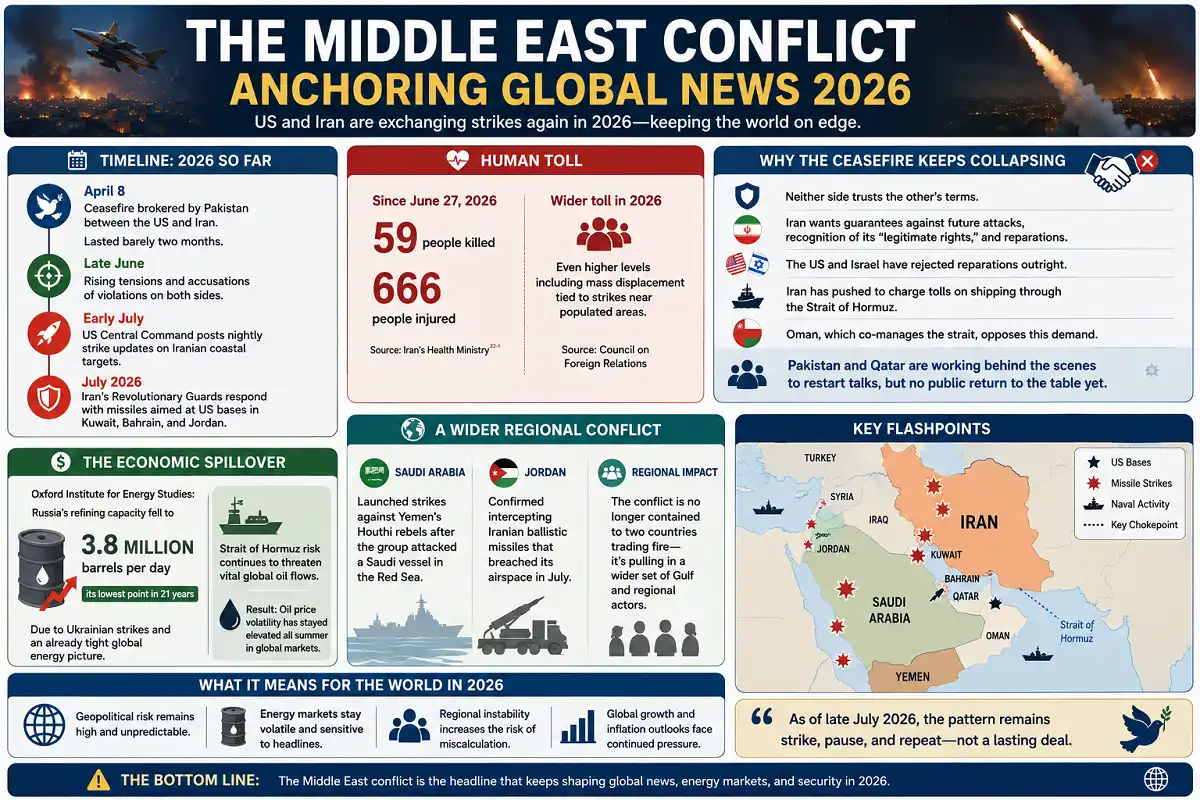
Yes, the US and Iran are exchanging strikes again in 2026. A ceasefire brokered by Pakistan on April 8 lasted barely two months before both sides accused each other of violations. By early July, US Central Command was posting nightly strike updates on Iranian coastal targets, and Iran’s Revolutionary Guards answered with missiles aimed at US bases in Kuwait, Bahrain, and Jordan.
This is the story that keeps showing up across every roundup of global news 2026, and for good reason. Iran’s health ministry reported <cite index=”22-1″>59 people killed and 666 injured since June 27</cite> as the strikes dragged into their second month. The Council on Foreign Relations tracks the wider toll from earlier in the year at even higher levels, including mass displacement tied to strikes near populated areas.
Why the Ceasefire Keeps Collapsing
The short answer: neither side trusts the other’s terms. Iran wants guarantees against future attacks, recognition of what Tehran calls its legitimate rights, and reparations. The US and Israel have rejected reparations outright. Iran has also pushed to charge tolls on shipping through the Strait of Hormuz, a demand Oman, which co-manages the strait, opposes.
Diplomacy hasn’t died completely. Pakistan and Qatar are working behind the scenes to restart talks, according to CNN reporting from Washington. But as of late July, neither government had signaled a public return to the table. For readers tracking the Qatar-mediated peace effort has fared, the pattern has been strike, pause, and repeat rather than any lasting deal.
The economic spillover is real. Oxford Institute for Energy Studies estimates Russia’s own refining capacity fell to 3.8 million barrels a day, its lowest point in 21 years, partly because of unrelated Ukrainian strikes compounding an already tight global energy picture. Combined with Strait of Hormuz risk, that’s kept oil price volatility elevated all summer, a detail that shows up constantly in coverage of global markets this year.
Regional partners beyond Iran and the US are also feeling the pressure. Saudi Arabia launched strikes against Yemen’s Houthi rebels after the group attacked a Saudi vessel in the Red Sea, and Jordan confirmed intercepting Iranian ballistic missiles that breached its airspace in July. The conflict is no longer contained to two countries trading fire; it’s pulling in a wider set of Gulf and regional actors, which raises the odds of a miscalculation turning a limited exchange into something broader.
Ukraine’s War Is Still Central to Global News 2026
Ukraine hasn’t dropped out of global news 2026 coverage just because Iran dominates headlines. Territorial changes have been small but consistent. Data from Ukraine’s DeepState OSINT group shows Russia gained a net 10 square miles of Ukrainian territory between June 30 and July 28, down from 31 square miles the prior month. The Institute for the Study of War, using a different methodology, actually recorded a net Ukrainian gain of one square mile over the same stretch.
Air defense has become the tighter constraint than territory. Ukraine’s stock of interceptors for US-made Patriot systems is running low. In June, Ukrainian defenses stopped only 14 of 54 incoming Russian ballistic missiles, and on July 6, Ukraine failed to intercept any of the 23 ballistic missiles Russia fired at Kyiv, according to the Wall Street Journal.
There’s a counter-pressure point, too. Ukrainian drone strikes on Russian refineries have knocked out roughly 20% to 28% of Russia’s refining capacity since March, per multiple analyst estimates cited by the Financial Times and WSJ. That’s squeezing Moscow’s export revenue even as Russian forces make slow ground gains. Anyone following global news 2026 through a purely territorial lens is missing half the story; the economic siege running in parallel matters just as much.
The Fed’s Rate Hold Is Reshaping Global News 2026
The Federal Reserve held its benchmark rate at 3.5% to 3.75% on July 29, the fifth straight meeting without a change. The vote wasn’t unanimous. Cleveland’s Beth Hammack, Minneapolis’s Neel Kashkari, and Dallas’s Lorie Logan all dissented, preferring a quarter-point hike, since inflation has stayed above the Fed’s 2% target for more than five years.
Fed Chair Kevin Warsh called it a “family fight,” and it’s a fight with real stakes for anyone reading global news 2026 through the lens of their mortgage or credit card rate. Mortgage rates have already climbed toward a one-year high, pushed partly by Middle East uncertainty feeding into Treasury yields. Warsh has also broken from past practice by giving markets less forward guidance, a shift he says is deliberate.
The next FOMC meeting lands September 15-16, and Warsh is expected to speak at the Jackson Hole symposium in August before then. Watch this one closely if you’re tracking the stagflation risk the Fed flagged earlier this year, since a rate cut or hike from here will move well beyond just US markets.
AI Regulation Is a Defining Thread in Global News 2026
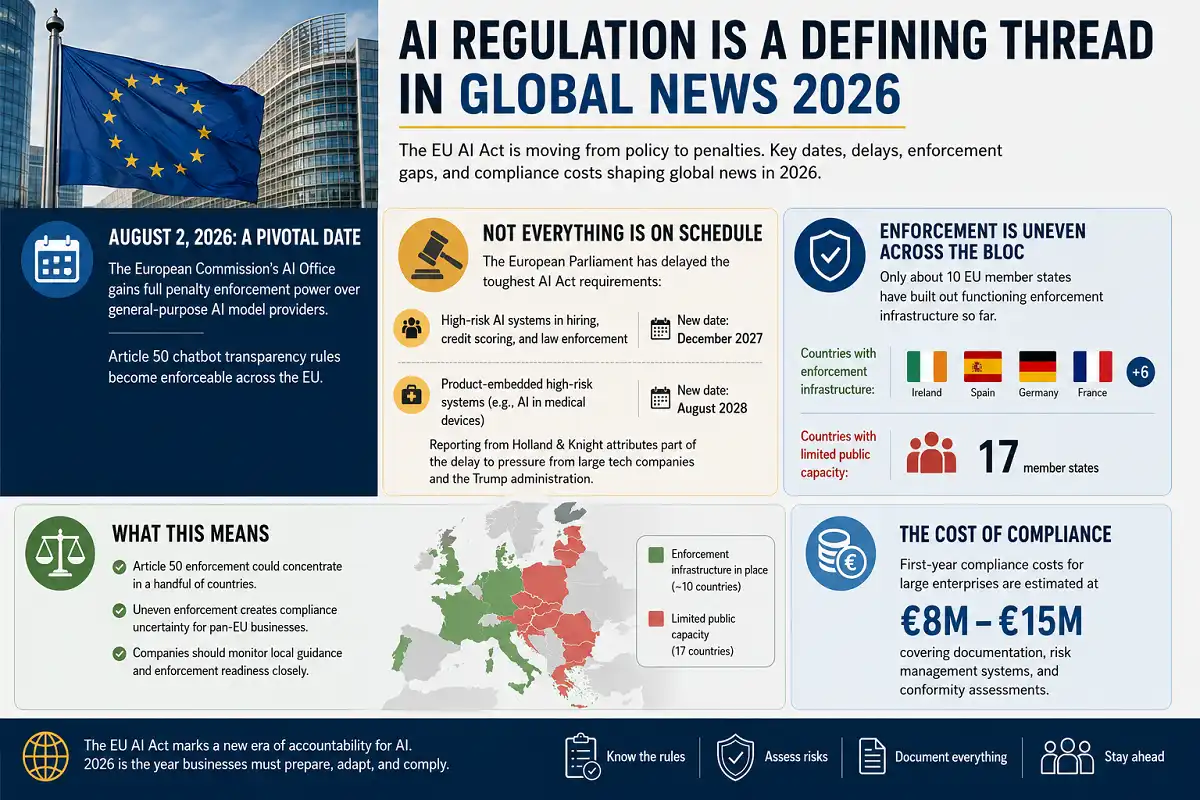
August 2, 2026 is the date every AI compliance team has circled, and it’s become one of the more consequential regulatory stories in global news 2026 this year. That’s when the European Commission’s AI Office gains full penalty enforcement power over general-purpose AI model providers, and when Article 50 chatbot transparency rules become enforceable across the EU.
Not everything is landing on schedule, which is its own recurring pattern in global news 2026 this year. The European Parliament pushed back the toughest requirements, covering high-risk AI systems used in hiring, credit scoring, and law enforcement, to December 2027. Product-embedded high-risk systems, like AI safety components in medical devices, now have until August 2028. Reporting from Holland & Knight attributes part of the delay to pressure from large tech companies and the Trump administration.
Enforcement is also uneven across the bloc. Only about ten member states, including Ireland, Spain, Germany, and France, have built out functioning enforcement infrastructure so far. Seventeen others still have limited public capacity, which means Article 50 enforcement could concentrate in a handful of countries rather than apply evenly across the single market. First-year compliance costs for large enterprises are running an estimated €8 million to €15 million, covering documentation, risk management systems, and conformity assessments.
What the EU AI Act Deadline Means for US Companies
If your company operates a chatbot or AI assistant serving EU users, the transparency requirement, disclosing that users are talking to AI, applies starting August 2, regardless of where your company is headquartered. This is the so-called Brussels Effect in action: because the EU market carries enough weight, many US firms are aligning globally with EU standards instead of running separate compliance tracks. Japan, Canada, Brazil, and South Korea are reportedly modeling parts of their own AI legislation on the EU framework, which means this single deadline is quietly setting the tone for AI governance well beyond Europe. It’s a trend worth watching alongside where AI investment dollars are actually flowing in 2026, since compliance costs are already shaping which startups can compete at scale.
Other Stories Rounding Out Global News 2026
A few threads outside the top three still matter for a complete read on the year:
Business confidence is shaky. CEO confidence dropped in the second quarter of 2026, reflecting the same uncertainty running through the Fed’s statement, which explicitly cited Middle East conflict as a factor weighing on the economic outlook. That ties directly into how executive sentiment has shifted through 2026, a pattern worth watching if you’re in a leadership role making budget calls right now.
Semiconductors remain a geopolitical flashpoint. Export controls and supply chain security concerns tied to advanced chips have kept computing power at the center of the US-China relationship. Every new restriction or workaround ripples into AI policy, since model training depends directly on chip access. Investors now watch this alongside interest rate decisions as a driver of tech-sector volatility.
Climate extremes hit Europe hard this summer. Heatwaves across the continent turned into an immediate public health and economic story rather than a distant future one, straining power grids and hospital systems in several countries at once.
Entertainment economics are behaving like market events. Major entertainment releases and infrastructure bets, from blockbuster game launches to large private space ventures going public, have started moving alongside traditional market indicators. Analysts increasingly treat these launches as data points rather than pure culture stories, a genuine shift from how entertainment used to sit outside financial coverage entirely.
How to Follow Global News 2026 Without Burning Out
Here’s a practical framework for keeping up, since trying to read everything is a losing game.
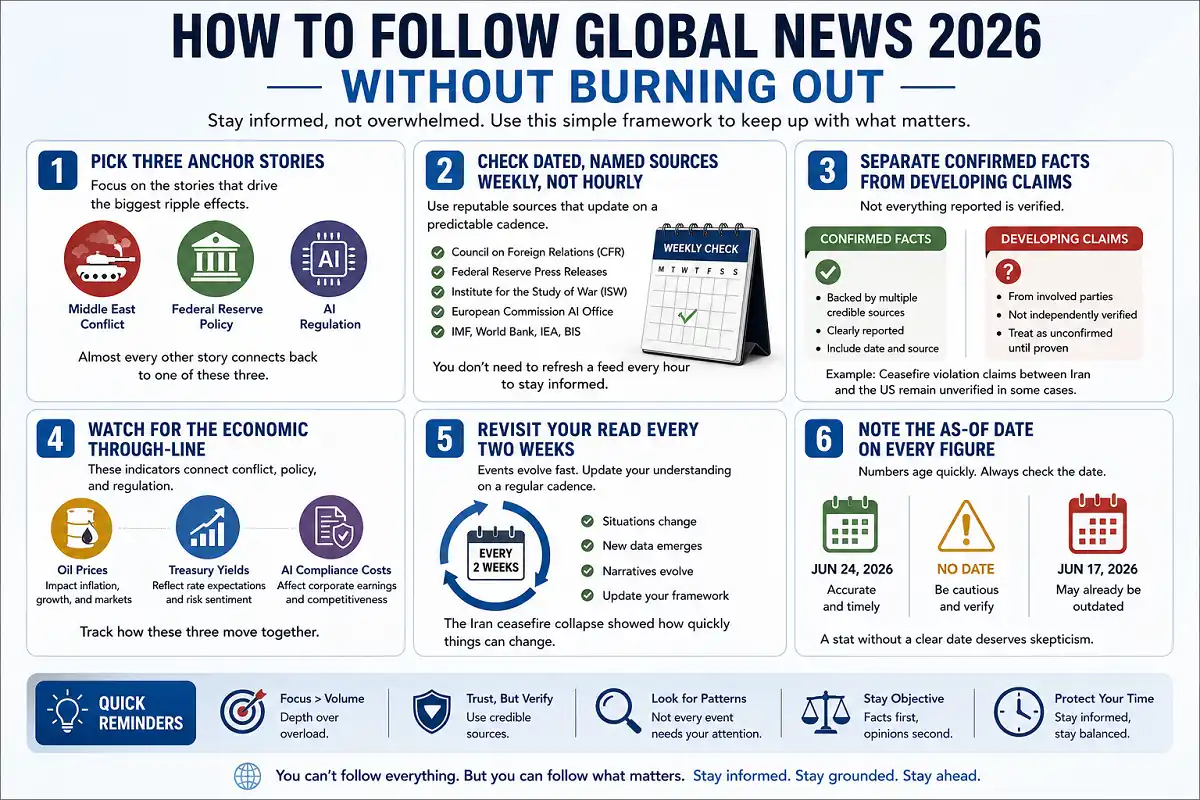
Pick three anchor stories. For 2026, that’s the Middle East conflict, Fed policy, and AI regulation. Almost every other story connects back to one of these three.
Check dated, named sources weekly, not hourly. Sources like the Council on Foreign Relations, the Federal Reserve’s own press releases, and the Institute for the Study of War update on a predictable cadence. You don’t need to refresh a feed every hour to stay informed.
Separate confirmed facts from developing claims. Iran and the US have each accused the other of ceasefire violations without independent verification in some cases. Treat unconfirmed claims from either side as exactly that until a neutral source confirms them.
Watch for the economic through-line. Oil prices, Treasury yields, and AI compliance costs are the connective tissue between conflict, policy, and regulation. If you only track one number, track how these three move together.
Revisit your read every two weeks. The situation shifts fast enough that a framework you built in May may already be outdated by July, as the Iran ceasefire collapse showed.
Note the as-of date on every figure. Territory numbers, oil prices, and interest rates are all moving targets. A stat that’s accurate on a Tuesday can look stale by the following week, so treat any figure without a clear date attached with some skepticism.
FAQs

What is the biggest story in global news 2026 so far?
Is the US still at war with Iran in 2026?
Will the Federal Reserve cut interest rates in 2026?
What does the EU AI Act mean for companies outside Europe?
How is Ukraine's war progressing in 2026?
What to Watch Next in Global News 2026
The next month will tell us a lot. Watch September’s FOMC meeting for whether the Fed’s five-meeting hold finally breaks. Watch whether Pakistan and Qatar can get the US and Iran back to a negotiating table before the current strike cycle causes a wider regional war. Global news 2026 has already proven that these stories move together, not separately, and the next quarter looks likely to prove it again.