
Why South Koreans Love AI More Than Any Nation in 2026
South Koreans love AI. And the data behind it is undeniable.
While many countries are still sorting out how to regulate the technology, South Koreans are busy using it every single day. Delivery robots cross busy sidewalks. AI-powered companion dolls keep elderly people company at home. Immigration checkpoints at airports process travelers with facial recognition, no human agent in sight.
This is not a future projection. This is daily life in Seoul right now.
Why South Koreans Love AI: The Numbers Behind the Jump
Microsoft’s AI Diffusion Report confirms why South Koreans love AI at a pace no other country has matched. In the first half of 2025, 25.9% of Koreans said they had used generative AI. By year’s end, that figure climbed to 30.7%, a 4.8 percentage-point jump, the largest growth recorded worldwide. That spike pushed South Korea’s global AI adoption ranking from 25th to 18th in just six months.
A cross-national study by OpenSurvey found that 50.9% of South Koreans have used ChatGPT. For a country of 52 million people, that figure is significant.
This kind of momentum fits into a broader global pattern. Building AI expertise has already become the fastest route to career advancement in 2026, and South Korea’s population is ahead of most in recognizing that.
South Koreans Love AI and Show the Lowest Concern Rate Globally
Here is a number that tells you a lot. Only 16% of South Koreans say they are more concerned than excited about AI. That is the lowest of any country in a 25-nation Pew Research Center survey, while 50% of Americans said they are more worried than excited.
MIT Technology Review points to history as the key reason South Koreans love AI more openly than most. As South Korea rose from poverty after the Korean War, technology lifted the nation into an economic powerhouse. In the 1970s, it manufactured steel and ships, then semiconductors in the 1980s, broadband in the 1990s, and smartphones in the 2000s. Each wave drove economic growth. South Koreans have good reason to see AI as the next step forward.
A majority of Koreans now use AI every day, either as a personal assistant or to handle tasks at work, according to surveys by the Ministry of Culture, Sports, and Tourism and the Korea Chamber of Commerce and Industry.
The Government Knows South Koreans Love AI and Is Funding It Heavily
South Korea’s government is not watching from the sidelines.
President Lee Jae-myung, who took office in 2025, has pledged to vault South Korea into the ranks of the “top three AI powers” alongside the US and China. He launched the Presidential Council on National AI Strategy to secure massive computing power and fund a sovereign AI foundation model project.
The government announced an 8% budget increase for 2026, the highest rise in four years, with around $7.25 billion earmarked for AI. Direct AI investment will jump by more than 300%. A portion of that is going toward purchasing 15,000 new GPUs and training over 11,000 South Koreans through AI-focused graduate programs.
South Korea also passed the AI Basic Act in 2024, one of the world’s first comprehensive AI laws, designed to promote AI development while keeping regulatory guardrails light. And 70% of South Koreans say advancing science and medicine through AI innovation matters more than protecting industries through regulation, according to the 2026 Stanford AI Index.
It is precisely because South Koreans love AI that this kind of policy finds such strong public support. Large-scale AI infrastructure investment is intensifying globally too. Google and Blackstone recently joined forces on a $5 billion AI infrastructure deal, which shows just how much capital is chasing this space right now.
South Koreans Love AI Hardware Too: Samsung and SK Hynix Lead the Way
You cannot talk about South Korea’s AI position without its semiconductor giants.
Samsung and SK Hynix together supply most of the world’s high-bandwidth memory chips, which power the cutting-edge Nvidia hardware used to train AI models. South Korea’s main equity index, the Kospi, surged to record highs in 2026, powered by the soaring share prices of both companies, each valued above $1 trillion.
South Koreans love AI and they supply the chips that make global AI possible. According to the 2026 Stanford AI Index, South Korea ranked first in AI patents per 100,000 people, at 14.31, for a second straight year. The country also ranked third globally for notable AI models released, behind only the United States with 50 and China with 30. It moved up one spot from fourth place the year before, overtaking Canada, France, and the United Kingdom.
New model releases from Anthropic and other US-based labs are pushing every country, including South Korea, to accelerate homegrown AI model development.
South Koreans Love AI in Their Everyday Lives
Walk through Seoul today and AI turns up everywhere.
Bus stops in Gangnam are being upgraded into AI-powered kiosks that answer riders’ questions in multiple languages. Delivery robots wait patiently at crosswalks. Unmanned immigration checkpoints process travelers at airports using facial recognition without any staff present.
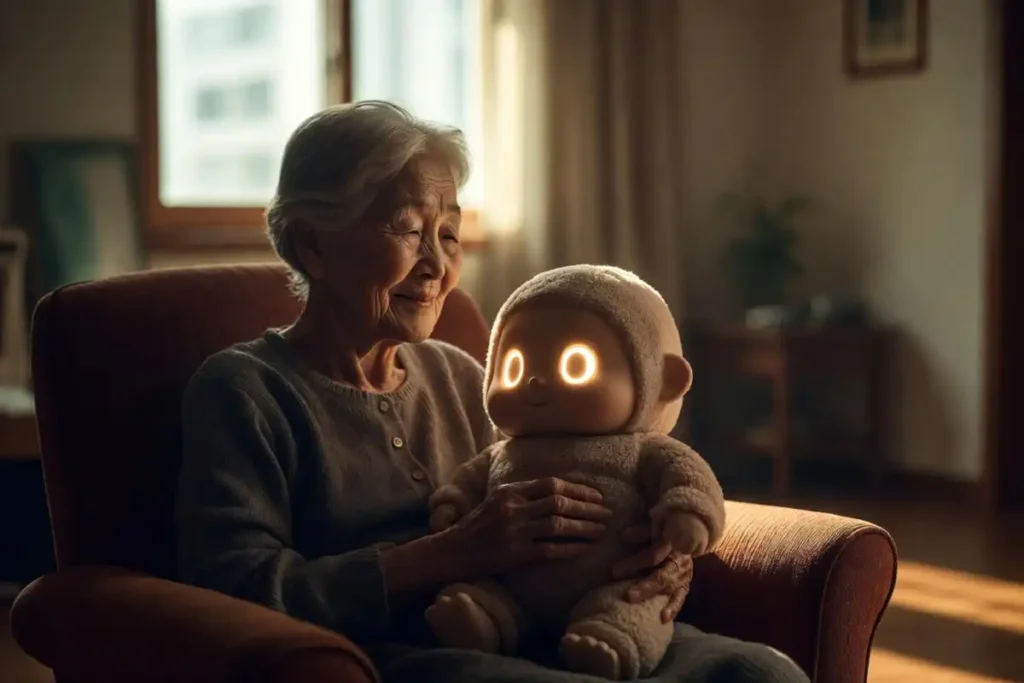
In eldercare, AI companion dolls called Hyodol are deployed by local governments and nursing homes across the country. Around 14,500 of these dolls are currently in use in South Korea, whether owned by individuals, rented out by governments, or placed in nursing homes. They converse with elderly people using ChatGPT, remind them not to skip meals or medication, and help maintain daily routines.
Government agencies are early adopters as well, deploying AI textbooks in schools and AI eldercare robots in welfare centers.
The fact that South Koreans love AI shows up strongly in app usage too. AI assistant apps have now taken over app store charts in 2026, and Korean users and developers are a major part of that global surge.
South Koreans Love AI in Business Too: The Enterprise Numbers
South Korea’s AI adoption goes well beyond individual consumers.
According to a 2025 DFINITE enterprise report, 55.7% of Korean companies already use generative AI. Three-quarters increased their AI budgets year-over-year. Nearly 80% plan to spend even more in 2026. Analysts project that 85% of Korean enterprises will run AI operations by end of the year. Korean factories are now running on algorithms.
That South Koreans love AI is not limited to personal use. Korean executives have moved on AI faster than most of their Western counterparts. Jamie Dimon issued a direct warning to CEOs about the risks of falling behind on AI leadership in 2026, and Korean business leaders appear to have absorbed that lesson well ahead of time.
AI adoption is also reshaping hiring across the board. Hiring managers in 2026 now show a clear preference for AI-skilled workers, a shift playing out in Korea as much as anywhere else.
What Comes Next
South Koreans love AI and their government, industries, and citizens are all pointing in the same direction.
The country has the hardware backbone through Samsung and SK Hynix. It has government funding expanding by hundreds of percent. It has a population with historically low resistance to new technology and a cultural instinct to stay ahead.
Vice Prime Minister Kyung-hoon Bae summed up the national ambition clearly: “We will further strengthen policy support so that South Korea establishes itself as a true top-three AI power and so that all citizens can equally enjoy the benefits of AI in daily life.”
The remaining challenge is scaling homegrown AI models and talent to compete at the frontier, not just in chips and infrastructure. South Korea is aware of that gap and actively working to close it.
For now, South Korea’s combination of cultural openness, industrial strength, and government direction offers a useful blueprint for any country trying to figure out how to move fast on AI.