

Hiring Managers Prefer AI Over 2026 College Grads
I cover hiring shifts every week, and this one stopped me. A June 3 survey shows nearly half of hiring managers would rather spend on AI tools than hire and train a 2026 college grad. Here is what the data says and what it means for new grads.
A ResumeTemplates.com survey of 1,000 U.S. hiring managers, released June 3, 2026, found 48% would rather invest in AI tools than hire and train a recent college graduate. The shift is steepest in technology and finance.
What the New Survey Actually Found
Forty-eight percent of hiring managers said their company would rather invest in AI tools than hire and train a recent graduate for entry-level work. The survey polled 1,000 U.S. hiring managers at companies with 101 or more employees.
This is not a future plan. It is already moving. 55% of companies have shifted entry-level hiring budget to AI tools, and 45% have restructured so one senior employee using AI does the work of multiple entry-level hires.
The math goes further. More than 1 in 4 companies say a senior worker plus AI does the equivalent of two entry-level workers, 11% say three, and nearly 1 in 10 say four or more. The jobs new grads used to fill are getting folded into senior roles instead of backfilled.
Why Are Employers Choosing AI Over New Graduates?
Cost and consistency drive the decision. Managers who lean toward AI cited four top advantages. Faster onboarding came in at 61%, more reliable and consistent output at 55%, 24/7 availability at 52%, and lower cost at 48%.
Then there are the people-management reasons. Managers said AI does not quit or get fired in the first year (37%), does not require management attention after setup (31%), avoids professionalism concerns (30%), and avoids workplace drama (30%).
One manager summed up the cost case in plain terms. “Don’t hire a human to do what an AI can do for $20 a month.” That line tells you how blunt the calculation has become. It mirrors the same pressure I wrote about when AI leadership skills jumped to the top of hiring priorities earlier this spring.
Which Industries Are Cutting Entry-Level Hiring Most?
Technology and finance lead the shift. In technology, 65% of hiring managers say they would rather invest in AI than hire and train a recent graduate, with finance close behind at 56%.
Government is the outlier. Just 20% of government hiring managers prefer AI over a recent grad, with the slowest budget reallocation at 20% and the lowest restructure rate at 13% of any sector surveyed. If you are a new grad, public-sector roles look like the safer harbor right now.
This split matters because entry-level work has long been the on-ramp to long-term career growth in business. When the bottom rung gets pulled, the whole ladder shifts.
How Bad Is the Class of 2026 Job Market?
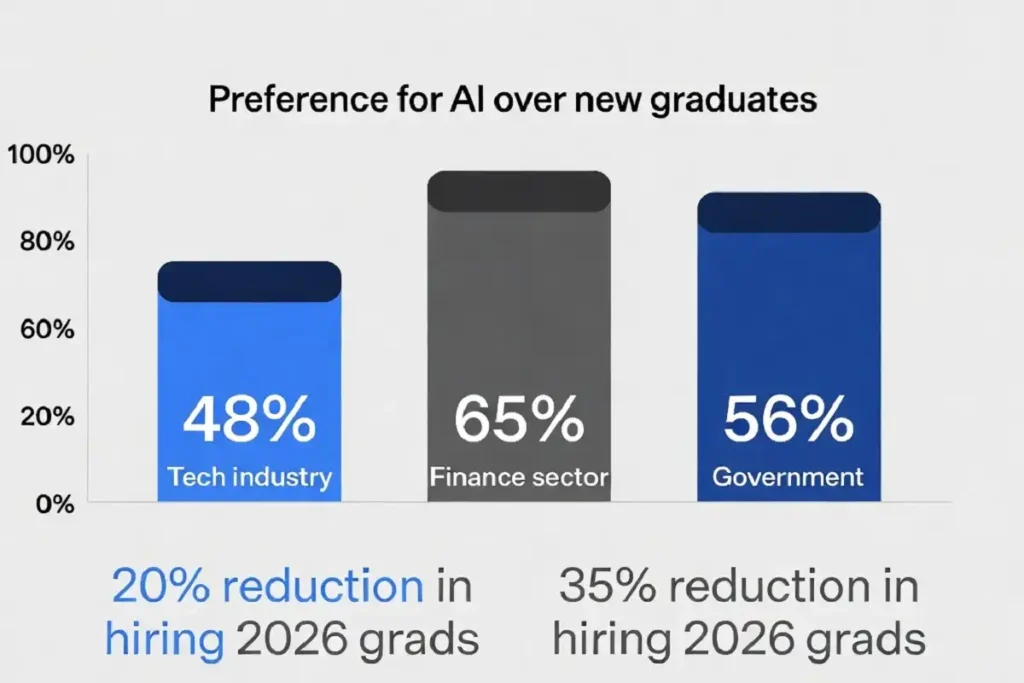
About a third of employers are pulling back. 35% of hiring managers will not hire class of 2026 graduates at the same volume as the class of 2025.
Here is the breakdown. 18% plan to hire fewer 2026 grads than the prior year, 5% will not hire any, and 12% have not committed to hiring decisions for the cohort.
There is competition beyond AI, too. Chief Career Strategist Julia Toothacre noted that the market is also flooded with experienced professionals laid off over the last few years, so unless a role is designated for recent graduates, new grads should expect significant competition in 2026. This tracks with the broader skills-based hiring shift reshaping how people move up, where proven ability beats a fresh credential.
Image name:
What New Grads Can Do Right Now
The grads who land offers are the ones who show AI fluency. Toothacre recommends a clear path. Graduates should experiment with AI tools, attend AI-focused professional events, build AI agents they can show on a resume, and pursue selective AI certifications with clear workplace outcomes.
The door is not shut. 65% of hiring managers will still hire class of 2026 grads at the same or higher volume as the class of 2025, and the grads who position themselves as AI-fluent will be the ones who land those offers.
That is why I keep telling early-career readers that AI skills are now the fastest route to career growth. The signal employers want is simple: show you can work alongside the tools, not compete against them. Pew Research Center has documented how fast AI use is spreading across U.S. workplaces, and that adoption curve is exactly what this survey reflects.
The Takeaway
The entry-level on-ramp is narrowing, and AI is the reason. Half of hiring managers now treat a $20-a-month tool as a real alternative to a new hire. But two-thirds of them still plan to hire grads, and government and many smaller firms remain open. If you are graduating in 2026, AI fluency is no longer a bonus line on your resume. It is the thing that gets you read. The market is harder, but it is not closed, and the people who adapt fastest will still get hired.