
Enterprise Strategy in 2026: A Complete Guide for Leaders
Most companies confuse having a plan with having a strategy. They set targets, build budgets, and call it direction. Then they stall. A real enterprise strategy answers one question: where will this company win, and how?
Enterprise strategy is the top-level plan that defines a company’s scope, its competitive advantage, and how it allocates resources across business units. It sets the boundaries for every lower-level decision. Done right, it aligns capital, people, and priorities toward a single coherent direction.
What Is Enterprise Strategy?
Enterprise strategy is the highest tier of strategic planning inside an organization. It defines what businesses a company should be in, how those businesses fit together, and where the firm competes.
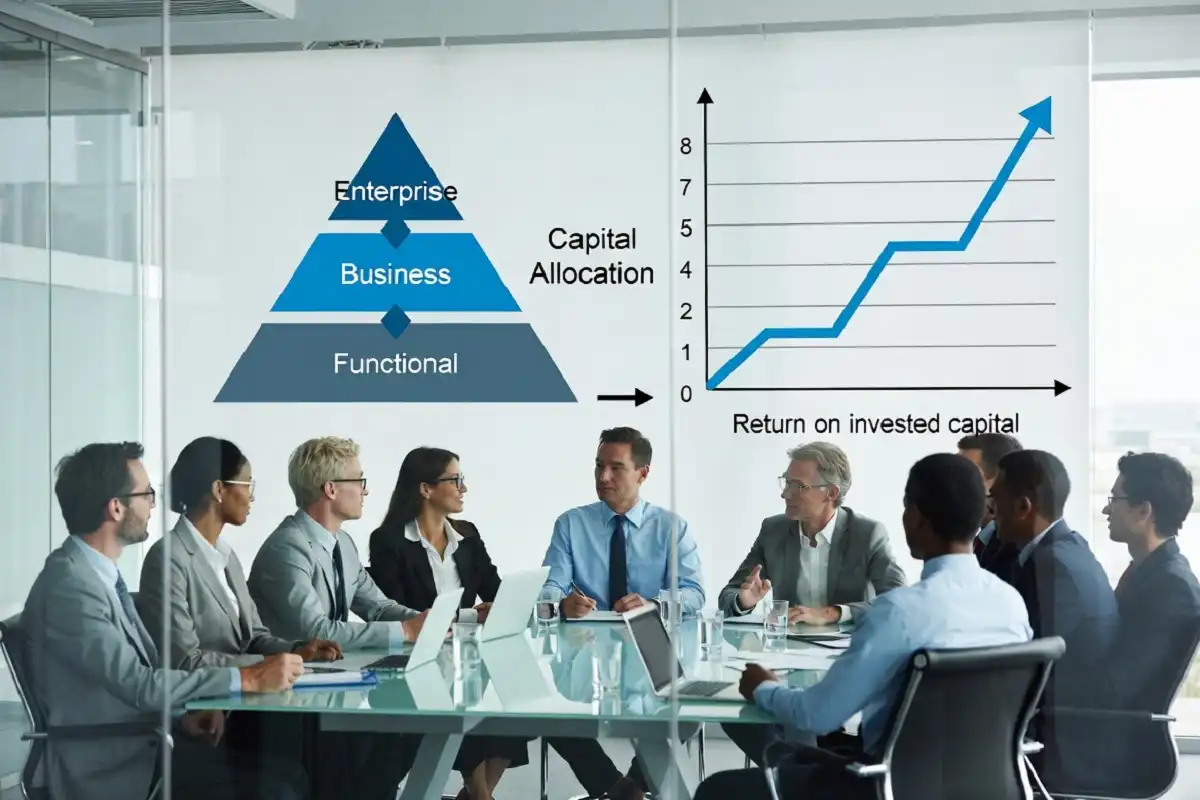
Think of three levels. Corporate strategy decides the portfolio. Business strategy decides how each unit competes in its market. Functional strategy runs marketing, operations, and finance. Enterprise strategy sits above and connects all three.
Michael Porter, the Harvard economist who shaped modern competitive theory, framed it plainly. Strategy is choosing what not to do. An enterprise strategy draws that line for the whole company.
The scope is broad by design. It covers capital allocation, mergers and acquisitions, geographic expansion, and technology bets. It also sets the guardrails for risk, values, and long-term positioning.
Why Enterprise Strategy Matters More in 2026
Speed changed the stakes. Markets shift faster, capital costs more, and technology cycles compress. A weak enterprise strategy now shows up in results within quarters, not years.
McKinsey research has long shown that a small share of business units capture the majority of economic profit. Most companies sit near the flat middle of that curve. Moving up requires deliberate, big strategic moves, not incremental tweaks.
Three forces raise the pressure this year. First, artificial intelligence is reshaping cost structures across sectors. Second, higher-for-longer interest rates make undisciplined capital allocation expensive. Third, geopolitical splits force firms to rethink supply chains and market exposure.
CEOs feel it directly. Boards now expect leadership teams to explain their AI posture, their capital discipline, and their competitive moat in specific terms. The pattern is visible across the way AI leadership skills top hiring priorities for senior roles.
The Core Components of an Enterprise Strategy
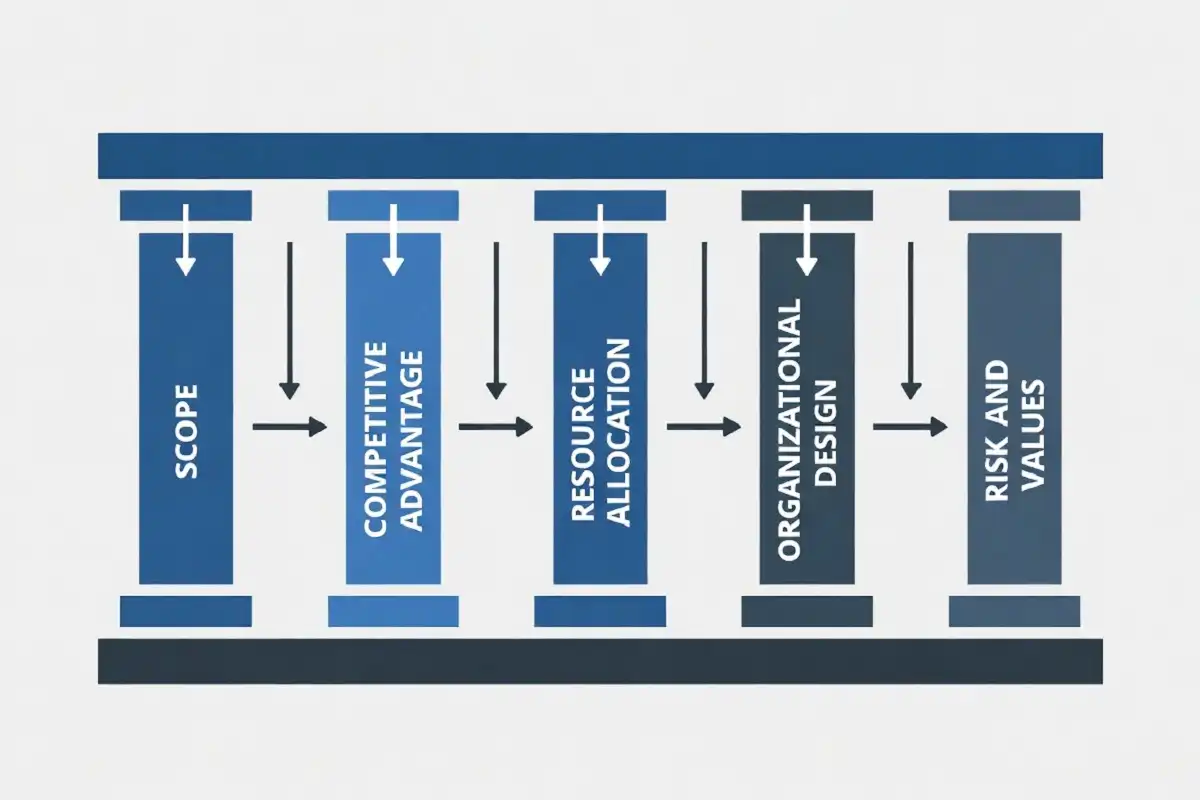
A complete enterprise strategy has five parts. Skip one, and the plan wobbles.
Scope. Which markets, products, and customers the company serves. Just as important, which ones it exits.
Competitive advantage. The specific reason customers choose this firm over rivals. Cost, differentiation, network effects, or switching costs.
Resource allocation. How capital and talent flow across units. Winners get funded. Laggards get fixed or sold.
Organizational design. The structure, governance, and incentives that make execution possible.
Risk and values. The boundaries the company will not cross, and the risks it will accept for return.
These five hold together only when they reinforce each other. A cost-leadership position funded by premium-priced acquisitions, for example, signals a broken enterprise strategy.
How to Build an Enterprise Strategy Step by Step
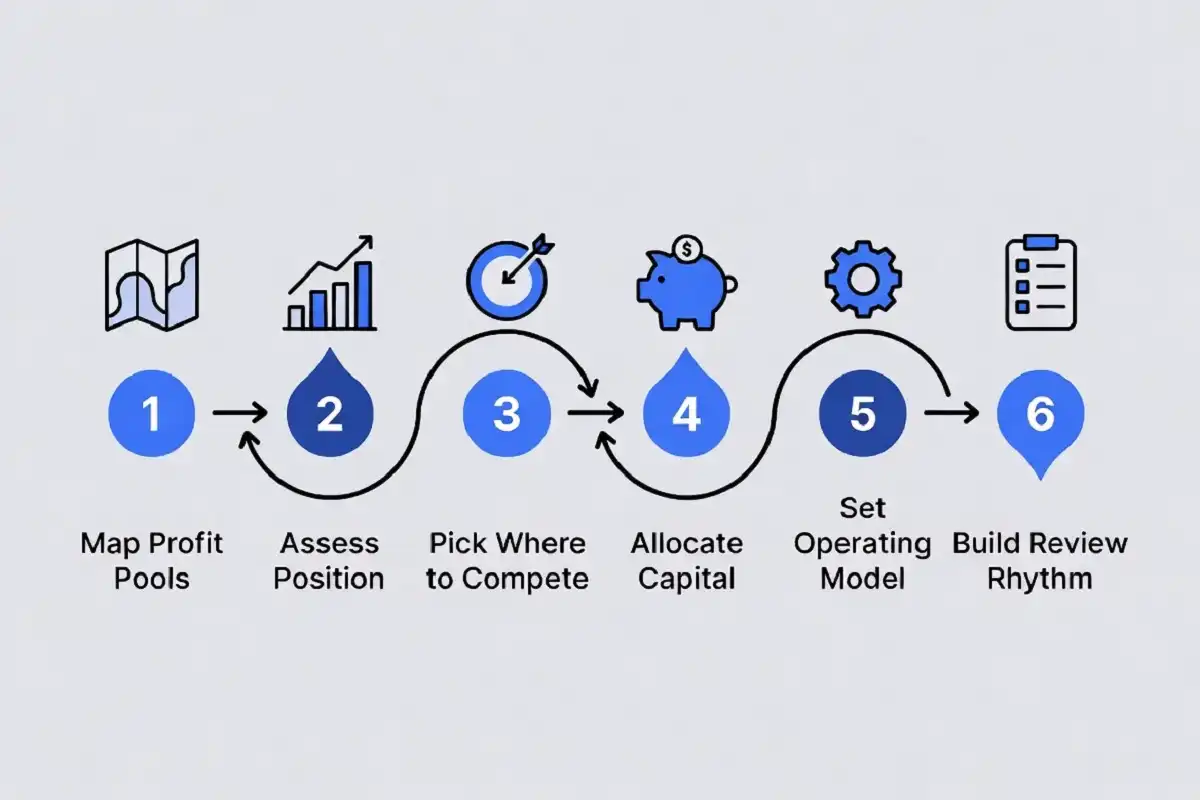
Start with evidence, not ambition. The strongest strategy work begins with a clear-eyed look at where profit actually comes from.
Step one: map the profit pools. Identify where money is made in your industry and where it is moving. Follow the margin, not the revenue.
Step two: assess your real position. Rank each business unit by its competitive strength and market attractiveness. Be honest about the weak ones.
Step three: pick where to compete. Decide which units to grow, hold, fix, or divest. This is the heart of enterprise strategy, and the hardest part.
Step four: allocate against the choices. Shift capital toward the highest-return units. The Boston Consulting Group’s growth-share matrix still offers a simple lens here: fund the stars, question the dogs.
Step five: set the operating model. Align structure, metrics, and incentives to the choices you made. Strategy without matching incentives fails.
Step six: build the review rhythm. Revisit the strategy quarterly against real results. Kill what is not working. Double down on what is.
Enterprise Strategy vs Corporate Strategy: What’s the Difference?
They overlap, but they are not the same. Corporate strategy focuses narrowly on portfolio choices, which businesses to own and how to add value across them.
Enterprise strategy is wider. It folds in the company’s role in society, its risk appetite, its stakeholder relationships, and its long-term legitimacy. The term gained traction as firms faced pressure from regulators, employees, and the public alongside investors.
In practice, enterprise strategy treats the company as an actor inside a larger system. Corporate strategy treats it mainly as a portfolio of assets. Large firms increasingly need both views at once.
Common Enterprise Strategy Mistakes
The failures repeat across industries. I see the same patterns in the filings and earnings calls I track.
Confusing goals with strategy. A revenue target is not a strategy. It is a wish without a mechanism.
Spreading capital evenly. Peanut-butter budgeting funds everything a little and nothing enough. It is the quiet killer of returns.
Ignoring exits. Companies love adding businesses. They hate cutting them. Portfolios bloat, and focus dies.
Over-planning, under-deciding. Thick strategy documents often hide an absence of real choices. Clarity beats volume.
Skipping the operating model. A brilliant strategy fails if incentives reward the opposite behavior.
How AI Is Reshaping Enterprise Strategy

Artificial intelligence now sits at the center of most serious strategy conversations. It changes both what companies sell and how they operate.
On the cost side, AI compresses expenses in software, service, and support functions. On the revenue side, it opens new products and pricing models. Firms that treat AI as a bolt-on tool fall behind those that rebuild processes around it.
The workforce implications run deep. Skills, hiring, and org design all shift. The broader move toward AI adoption across the workplace is now a board-level strategic input, not an IT project.
My read on the current cycle: AI raises the ceiling and the floor at once. Leaders who set a clear enterprise strategy around it gain ground. Those who wait for certainty lose it.
Measuring Whether Your Enterprise Strategy Works
Good strategy shows up in a few hard numbers. Track these, and you will know if the plan is real.
Return on invested capital tells you whether the business earns more than its cost of capital. Economic profit, revenue minus all costs including capital charges, shows true value creation. Market share trends reveal competitive momentum.
Watch the direction, not just the level. A strategy is working when returns rise, capital concentrates in strong units, and weak units shrink or improve. Flat numbers across the board usually signal a strategy that never made real choices.
Where This Leaves Us
A strong enterprise strategy is not a document. It is a set of hard choices, backed by capital, that tells the whole company where to win. In 2026, the pressure from AI, rate costs, and geopolitics rewards clarity and punishes drift. Map your profit pools, fund your winners, cut your laggards, and review the results without flinching. That discipline, repeated, is the whole game.