AI Productivity Impact 2026: Gains, ROI & Limits
Companies are no longer asking whether AI helps workers. The question now is how much. The AI productivity impact 2026 is showing up in earnings calls, hiring plans, and BLS data. Here is what the numbers say.
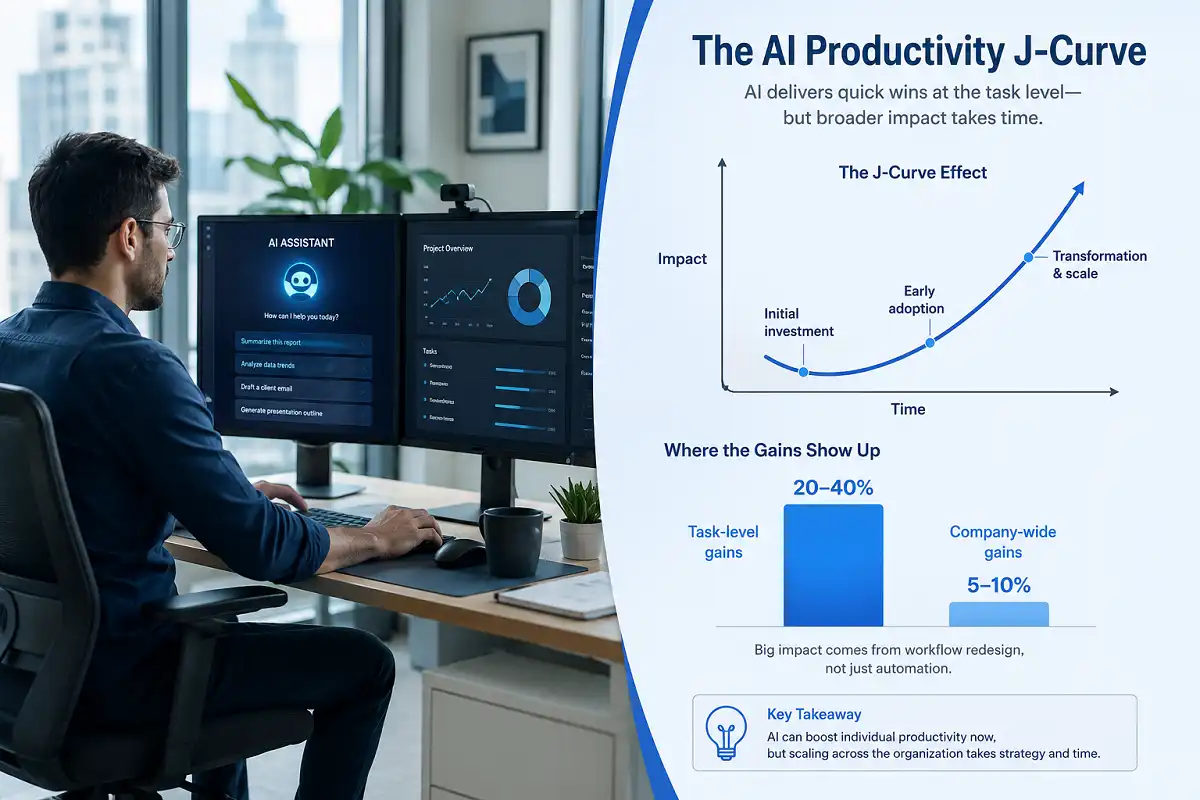
The AI productivity impact 2026 is real but uneven. Early adopters report 20% to 40% task-level gains, while broad company-wide output growth stays modest. Skilled users benefit most. Results depend on workflow design, not just tool access.
What Is the AI Productivity Impact 2026?
The AI productivity impact 2026 is the measurable change in worker output tied to generative AI tools this year. It covers speed, quality, and cost per task. In my reporting on this sector, the story splits in two. Individual tasks get much faster. Whole-company numbers move slower.
The gap matters. A developer using GitHub Copilot finishes a function in less time. That does not mean the whole engineering org ships twice the code. Bottlenecks shift elsewhere. Review, testing, and coordination still take time.
Stanford’s Digital Economy Lab and the U.S. Bureau of Labor Statistics both track this closely. Their read is consistent. Task-level gains are large. Aggregate gains are smaller and slower to appear.
How Big Are the Gains in 2026?
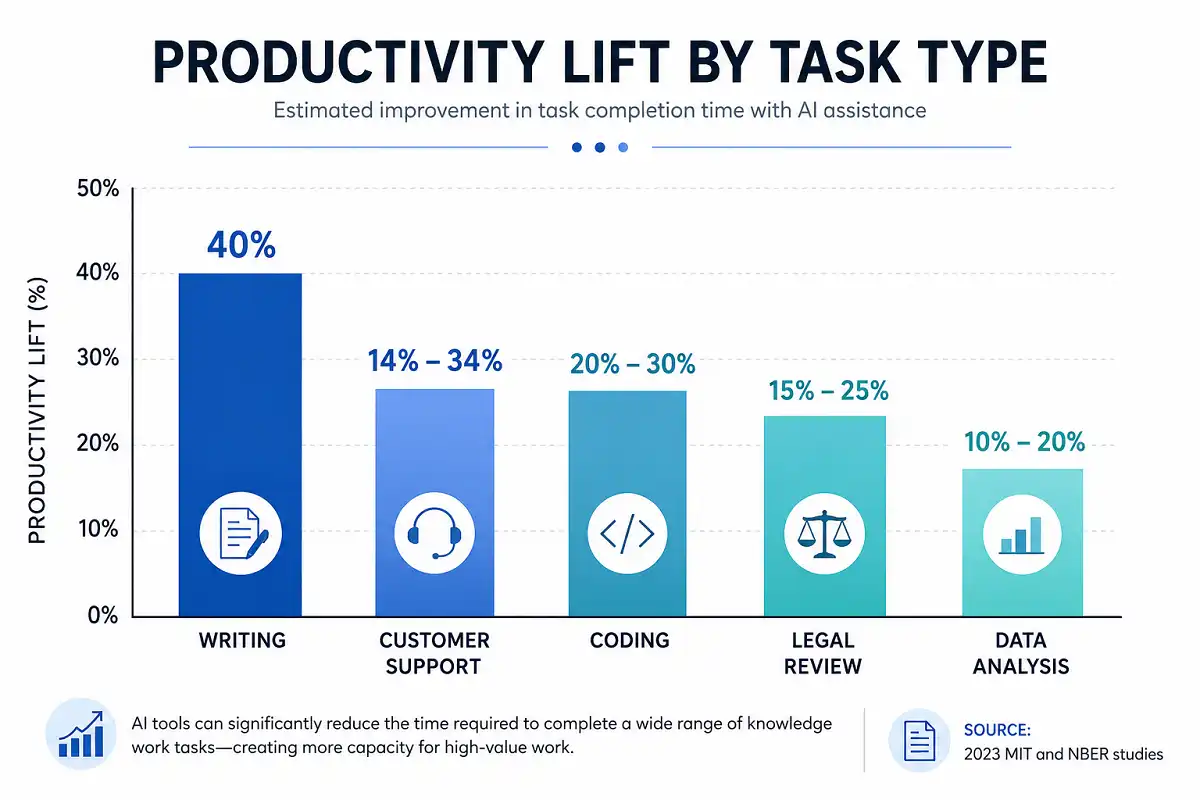
Task-level gains run from 20% to 40% for the right work. The AI productivity impact 2026 is strongest in writing, coding, and customer support. These are language-heavy jobs. Large language models fit them well.
A 2023 study from MIT researchers Shakked Noy and Whitney Zhang found writing tasks finished 40% faster with ChatGPT. Quality rose too. A separate National Bureau of Economic Research paper on customer support agents found a 14% average productivity lift. Newer and less experienced workers gained the most, up to 34%.
Those findings still guide 2026 planning. The pattern holds across the filings I reviewed this year. Support and content teams show the clearest returns. Legal review and data analysis follow close behind.
Which Jobs Gain the Most?
Language-heavy roles gain the most. The AI productivity impact 2026 concentrates where work is text, code, or structured reasoning. Think copywriters, coders, analysts, paralegals, and support reps.
Physical jobs see less direct change. A warehouse worker or a nurse gains little from a chatbot at the task level. Their tools are different. Robotics and automation affect them more than language models do.
Here is the split I keep seeing in the data. Desk work with clear inputs and outputs gains fast. Judgment-heavy or physical work gains slower.
How the AI Productivity Impact 2026 Varies by Industry
The effect changes by sector. Software leads. Firms report faster code review, quicker bug fixes, and better documentation. GitHub’s own data shows developers accept a large share of AI-suggested code, and that share keeps climbing through 2026.
Financial services come next. Banks use AI for research summaries, compliance checks, and client reports. JPMorgan Chase deployed internal assistants across thousands of employees. The bank ties usage to hours saved on routine analysis.
Healthcare moves slower but shows promise. Clinical note-taking tools cut documentation time for doctors. That gives back minutes per patient. The gain is real, though regulation and accuracy checks keep the pace careful.
Retail and logistics lean on forecasting and inventory tools. Here the AI productivity impact 2026 blends with older automation. The line between “AI” and “software” blurs, which makes the gains harder to isolate cleanly.
Why Company-Wide Numbers Stay Modest
Task speed does not equal company output. This is the core tension in the AI productivity impact 2026 story. Erik Brynjolfsson at Stanford calls this the “productivity J-curve.” Gains take time to show up in official statistics.
Three things slow the effect. First, adoption is partial. Not every worker uses the tools well. Second, processes need rebuilding. Old workflows waste new speed. Third, the saved time gets absorbed. Workers take on other tasks instead of producing more measured output.
McKinsey’s 2025 State of AI report backs this up. Most firms run pilots. Fewer scale AI across whole functions. The AI productivity impact 2026 stays limited when tools sit in silos.
The J-Curve Effect Explained
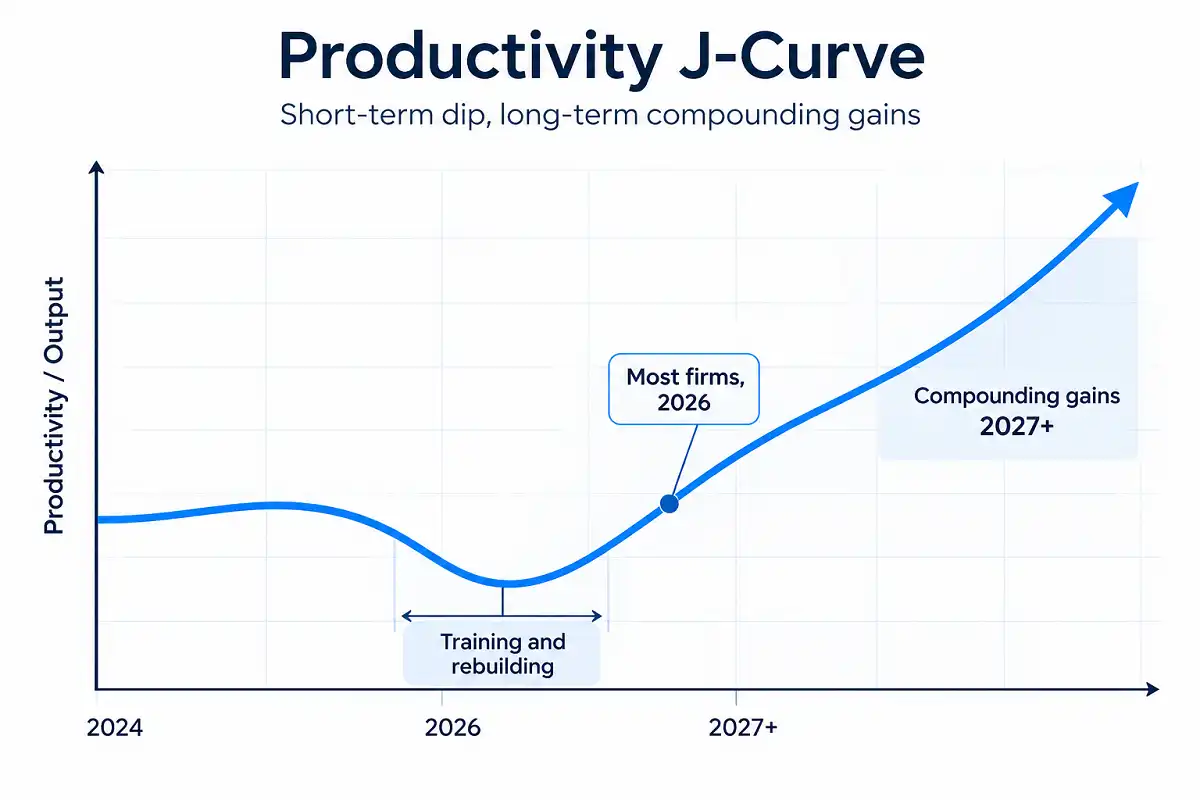
The J-curve means productivity dips before it climbs. Firms spend money and time first. They train staff. They rebuild processes. Output lags during this phase.
Then it turns. Once new workflows lock in, gains compound. The AI productivity impact 2026 sits early on that upward slope for most companies. The steep climb comes later, likely 2027 and beyond.
Real Numbers From 2026 Reporting
The AI productivity impact 2026 shows up in company disclosures. ServiceNow reported strong demand for its AI agents through the first half of the year. Microsoft tied Copilot adoption to measurable time savings in internal studies. These figures shape how companies are folding AI into daily work across every department.
Klarna made headlines earlier by using AI to handle customer service work equal to hundreds of agents. The company later rebalanced, hiring some human staff back. That correction is instructive. AI shifts work. It rarely erases it cleanly.
As of mid-2026, aggregate U.S. labor productivity growth runs above the sluggish 2010s pace. Economists disagree on how much AI drives it. The signal is positive but not yet decisive. Verify the latest BLS quarterly figure before citing a specific number, since these revise often.
The Skills Gap in 2026
Skill decides who gains. The AI productivity impact 2026 rewards workers who prompt well, verify output, and edit fast. Raw tool access is not enough. Training closes the gap.
I have watched two workers with the same tool get very different results. One writes sharp prompts and checks the output. The other pastes and hopes. The first finishes hours ahead. This is why building AI skills has become the fastest route up the career ladder for many professionals.
Companies that train see the returns. Those that hand out licenses and walk away do not. The tool is a lever. The worker is the hand on it.
How to Capture the Gains
Start with high-volume, repeatable tasks. Map where your team spends time on text, code, or search. Point AI there first. Measure before and after.
Then rebuild the workflow around the new speed. Do not bolt AI onto old steps. Cut the steps the tool makes unnecessary. Train everyone to verify output. Accuracy still needs a human check.
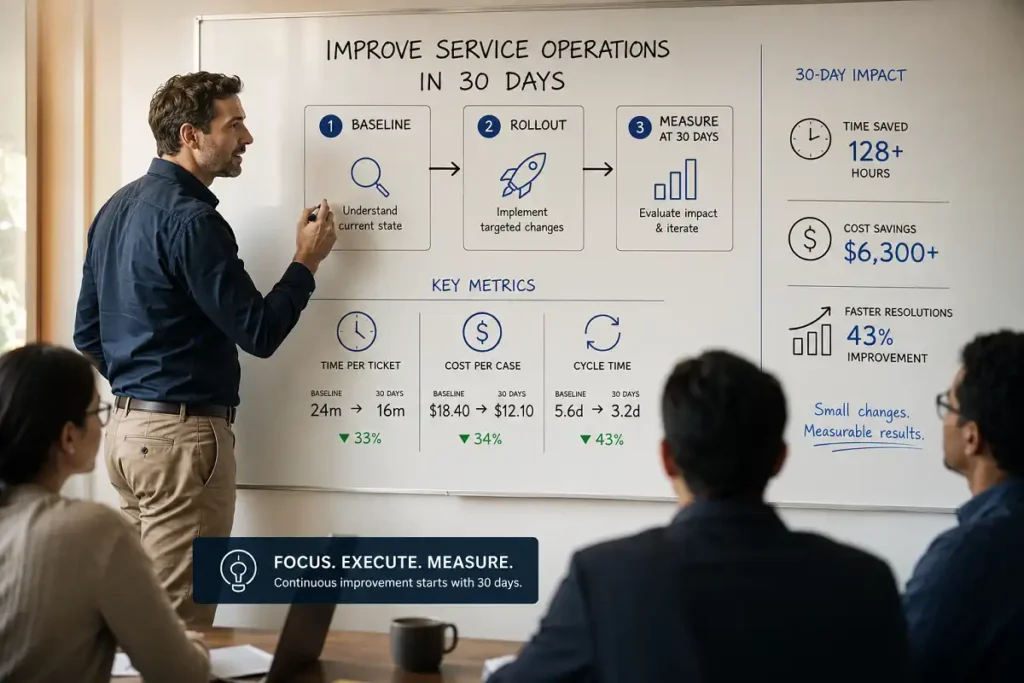
Track a real metric. Time per ticket. Drafts per day. Cost per resolved case. The AI productivity impact 2026 only counts when you can measure it.
How to Measure ROI in 2026
Most firms measure the wrong thing. They count licenses bought, not output gained. The AI productivity impact 2026 needs a before-and-after baseline tied to a business metric.
Start simple. Pick one task. Record the current time and cost. Roll out the tool. Record again after 30 days. The difference is your gain. Do this per function, not company-wide, since results vary so widely.
Watch for hidden costs too. Training hours count. Verification time counts. A tool that saves 20 minutes but adds 10 minutes of fact-checking nets 10 minutes, not 20. Honest math builds trust with finance teams.
Gartner’s 2026 guidance pushes firms toward outcome metrics over activity metrics. That means measuring revenue per employee, cost per case, or cycle time, not seat counts. The AI productivity impact 2026 gets clearer when the metric is a business result.
What Small Businesses Should Know
Small firms can capture gains too. You do not need an enterprise contract. Off-the-shelf tools handle drafting, email, scheduling, and basic analysis. The AI productivity impact 2026 reaches a two-person shop as much as a Fortune 500.
Focus on your biggest time sink. A solo consultant might automate proposals. A small agency might speed up content drafts. Point the tool at the task that eats your week. Measure the hours you get back.
The advantage for small teams is speed. No committee. No long procurement cycle. You test a tool on Monday and know by Friday if it helps. That agility is a real edge in 2026.
Which Tools Drive the Gains?
The category matters more than the brand. General assistants like ChatGPT, Claude, and Gemini handle writing, summaries, and research. Coding assistants like GitHub Copilot and Cursor speed up developers. Specialized tools handle notes, contracts, and support tickets.
Pick by task, not by hype. A support team needs a tool that reads tickets and drafts replies. A finance team needs one that summarizes filings and checks numbers. Match the tool to the job, then measure the result.
Integration is the deciding factor in 2026. A tool that lives inside your existing systems beats one that forces copy-paste. The less friction between the worker and the tool, the larger the gain. That is where adoption sticks.
Risks and Limits
The gains come with costs. Over-reliance is real. Workers who stop checking output ship errors. Hallucinated facts, wrong code, and bad citations still happen in 2026.
Security is another limit. Feeding sensitive data into public tools creates exposure. The rise in security threats moving through software supply chains has pushed firms to lock down what employees can share. Governance now shapes how much of the AI productivity impact 2026 a company can safely capture.
There is also a quality trap. Faster output is not better output. Some teams produce more low-value work. Volume rises. Value does not. Watch for that.
Change fatigue is a quieter risk. Rolling out new tools every quarter wears people down. Adoption drops when workers feel whiplash. Pick a tool, train on it, and give teams time to settle before the next shift.
Cost creep matters too. Per-seat pricing adds up fast across a large org. Some firms pay for licenses that sit unused. Audit usage quarterly. Cut the seats no one touches. The gain has to clear the bill.
Bias in output is the last flag. Models reflect their training data. In hiring, lending, and screening, that carries legal risk. Keep a human in the loop for decisions that affect people. Speed never justifies skipping that check.
Does AI Productivity Growth Cost Jobs in 2026?
Not the way headlines suggest. So far the AI productivity impact 2026 shifts work more than it cuts jobs. U.S. unemployment stays low through mid-year. Layoffs tied directly to AI remain a small share of the total.
The clearer effect is on hiring at the margin. Some firms slow entry-level hiring in text-heavy roles. They ask smaller teams to do more with AI support. The pattern shows in recent jobs reports, where openings soften in categories AI touches most.
Roles change rather than vanish. A support rep becomes a support supervisor for AI-handled tickets. A junior analyst spends less time on data pulls and more on interpretation. The task mix moves up the value chain. Workers who make that shift hold their footing.
The signal to watch is entry-level demand. If firms keep trimming junior roles while output rises, that points to a deeper structural change. The question of automation and employment is not settled, and honest reporting keeps it open.
What This Means for Workers
Adapt or fall behind. That is the plain read. The AI productivity impact 2026 will not replace most workers this year. It will reward those who use the tools well and pressure those who ignore them.
Learn to prompt. Learn to verify. Learn where the tool helps and where it fails. These are the durable skills. They outlast any single product.
For managers, the job is workflow design. Buying licenses is the easy part. Rebuilding how work flows is the hard part. That is where the real AI productivity impact 2026 gets won or lost. The competitive gap between adopters and holdouts widens every quarter.
The Numbers to Watch Next
Watch three signals through the rest of 2026. First, BLS quarterly labor productivity growth. A sustained lift above 2% points to a broad AI effect. Second, enterprise AI spending in earnings reports. Rising budgets signal confidence in returns. Third, the adoption-to-scale ratio. When pilots turn into company-wide rollouts, the J-curve steepens.
The AI productivity impact 2026 is a first chapter, not the whole book. Task gains are proven. Company gains are building. The workers and firms that rebuild around these tools now will hold the lead as the curve bends upward. Learn more about the broader shift in workplace impact of artificial intelligence to see how this trend fits the longer arc.