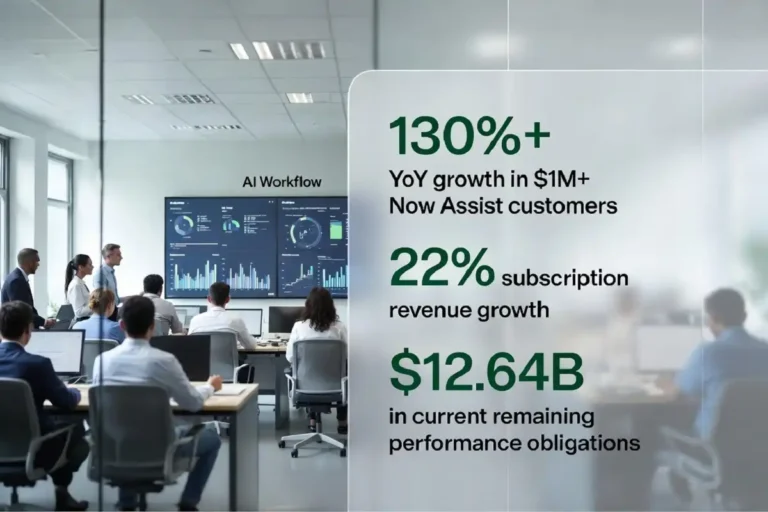

Inside ServiceNow Software AI: Now Assist & More
Enterprise teams keep hearing that ServiceNow Software AI can cut ticket times and automate routine work. Here is what it actually is, how it works, and what it costs in 2026.
ServiceNow Software AI is a set of generative and agentic AI capabilities built into the Now Platform. It powers Now Assist, custom AI agents, and domain-specific language models across IT, HR, customer service, and security workflows.
What Is ServiceNow Software AI?
ServiceNow Software AI is the collection of artificial intelligence features embedded directly in ServiceNow’s Now Platform. It is not a single product. It is a layer that runs across every workflow the platform already handles.
Think of it this way. ServiceNow runs the tickets, requests, and processes inside large companies. The AI layer sits on top and does three main jobs. It summarizes work, it answers questions in plain language, and it takes actions on its own.
The company groups these features under a few brand names. Now Assist covers the generative assistant. AI Agents cover autonomous task handling. Now LLM covers the underlying models. Together they form what most buyers mean by the term.
The Core Products Inside the Platform
Now Assist
Now Assist is the generative AI assistant embedded across ServiceNow modules. It drafts responses, summarizes long case histories, and turns plain requests into working code or workflows.
An IT agent reading a messy incident gets a clean summary in seconds. A customer service rep gets a suggested reply. A developer describes what they want, and Now Assist generates the flow. This is the most visible part of the AI suite for daily users.
Now Assist works inside IT Service Management, Customer Service Management, HR Service Delivery, and the platform’s low-code tools. Because it lives inside the existing screens, staff do not switch apps to use it.
AI Agents and Agentic Automation
AI Agents are the autonomous side of ServiceNow Software AI. Where Now Assist helps a person, AI Agents complete tasks without one.
ServiceNow announced its agentic push heavily through 2025. The AI Agent Orchestrator coordinates multiple agents across a workflow. AI Agent Studio lets teams build custom agents for their own processes. An agent can triage an incident, gather data, propose a fix, and route it, all before a human steps in.
The company frames this as a shift from assistance to action. Verify the current agent library size and released use cases on ServiceNow’s site before publishing, as this area updates every release.
Now LLM and the Model Layer
Now LLM refers to ServiceNow’s domain-specific large language models. These models are trained for enterprise workflow tasks rather than general chat.
The purpose is accuracy and cost control. A model tuned for IT tickets and case notes performs narrow tasks well and runs cheaper than a giant general model. ServiceNow also connects to third-party models through its platform, so customers pick what fits. This flexible model approach is a defining trait of the offering.
RaptorDB and the Data Foundation
RaptorDB Pro is the high-performance database engine that speeds up the platform. Fast data access matters because AI features need to read large records quickly.
Alongside it, ServiceNow’s Workflow Data Fabric connects data across systems without heavy copying. Good data plumbing is the quiet requirement behind every AI claim. Without it, the smart features stall.
How ServiceNow Software AI Works
The system works by layering models over structured workflow data the platform already holds. The AI reads the record, understands the request, and either drafts output or triggers an action.
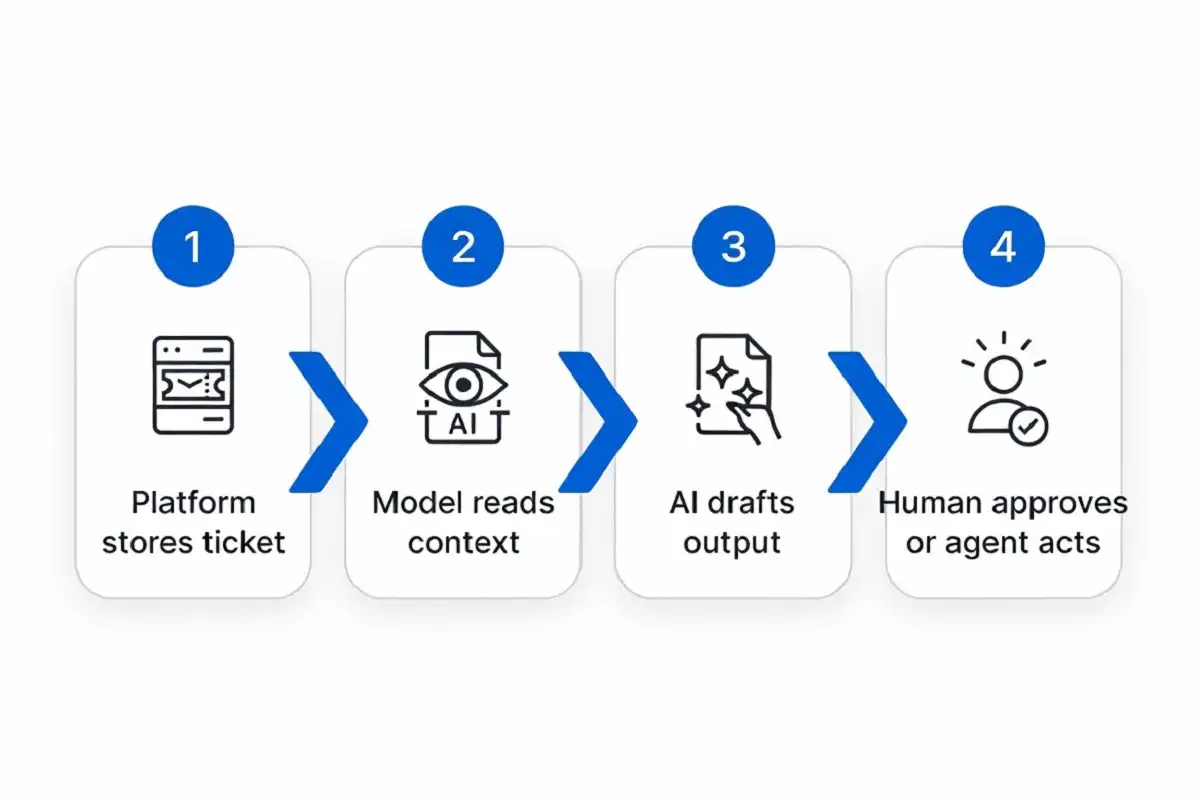
Here is the basic flow. First, the platform stores the ticket, case, or request. Second, the model reads that context plus company knowledge. Third, it produces a summary, a reply, or a completed task. Fourth, a person approves it or an agent runs it directly.
The key advantage is context. General chatbots guess. The platform reads the actual company data tied to each task, so its output fits the real situation.
Who Uses ServiceNow Software AI?
Large enterprises are the main users. The platform serves most of the Fortune 500, spanning banks, hospitals, manufacturers, and government agencies.
Inside those companies, four teams use it most. IT departments use it for faster incident handling. HR teams use it for employee questions. Customer service teams use it for quicker case resolution. Security teams use it for threat response. The reach across departments mirrors the broader wave of AI adoption reshaping how work gets done inside big organizations.
ServiceNow Software AI Pricing in 2026
The AI suite is sold as paid add-ons layered on top of base platform licenses. It is not included by default in standard subscriptions.
The company packages AI under Pro Plus and Enterprise Plus tiers. Pricing runs on a per-user or consumption basis, and ServiceNow rarely publishes list prices. Enterprise deals are negotiated, and totals depend on user count, modules, and AI usage volume.
For exact 2026 figures, confirm current SKU names and any usage-based rates directly with ServiceNow sales or a certified partner. Prices and packaging shift with each platform release, so treat any figure here as a starting point, not a quote.
What Does It Cost a Business to Run?
Beyond the license fee, the real cost includes data prep, adoption, and governance. Companies budget for cleaning knowledge bases and training staff, not just the subscription.
The payoff is measured in deflected tickets and saved hours. ServiceNow and its customers report faster case resolution and lower manual workload, which ties into the wider story of how AI is lifting workplace productivity across sectors. Confirm any specific percentage gains against a named ServiceNow customer study before you cite them.
ServiceNow Software AI vs Competitors
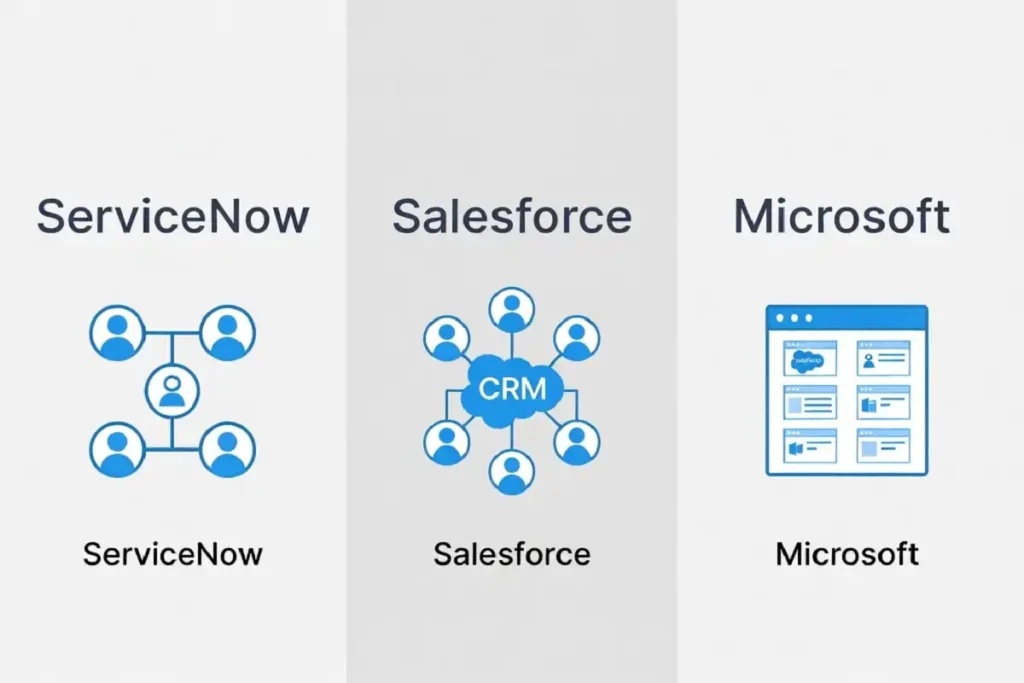
ServiceNow Software AI competes with AI features from Salesforce, Microsoft, and specialized vendors. Each attacks enterprise AI from a different starting point.
Salesforce Agentforce pushes agents from the CRM side. Microsoft Copilot pushes AI from productivity apps and Azure. ServiceNow’s edge is the workflow layer, the connective tissue between departments. Because ServiceNow already runs the process, its AI acts on live operational data rather than sitting beside it.
The competition is intense, and it shapes how these firms are valued. Investors tracking the sector often compare ServiceNow against other AI software names when weighing growth and margins.
Recent Developments
ServiceNow expanded its AI suite through 2025 with agentic features and targeted acquisitions. The company bought Moveworks to strengthen front-end AI assistance and enterprise search.
Other deals added conversation analytics and data cataloging to support AI governance. The Now Platform release cycle uses alphabetical city names, with 2025 releases carrying AI upgrades in each version. For the latest release name, acquisition closings, and feature list, check ServiceNow’s newsroom, since these details change quarterly and sit past my last verified data.
Benefits and Limits of ServiceNow Software AI
Main Benefits
The main benefit is speed on repetitive work with the context to get answers right. Staff spend less time on summaries, searches, and routine replies.
Other gains include consistency, since the AI applies the same knowledge every time, and scale, since agents handle volume without added headcount. For companies already on ServiceNow, the AI builds on data they own.
Honest Limits
The technology depends heavily on clean data and existing platform adoption. Companies not already deep in ServiceNow get less value, and the add-on cost is significant.
AI output still needs review for accuracy. Governance, security, and human oversight remain essential. The technology speeds work; it does not remove the need for judgment.
FAQs

Is ServiceNow Software AI free with a ServiceNow license?
Does ServiceNow build its own AI models?
Is ServiceNow Software AI safe for enterprise data?
What is the difference between Now Assist and AI Agents?
The Bottom Line
ServiceNow Software AI is a workflow-first AI layer, strongest for companies already running the Now Platform at scale. Its advantage is context: it acts on real operational data across departments, not generic prompts.
The trade-off is cost and dependency. It rewards clean data and deep platform use, and it charges accordingly. Watch the next platform release, the Now Assist adoption numbers, and how the agentic features perform against Salesforce and Microsoft. Those signals will show whether the workflow bet keeps paying off.