Office Workplace Trends in 2026: What the Data Shows
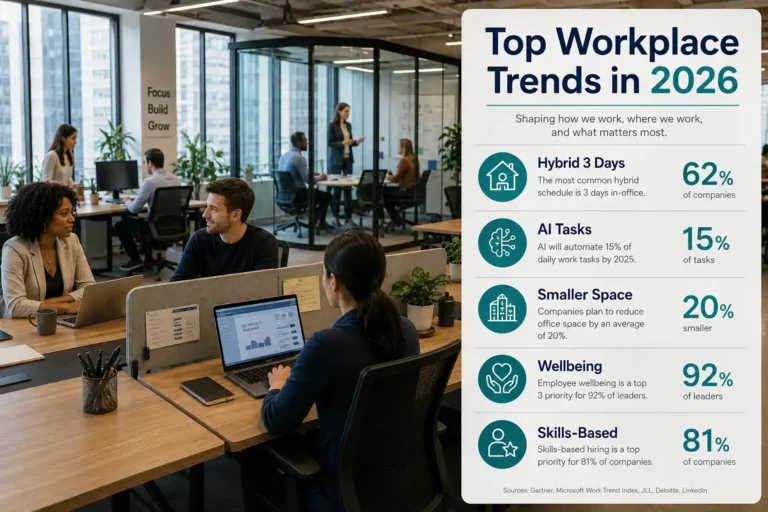
The office is not dead, but it looks nothing like 2019. Office Workplace Trends in 2026 point to one clear reality: hybrid won the argument, and the numbers back it up. Here is what is actually happening, based on the latest data.
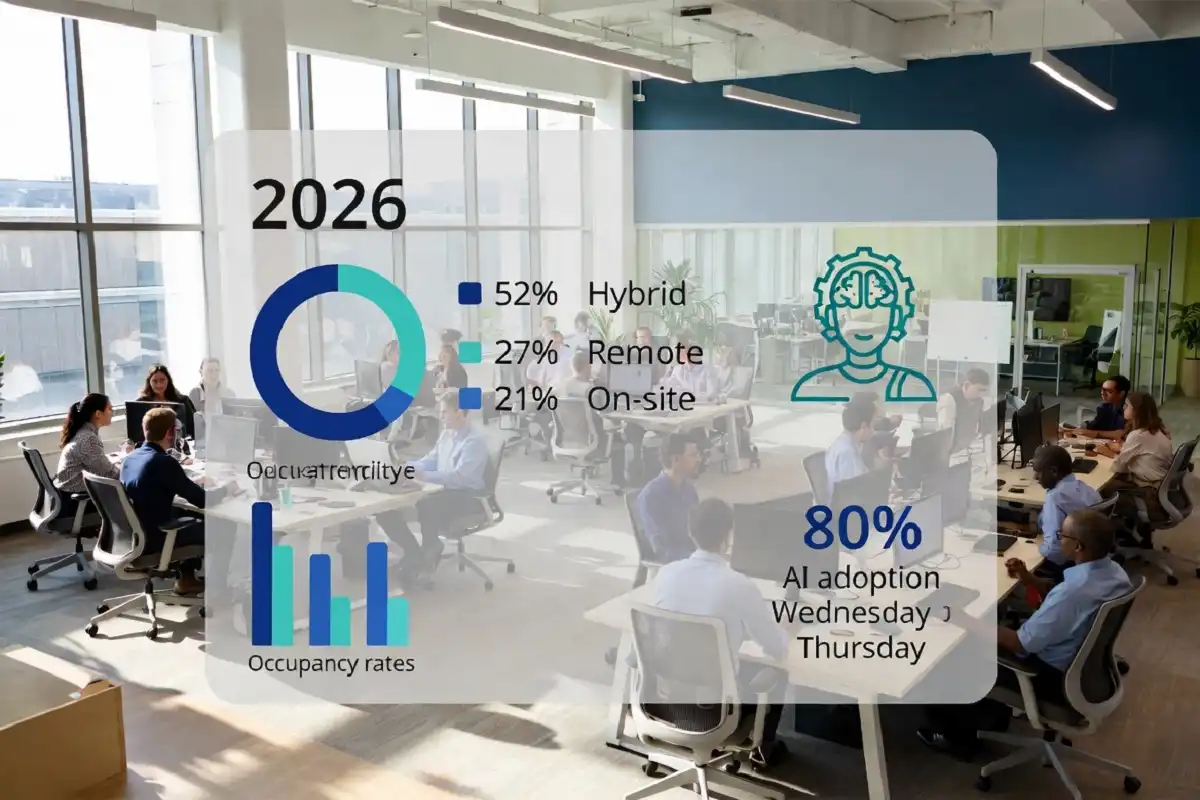
Hybrid work is the 2026 standard. Gallup data shows 52% of remote-capable workers in hybrid roles, 27% fully remote, and 21% fully on-site as of early 2026. Five-day mandates grab headlines, but most companies keep flexibility. The leading Office Workplace Trends now put employee experience ahead of attendance rules for retention.
Where Does the Office Stand in 2026?
The office is a destination for collaboration, not a daily requirement. Government data settles the debate. The U.S. Bureau of Labor Statistics puts the telework rate at 23.7% of employed adults in early 2025, up from 17.9% in October 2022. That trend has held steady for over a year.
I’ve been tracking this since the first wave of return-to-office orders, and the pattern is consistent. The loud mandates come from a small group of very large employers. Only 12% of executives with hybrid or remote staff plan a full return-to-office mandate over the next year, per Stanford and Atlanta Fed research. Most leaders are choosing balance.
Office attendance itself tells the story. Kastle Systems data shows average office occupancy across U.S. markets has plateaued at roughly 50% of pre-pandemic levels. Offices fill up Tuesday through Thursday and empty out around the edges.
Which Office Workplace Trends Matter Most This Year?
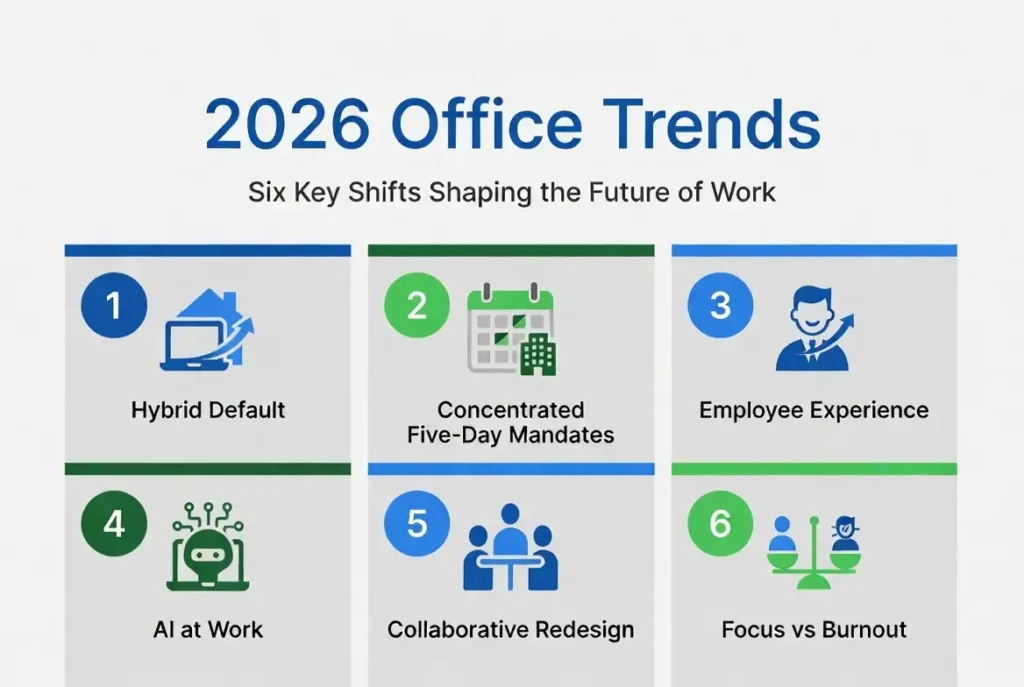
Six shifts define Office Workplace Trends in 2026. Each one is backed by fresh data, not opinion.
1. Hybrid Became the Permanent Default
Hybrid is no longer an experiment. It is the operating model. By the end of 2025, 27% of companies required fully in-person work, 67% operated under hybrid models, and 6% remained fully remote. The center of gravity has moved. For many large employers, the standard shifted from two or three office days to four.
Job postings confirm the direction. Across roles analyzed in Q1 2026, 77% of new job postings are fully on-site, compared to 19% hybrid and 4% fully remote. On-site postings dominate raw volume, yet hybrid remains the option workers want most.
2. Five-Day Mandates Are Real but Concentrated
Full return-to-office orders are rising in specific sectors. As of April 2026, companies requiring five-day in-office attendance include Amazon, JPMorgan Chase, Goldman Sachs, Morgan Stanley, AT&T, Dell, Walmart, and Paramount Skydance, according to HybridHero’s 2026 RTO tracker. Amazon’s mandate covers roughly 350,000 corporate staff.
Enforcement is harder than it looks. Amazon later signed a coworking lease with WeWork to cover a shortfall in desks and parking, per Fortune’s reporting. The math of fitting everyone back in the same building trips up even the biggest firms. This mirrors the leadership pressure I’ve covered around how AI is reshaping executive hiring priorities, where control and culture arguments keep colliding with practical limits.
3. Employee Experience Now Drives Retention
The office door swings both ways on turnover. SurveyMonkey’s 2026 workforce research found that 29% of remote and hybrid employees would consider quitting if forced back into the office full-time. Rigid rules carry a cost.
What people find inside the office matters more than the mandate. Twenty-eight percent of hybrid employees still feel disconnected from culture, even after returning. Flexibility protects retention. 76% of companies experience greater employee retention by allowing remote work. Among all Office Workplace Trends, this one carries the sharpest financial stakes.
4. AI Moved Into Daily Office Work
AI is now part of the standard workday. AI adoption reached 80% and it’s accelerating work rather than reducing it, according to ActivTrak’s 2026 State of the Workplace report. Frontline use jumped fast. 74% of frontline workers now say they use AI every day or a few times a week, up 23 percentage points from 2025, per BCG.
The gains are real but uneven. Gallup’s February 2026 survey of 23,717 U.S. employees found only about one in 10 employees at AI-adopting organizations strongly agree AI has transformed how work gets done. The tools help individual tasks. Most companies have not redesigned workflows around them yet. This gap connects directly to how AI skills are becoming the fastest route to career growth for workers who learn to use them well.
5. Offices Are Being Redesigned for Collaboration
Companies are shrinking footprints and rethinking layouts. Desk-sharing surged from 12% to 36% in new workplace design projects, driven by shrinking office footprints and hybrid needs, per CBRE Global Workplace data. The purpose of the office is changing.
Fixed desks are giving way to purpose-built spaces. In 2026, offices focus on meetings and spaces built for creativity, workshops, and hands-on problem solving, such as ideation studios and prototyping areas. The office becomes the place for work that benefits from being in person.
6. Focus and Burnout Pull in Opposite Directions
Productivity is up, but focus is slipping. The average workday shrank from 8 hours 53 minutes in 2023 to 8 hours 44 minutes in 2025, while productive hours rose 5% to 6 hours 36 minutes daily. Focus efficiency fell to 60%, a three-year low.
Interruptions are the culprit. Workers experienced up to 275 interruptions per day, per Microsoft’s Work Trends Index. Managers feel the squeeze too. Manager engagement has fallen to its lowest point in four years, affecting productivity, retention, and AI adoption at once.
Which Industries Offer the Most Flexibility?
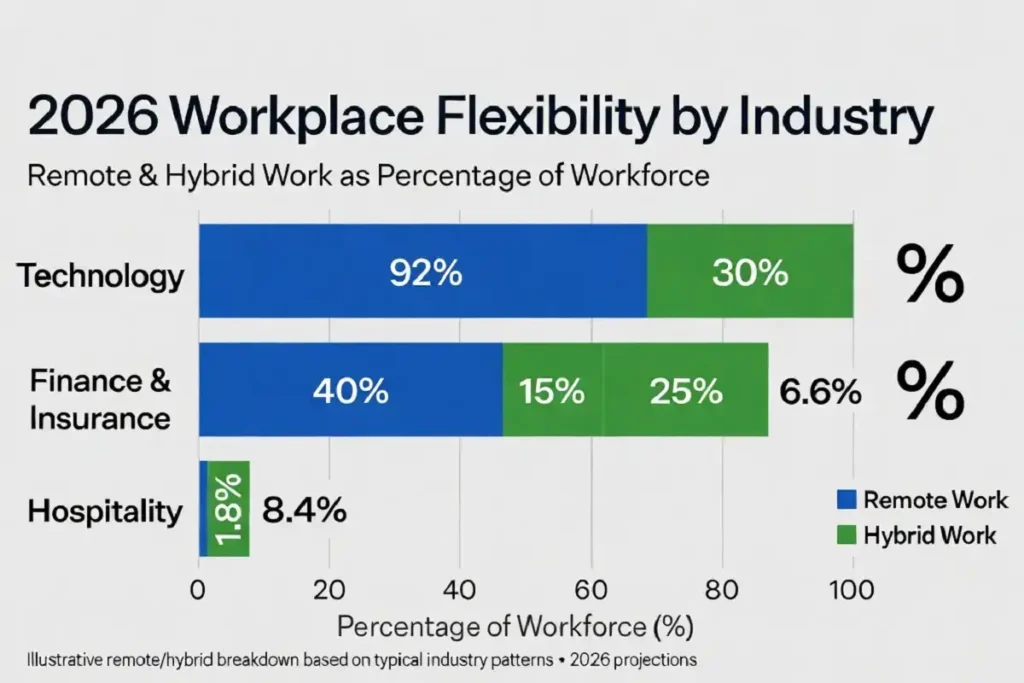
Technology leads by a wide margin. Technology leads with 92% of workers remote or hybrid, split between 47% fully remote and 45% hybrid, per BLS Q1 2026 data. Finance and insurance follow at around 40%.
Some sectors stay firmly on-site. Hospitality and leisure has the lowest telework rate at 8.4%. Healthcare and administrative roles also remain almost entirely in person. The type of work still decides the location, and it shapes how Office Workplace Trends play out sector by sector.
How Many Days Are Workers Actually in the Office?
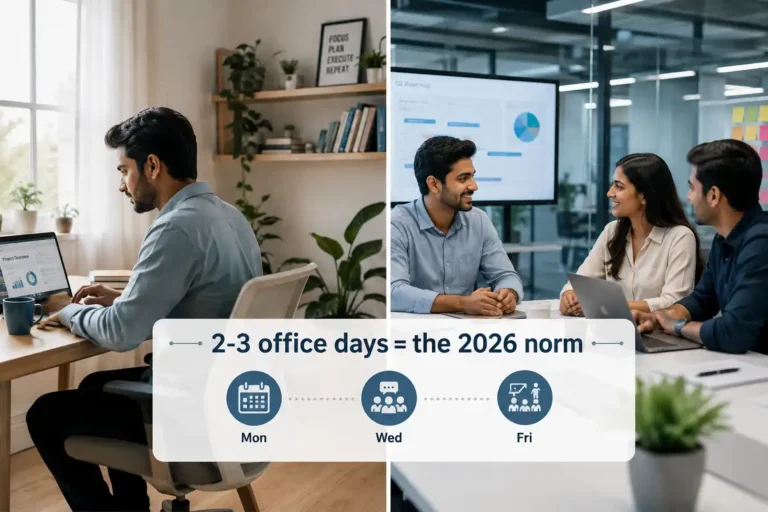
Three days per week is the most common requirement. Three days per week is the most common in-office requirement in 2026, per a WTW survey, with over 50% of companies letting employees choose which days they attend. Actual behavior tracks close to expectations. Employers expect 3.2 office days a week, while employees average 2.9.
Mandates and reality do not always match. Required office time increased by 12% between 2024 and 2025, while actual attendance rose only 1% to 3%. Monitoring is rising. 69% of U.S. employers now track office attendance, up from 45% the prior year.
What Do Employees Want in 2026?
Employees want choice, and they are willing to act on it. Hybrid continues to reign among job seekers, with 55% ranking it as their top choice. Fully in-office work is the least popular option. Just 16% of professionals said their top choice is an in-office job.
Flexibility shapes career moves. 64% of U.S. employees would prefer remote or hybrid roles over working from the office every day. This preference feeds directly into the broader shifts I’ve reported on in how skills-based hiring is changing the way people advance, where flexibility and skill relevance now weigh as heavily as pay.
How Should Leaders Respond to These Office Workplace Trends?
Leaders should design work around outcomes, not attendance. The data is clear that flexibility protects retention while rigid mandates raise turnover risk. Set a purpose for office days, invest in AI training rather than tools alone, and measure focus and manager engagement. Companies that treat Office Workplace Trends as a design problem, not a compliance problem, hold onto talent.
What This Means Going Forward
Office Workplace Trends in 2026 settle one question and open another. Hybrid is permanent. A KPMG study found only 34% of CEOs expect a full return to the office within the next three years. The real contest is no longer location. It is whether companies design work, tools, and culture around how people actually perform. Watch three numbers next: office occupancy rates, AI workflow redesign, and manager engagement. Those will tell you where the office heads from here.