AI Productivity Impact in 2026: What the Real Data Shows
Every executive wants to know one thing right now. Is AI actually making workers more productive, or just adding noise? The honest answer sits between the hype and the doubt. Here is what the 2026 data reveals.
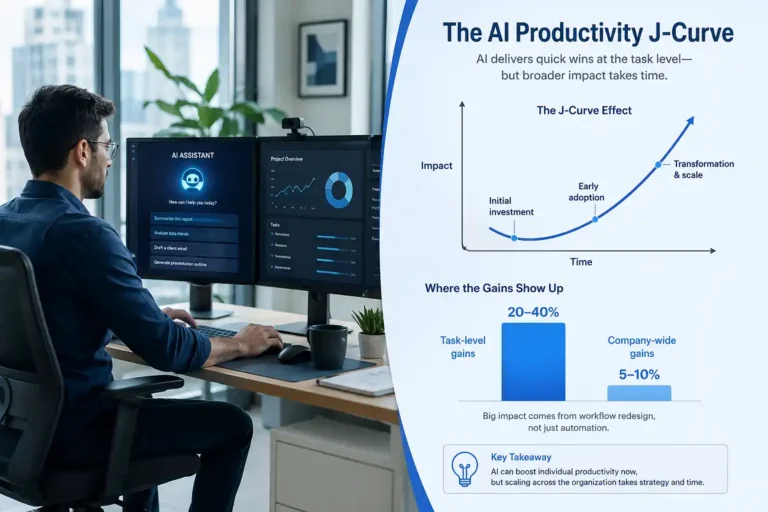
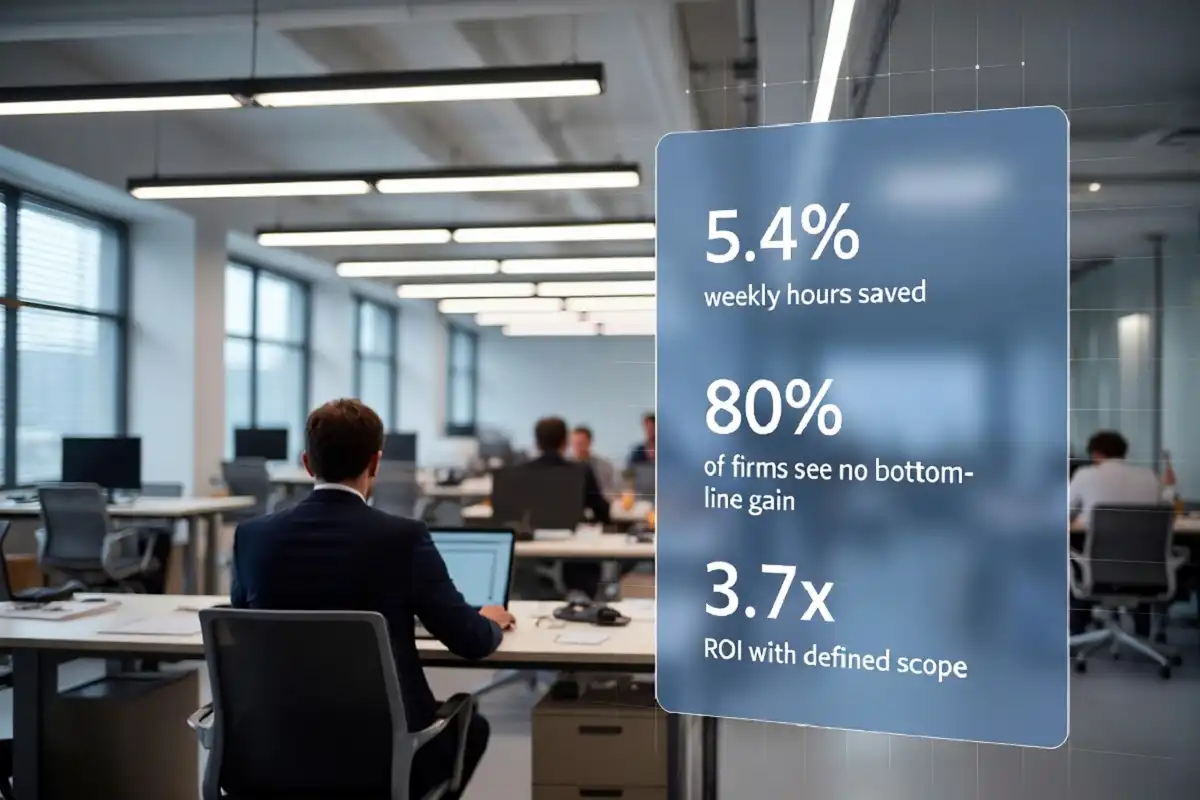
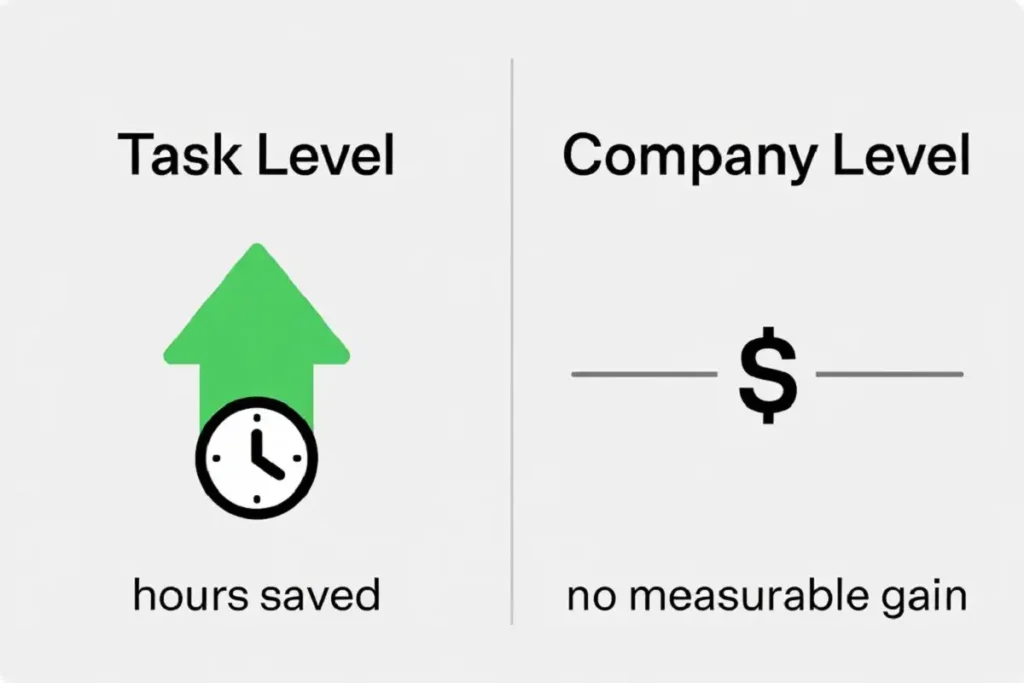
The AI productivity impact is real at the task level but hard to see on the bottom line. Workers save an average of 5.4% of their work hours weekly, yet most firms report no measurable financial gain. The gap is organizational, not technological.
How Big Is the AI Productivity Impact Right Now?
At the individual task level, the gains are clear. Most HR professionals said they feel AI tools have a high (28%) or medium (46%) impact on their work productivity. A separate SHRM survey of nearly 5,900 US workers backs this up. Just over two-thirds of workers (68%) reported improved work efficiency, while 63% reported improved quality in their work.
The time savings are measurable too. Workers using AI recover about 2.2 hours per week. That figure jumps for people using more advanced tools. Knowledge workers using production AI agents recover a median 6.4 hours per week per seat. Senior practitioners save 10-12 hours. Customer service representatives save 8-9 hours weekly.
I’ve been tracking these numbers since early 2026. The pattern is consistent. When you measure a single worker doing a single task, AI helps.
Why Don’t Companies See the Gains on Their Books?
Because task-level speed does not automatically become company-level profit. This is the core finding of 2026, and it has a name.
A February 2026 NBER study found that 80% of companies actively using AI report no productivity impact at all. Another large survey of executives told a similar story. A landmark NBER study of 6,000 CEOs, CFOs, and senior executives found 89-95% of firms saw no measurable impact on productivity or employment over the prior three years.
McKinsey calls this the performance paradox. Its report argues that most current AI applications are “tools that accelerate existing work” but “largely preserve underlying workflows,” and that the larger productivity gains will only emerge once organisations redesign processes around AI rather than simply bolting it on top.
That distinction matters. Bolting AI onto a broken process just makes the broken process faster.
What Is “Workslop” and Why Does It Cost So Much?
Workslop is AI-generated content that looks polished but lacks real substance, forcing someone else to fix it. It is a hidden tax on the AI productivity impact.
Stanford and BetterUp researchers identified that 40% of workers have received AI-generated content that was unhelpful, low-effort, or low-quality in the past month. The cost adds up fast. The financial impact? $186 per month per employee in lost productivity. For a 10,000-person organization, that’s over $9 million in wasted time annually.
It damages trust between coworkers too. When a colleague sends sloppy AI output, people quietly downgrade their opinion of that person’s work.
Where the AI Productivity Impact Is Strongest

The gains cluster in a few functions. McKinsey analyzed 63 use cases and found the value concentrates sharply. About 75 percent of the value that generative AI use cases could deliver falls across four areas: Customer operations, marketing and sales, software engineering, and R&D.
Here is how the AI productivity impact breaks down by function, based on documented 2026 deployments.
| Function | Documented Gain | Source |
|---|---|---|
| Customer support | 30-45% reduction in average handle time | McKinsey 2026 |
| Software engineering | 25-40% faster task completion | McKinsey 2026 |
| Legal work | 4-6 hours saved per attorney weekly | AI Industry Guide, April 2026 |
| Customer service resolution | 14% more issues resolved per hour | McKinsey case study |
Software teams see real speed on routine work. The productivity gain is highest for boilerplate generation and test writing, not for architectural decisions or novel problem-solving.
The Software Development Warning
There is one important caveat for engineering leaders. Faster does not always mean faster.
A 2025 METR study produced a surprising result. 19% more time was required for experienced developers to complete coding tasks when using AI tools, despite their belief that they were 20% faster.
Read that twice. The developers felt quicker. The stopwatch said otherwise. This is why measuring real output beats trusting perception. The way AI adoption is reshaping technical work depends heavily on how you track results, not how the work feels.
Which Workers Gain the Most?
Skilled workers who use AI as a tool tend to pull ahead. McKinsey estimates 20-25% productivity gains for these workers, data scientists, strategic consultants, senior engineers, who can leverage AI as a sophisticated tool while maintaining their expertise advantage.
This shift is already showing up in hiring. Employers increasingly reward people who can direct AI well, which is part of why AI skills now sit near the top of the fastest ways to grow a career in 2026. Building these capabilities has become one of the clearest paths to staying competitive.
Why Adoption Looks High but Real Usage Is Low
Companies say they use AI. Most workers barely touch it. That gap explains a lot of the missing AI productivity impact.
Only 21% of workers use AI daily despite 91% of organizations claiming to use it. 56% of workers received no AI training. Confidence is slipping too. ManpowerGroup’s 2026 Global Talent Barometer reveals regular AI usage jumped 13% to reach 45% of workers, while confidence in using technology fell sharply by 18%.
Training is the missing piece. You cannot expect a productivity return from a tool nobody was taught to use.
How to Turn AI Speed Into Real Results
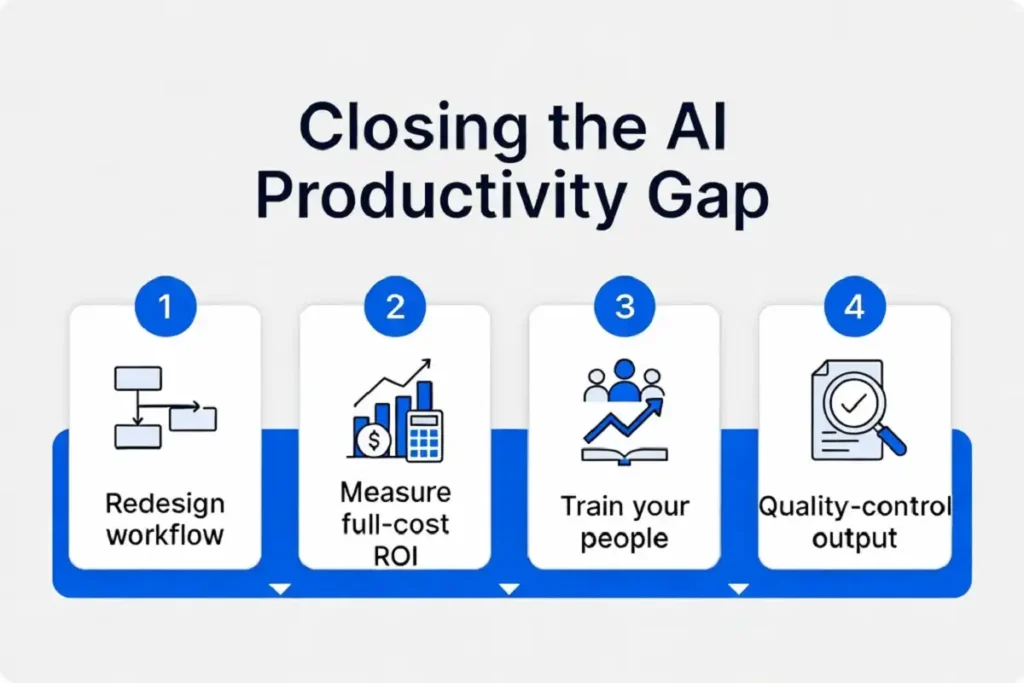
Focus on four moves. Each one closes the gap between task savings and business results.
First, redesign the workflow, do not just add AI on top. The McKinsey data is clear that bolted-on tools preserve old bottlenecks.
Second, measure ROI with the full cost stack. Only 20% of organizations measure AI ROI at all. McKinsey’s 2026 State of AI data shows a median 3.7x return on GenAI investment for organizations that deploy with a defined scope and measurable baseline. Scope and measurement drive the return.
Third, train your people. More than half of workers got no training. Fix that first.
Fourth, quality-control the output. Catch workslop before it spreads and costs you real money. Broader shifts in how teams measure output tie directly into wider workplace productivity trends emerging this year.
What the Long-Term Numbers Suggest
The ceiling is high, but distant. McKinsey research shows generative AI could add a potential $4.4 trillion annual productivity boost, about 4% of global GDP. Goldman Sachs Research estimates that generative AI will raise labor productivity by around 15% when fully adopted across developed markets.
Those are ceilings, not today’s reality. Only 1% of organizations consider themselves “mature” in AI deployment. The agentic AI shift is the near-term driver to watch. 86% of organizations say their AI budget will increase in 2026.
What to Watch Next
The AI productivity impact is genuine, but it rewards organizations that do the hard work of redesign, training, and measurement. Task-level speed is easy. Turning it into profit is not. Through 2027, watch whether agentic AI moving from pilot to production finally closes the gap between tool adoption and real financial gains. The firms that measure honestly will separate from those still chasing the hype.