AI Trade Signals in 2026: What Works, What’s Hype, and How to Vet Them
AI trade signals now sit behind a growing share of the buy and sell decisions retail traders make. The tools got cheap, the marketing got loud, and the scams got smarter. Here is what these signals actually deliver in 2026, what they cost, and how to separate real systems from fraud.
AI trade signals are machine-generated buy, sell, or hold alerts built from pattern recognition across price, volume, and news data. They work as decision support, not guaranteed forecasts. Accuracy claims above 75% almost always come from backtests, not live trading.
What Are AI Trade Signals?
AI trade signals are automated alerts that tell a trader when a model has detected a setup worth acting on. A signal typically includes an asset, a direction, an entry zone, and sometimes a stop and target. The model behind it scans price action, volume, order flow, news sentiment, or all four at once.
The category is broad. It covers simple indicator scripts on charting platforms, subscription alert services, and full institutional systems. TradingView alone now hosts more than 150,000 Pine Script publications, and a large share of the newer ones carry AI-driven labels. That flood is exactly why vetting matters. A logistic regression repackaged with an “AI” badge is not the same thing as an adaptive machine learning system, and regulators now call that repackaging “AI-washing,” where traditional analytics get rebranded as AI despite lacking real adaptive learning.
The money behind the category is real, though. The AI in trading market reached $27.85 billion in 2026, with projections of $45.74 billion by 2030 at a 13.2% compound annual growth rate, per Lune Finance’s May 2026 industry roundup. On the institutional side, nearly 85% of firms plan to increase AI use in corporate bond trading over the next year, up sharply from 57% in 2024, according to The TRADE’s 2026 predictions series.
How Do AI Trade Signals Actually Work?
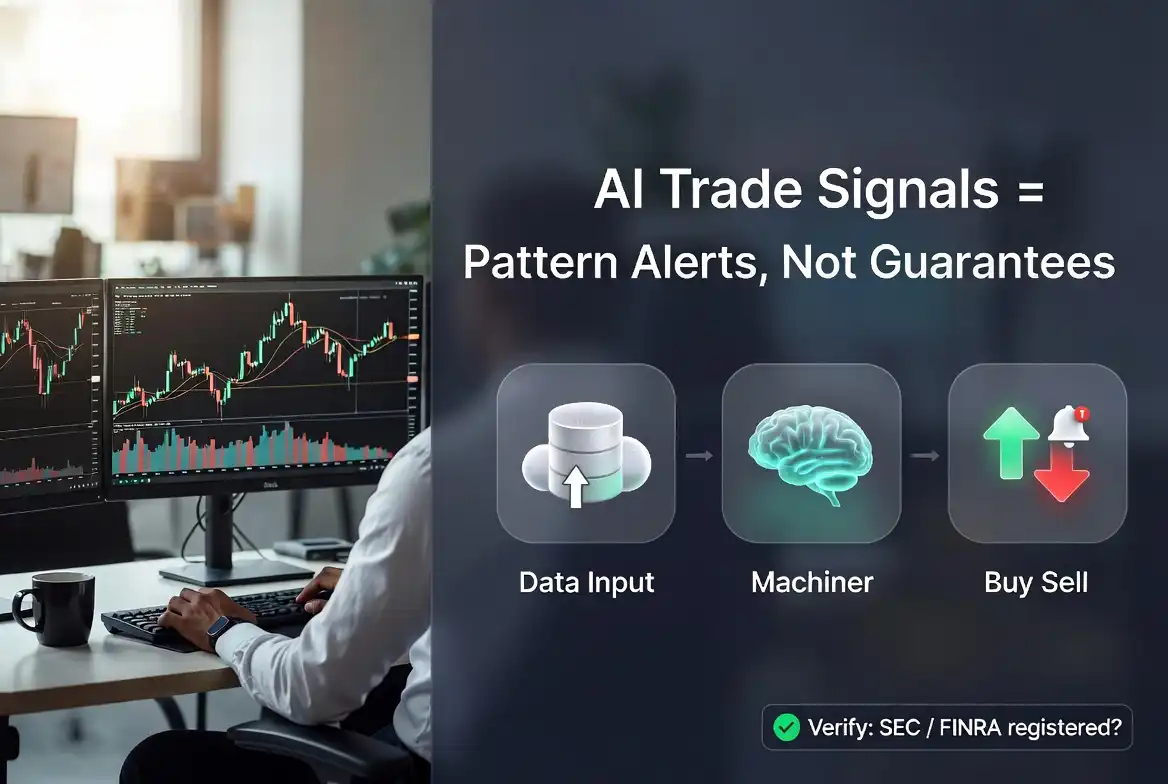
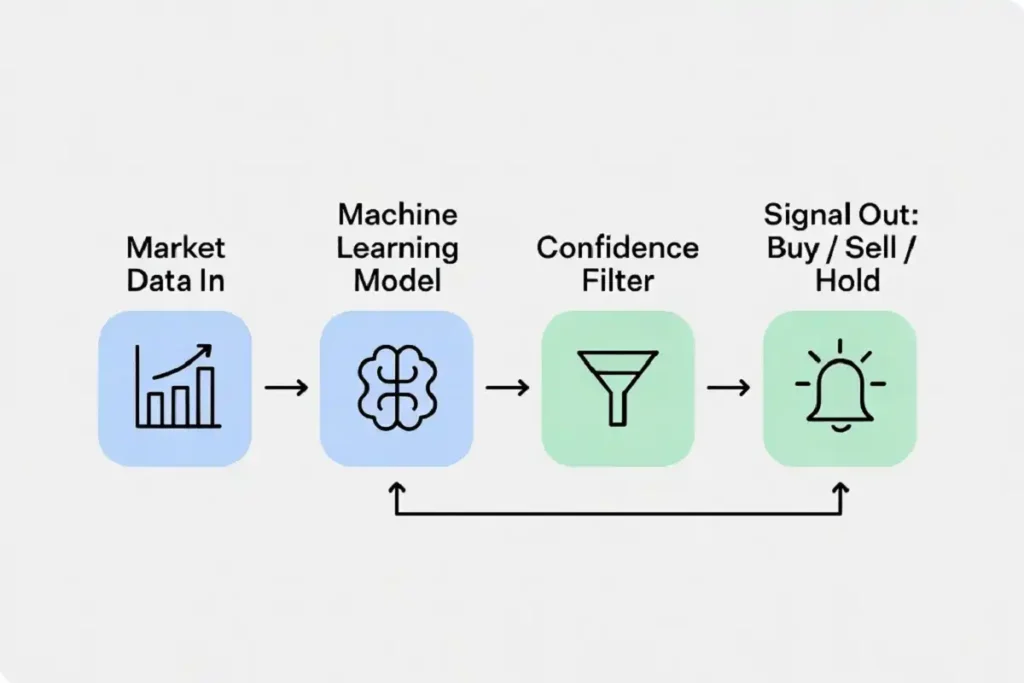
AI trade signals come from models that learn statistical patterns in historical market data, then flag those patterns when they reappear in live prices. The pipeline runs in four steps. First, the system ingests data: ticks, candles, order books, filings, headlines. Second, a model (often gradient boosting, a neural network, or reinforcement learning) scores the current setup against patterns it learned. Third, a filtering layer removes low-confidence outputs. Fourth, the signal reaches you as an alert or, in automated setups, as an order.
The 2026 technical shift worth knowing: speed. High-frequency systems are moving from transformer architectures to State Space Models like Mamba, which process long market data sequences with linear rather than quadratic computational cost. That matters even for retail traders. It means institutional models react to the same data you see, faster than you can. Algorithms already handle an estimated 60 to 70% of US stock trades, so a retail signal is usually late to whatever the machines already priced in.
Sentiment is the other engine. Natural language processing models scan earnings calls, Fed statements, and social feeds, then convert tone into a tradable score. In practice, these signals work best around scheduled events. For example, macro regime shifts like the stagflation risk that resurfaced after the Fed’s May minutes are exactly the kind of catalyst that sentiment models flag before lagging technical indicators catch up.
How Accurate Are AI Trade Signals in 2026?
AI trade signals are accurate enough to be useful and unreliable enough to require risk controls. That is the honest answer. Most published accuracy numbers come from backtests. TradeSmith, for example, reported in April 2026 that its machine learning system processed over 1 trillion data points, surfaced 200-plus signals, and produced a 54% compounded annual return in a backtest running from January 2020 through January 2026. Impressive, but backtested. Live results always run lower.
Three things degrade live accuracy. Overfitting is the biggest: a model memorizes historical quirks that never repeat. Slippage is second, since fast markets fill you worse than the model assumed. Regime change is third. A model trained on the 2023 to 2025 bull run struggles when conditions flip, and 2026 has already delivered both extremes. Crypto signal services looked brilliant during bitcoin’s ETF-fueled run to $120K in May, then many of the same services whipsawed subscribers during the pullback weeks later.
So judge any accuracy claim against a benchmark, not in isolation. A signal service that returned 12% while the S&P 500 hit a record close in June on the Nvidia rally added nothing over an index fund. Demand three numbers from any provider: win rate, maximum drawdown, and performance versus the S&P 500 over the same live period. The Bank for International Settlements makes the institutional version of this point: AI improves efficiency but carries risks, and it requires transparency and human oversight.
Free vs. Paid Signal Services: What You Actually Get
Free signals come with a hidden business model. That is the rule, and it rarely breaks. Free Telegram and Discord signal rooms usually monetize through broker referral kickbacks, paid tier upsells, or worse. Regulators warn that the signal group itself is often the sales funnel, moving members from free picks to paid tiers, recommended brokers, bot subscriptions, or outright token promotions.
Paid services run from roughly $20 to $300 per month for retail tools, and far more for institutional data feeds. Price does not equal quality. What separates legitimate paid AI trade signals from junk is documentation: a published methodology, live (not backtested) track records, drawdown history, and clear disclosure that past results do not guarantee future performance. Legitimate providers publish losing trades. Fraudulent ones never do.
Evaluate total cost, too. Add subscription fees, data fees, commissions, and slippage. A signal service needs to beat the market by more than its all-in cost. Most do not clear that bar.
The Scam Problem: What the SEC and FINRA Are Seeing
Signal fraud is the fastest-growing corner of this market, and regulators have said so directly. The SEC, NASAA, and FINRA issued a joint investor alert flagging the rise of investment frauds built on purported AI, including unregistered platforms making claims like “Our proprietary AI trading system can’t lose”. The CFTC added its own warning that AI bots promising guaranteed profits are frequently fraudulent, because AI cannot predict market movements with certainty.
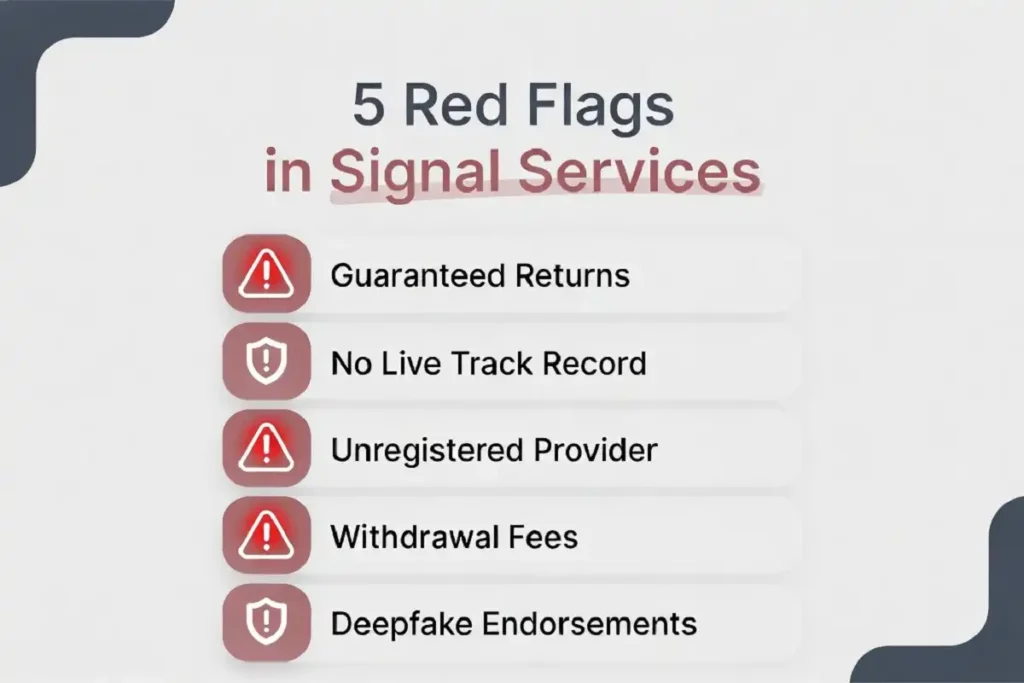
The enforcement record backs this up. In December 2025, the SEC charged a network of fake crypto platforms and “AI investment clubs” that recruited victims through social media ads and WhatsApp groups, promoted AI-generated investment tips to build trust, and misappropriated at least $14 million from US retail investors. No real trading ever occurred. The pattern I keep seeing in these cases is identical: fake dashboards showing fake profits, then blocked withdrawals, then demands for “fees” to release funds.
FINRA has formalized the concern. Its 2026 Annual Regulatory Oversight Report is the first to devote a dedicated section to AI risks, including scammers using AI-generated images and videos of real people. Deepfake endorsements are now standard scam infrastructure. A short clip of a famous investor “recommending” a signal app costs the fraudster almost nothing to produce.
How to Vet a Signal Provider in 5 Steps
Run every provider through this checklist before paying or connecting an account. It takes under an hour.
- Verify registration first. Check FINRA BrokerCheck for brokers, the SEC’s Investment Adviser Public Disclosure database for advisers, and NFA BASIC for futures and forex activity. Unregistered means unprotected. Stop there if the check fails.
- Demand a live track record. Backtests do not count. Ask for at least 12 months of live, timestamped signals with wins and losses shown. Marketing screenshots prove nothing.
- Stress-test the accuracy math. Ask for maximum drawdown and performance versus the S&P 500 over the identical period. Refusal is your answer.
- Protect your credentials. FINRA specifically warns against handing brokerage usernames and passwords to unregistered auto-trading services, which creates serious financial and privacy risk. Use read-only API keys or manual execution instead.
- Test withdrawals early and small. If the provider holds your money on its own platform, withdraw a small amount in week one. Friction at withdrawal is the single most reliable fraud signal.
What the Rules Say in 2026
Regulation is tightening on both sides of the Atlantic. The EU AI Act classifies trading AI as high-risk and demands explainability, which pushes providers toward transparent models with audit trails. In the US, FINRA holds that its rules are technology neutral. Securities laws apply to firms using generative AI exactly as they apply to any other tool, including third-party AI embedded in existing products.
For you as a trader, the practical read is simple. A US provider selling personalized trade recommendations generally needs registration. AI trade signals sold as generic “education” occupy a gray zone that fraudsters exploit deliberately. When a provider hides behind the education label while pushing specific entries with position sizes, treat it as a red flag, not a technicality.
Should You Use AI Signals in Your Own Trading?
Use them as one input, never as the decision. That is the framework professionals apply, and it fits retail traders even better. AI trade signals do three things well: they scan more assets than you can watch, they remove emotion from setup identification, and they enforce consistency. They do three things badly: they miss regime changes, they inherit their training data’s blind spots, and they create false confidence.
A workable retail process looks like this. Let the signal surface the idea. Then you confirm the setup on your own chart, check the economic calendar for event risk, size the position at 1 to 2% account risk, and set the stop before entry. If the signal conflicts with your risk rules, the risk rules win. Every time.
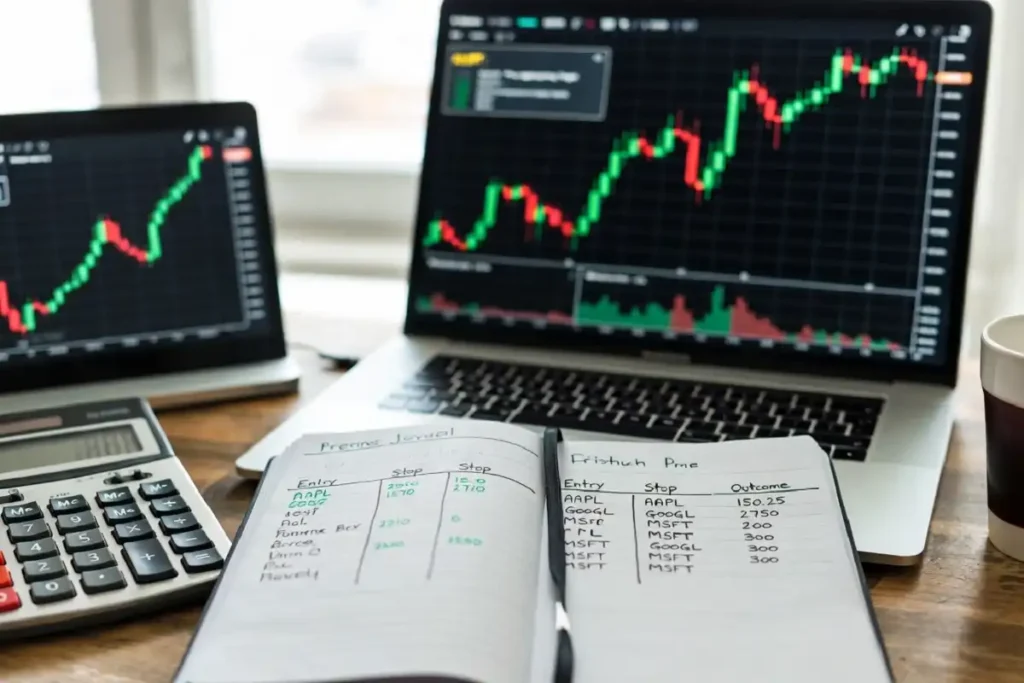
Paper trade any new signal source for 60 to 90 days before committing capital. Track its calls in a journal against actual market outcomes. Most services fail this test, and finding that out for free is the whole point.
The Numbers to Watch Next
Two forces will define this market through the rest of 2026. Institutional adoption keeps climbing, which compresses the edge available to retail signal followers. Meanwhile, enforcement is accelerating, and the SEC’s Cyber and Emerging Technologies Unit has made AI-branded fraud a stated priority. Treat AI trade signals as a research accelerant with a verification burden attached. The traders who profit from them in 2026 are the ones who check registration, demand live data, and keep the final decision human.