
AI Adoption in the Workplace: What 2026 Data Shows
AI adoption in the workplace is no longer a future conversation. It is happening right now, and the numbers tell a story that is more complicated than most headlines suggest.
About 91% of businesses say they use AI tools in at least one capacity in 2026. But here is the catch. Only 21% of workers actually use AI at work on a regular basis, which means the gap between corporate claims and daily reality is massive.
So what is really going on with AI adoption in the workplace, and why does it matter for you and your organization right now?
The Current State of AI Adoption in the Workplace
Over 75% of organizations report using AI in at least one business function, and generative AI adoption has more than doubled year-over-year since 2023. That sounds like serious progress, and it is.
But adoption at the organizational level and adoption at the employee level are two different things. U.S. Census Bureau data from December 2025 through May 2026 shows that overall AI usage among businesses hovered between 17% and 20%. Larger firms lead the way, with 37% of firms with at least 250 employees reporting AI use in their business operations, compared to less than 20% of firms with four or fewer employees.
AI adoption in the workplace is not evenly distributed, and that gap matters.
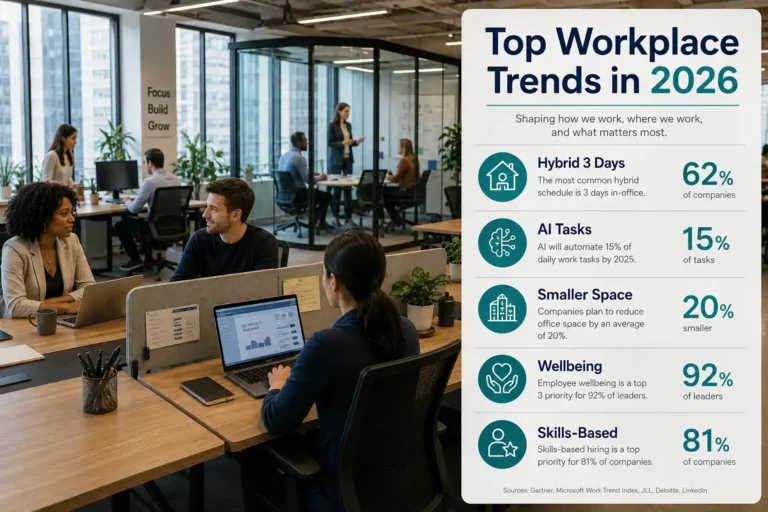
If you follow workplace trends in 2026, you already know the story is less about technology and more about people, processes, and leadership.
Productivity Gains Are Real, But Concentrated
Workers who actually use AI are seeing real benefits. Within organizations implementing AI, 65% of employees say artificial intelligence has improved their productivity and efficiency.
AI tools now save workers an average of 52 to 60 minutes daily across industries. That is meaningful time back in the day, especially for knowledge workers.
But here is where it gets interesting. AI super-users save nearly 9 hours per week, which is 4.5 times more than the 2 hours a week reported by AI laggards. The gap between those who embrace AI adoption in the workplace and those who do not is widening fast.
AI super-users were also 3 times more likely to have received both a promotion and a pay raise in the past year. That is not a small difference.

The Big Problem: Strategy Without Substance
One of the most striking findings in 2026 is how many organizations are faking it when it comes to AI strategy.
Three-quarters of executives admit their company’s AI strategy is more for show than actual internal guidance, and 48% describe adoption as a massive disappointment.
Despite 59% of companies investing over $1 million annually in AI technology, 79% of organizations face challenges in adopting AI, a double-digit increase from 2025.
That is a striking disconnect. Companies are spending more and getting less than expected. The reason, according to IBM, is that AI is more of a leadership challenge than a technology challenge. Organizations often have the tools. What they lack is the operational foundation to scale AI across their teams.
This is why the conversation around AI skills and career growth has become so important in 2026.
Workers Are Using AI Without Confidence
Here is a trend that deserves serious attention. Workers are using AI more, but they trust it less.
ManpowerGroup’s 2026 Global Talent Barometer found that while regular AI usage jumped among workers by 13% in 2025, confidence in the technology’s use dropped by 18%. Their VP of global insights put it plainly: workers are being handed tools without training, context, or support.
The confidence gap is most pronounced among older workers, with a 35% drop among baby boomers and a 25% drop among Gen X workers.
And the training situation is not good. While 77% of employers say they plan to reskill workers for AI, only 13% of employees have actually received any AI training.
Despite 82% of enterprise leaders saying their organization provides some form of AI training, 59% still report an AI skills gap.
For companies serious about AI adoption in the workplace, training is the missing link. Organizations with formal AI training programs achieve 2.3 times faster AI adoption and 67% higher AI ROI compared to those struggling with talent gaps.
The Two-Tiered Workplace Is Here
AI adoption in the workplace is creating a split inside organizations that leaders need to address.
92% of C-suite leaders are actively cultivating a new class of “AI elite” employees, and 60% plan to lay off those who cannot or will not adopt AI.
77% of executives warn that employees who refuse to become AI-proficient will not be considered for promotions or leadership roles.
That is a direct signal to anyone still sitting on the fence. AI adoption in the workplace is becoming a career requirement, not an optional skill.
You can see this dynamic playing out in hiring too. If you have been following how hiring managers are shifting their priorities, AI fluency is now one of the top factors in promotion and hiring decisions.

The Global Picture of AI Adoption in the Workplace
AI adoption in the workplace is not just a U.S. story. Microsoft’s global diffusion report shows that AI usage increased from 16.3% to 17.8% of the world’s working-age population in Q1 2026.
The UAE leads global workforce AI adoption at 64% of working-age adults using AI tools, with Singapore following at 60.9%. These numbers are well ahead of the U.S. and European averages.
According to Microsoft’s official report, Asia is seeing accelerating adoption driven by improved AI capabilities in local languages, with South Korea, Thailand, and Japan seeing the biggest movement.
Meanwhile, in HR specifically, 92% of CHROs anticipate AI will be further integrated into the workforce this year, with 87% forecasting greater adoption of AI within HR processes.
What Drives Successful AI Adoption in the Workplace
The organizations getting real results from AI adoption in the workplace share a few things in common.
They treat it as a people problem, not a tech problem. BCG’s research shows that 70% of AI success comes down to people, process, and change management, not algorithms or infrastructure.
They train employees on actual job tasks. Generic AI training does not move the needle. Digital training is 93.7% more effective than traditional methods when applied to real workflows.
They identify internal champions. Peer-to-peer learning and departmental AI champions make adoption stick far better than top-down mandates.
They measure actual output, not just access. Only 23% of enterprises can accurately measure AI ROI. Companies that build measurement systems early are better positioned to improve over time.
If you want more context on how leadership fits into this, the recent CEO confidence data for Q2 2026 gives a useful read on how nervous the C-suite is about getting this right.
What This Means for You
AI adoption in the workplace is not slowing down. 92% of companies plan to invest in generative AI over the next three years.
The workers and organizations that will come out ahead are not the ones with the best AI tools. They are the ones who figure out how to actually use them, train their teams properly, and build workflows that stick.
AI adoption in the workplace is a leadership challenge first, a culture challenge second, and a technology challenge last. The companies getting that order right are already pulling ahead.
For leaders, the variation in how employees experience AI highlights the importance of managing AI adoption challenges effectively. Long-term success may depend as much on how leaders guide adoption and redesign work processes as on the AI tools themselves.
If your organization is still in the pilot phase, the window to catch up is closing. AI adoption in the workplace is no longer something you plan for. It is something you need to be doing right now.