
ServiceNow AI Targets: What the Numbers Show for 2026
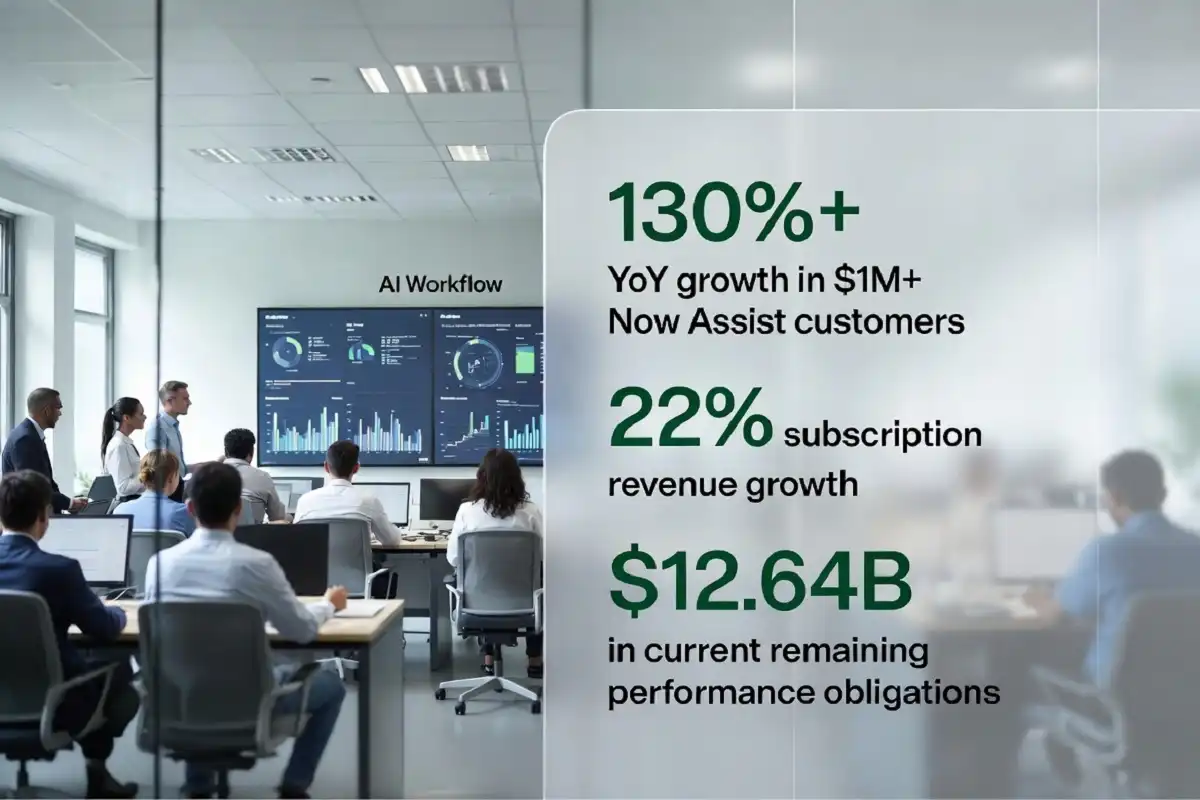
ServiceNow AI targets now anchor the company’s entire growth story. Q1 2026 results show Now Assist customers spending over $1 million in annual contract value grew more than 130% year-over-year. That pace sets the bar for every goal the company has set for the rest of 2026.
ServiceNow AI targets center on Now Assist adoption, agentic AI expansion, and subscription revenue growth of 22% to 22.5% for full-year 2026. The company beat guidance in Q1 2026, and AI-linked contract value drove the raised outlook.
Where ServiceNow AI Targets Stand After Q1 2026
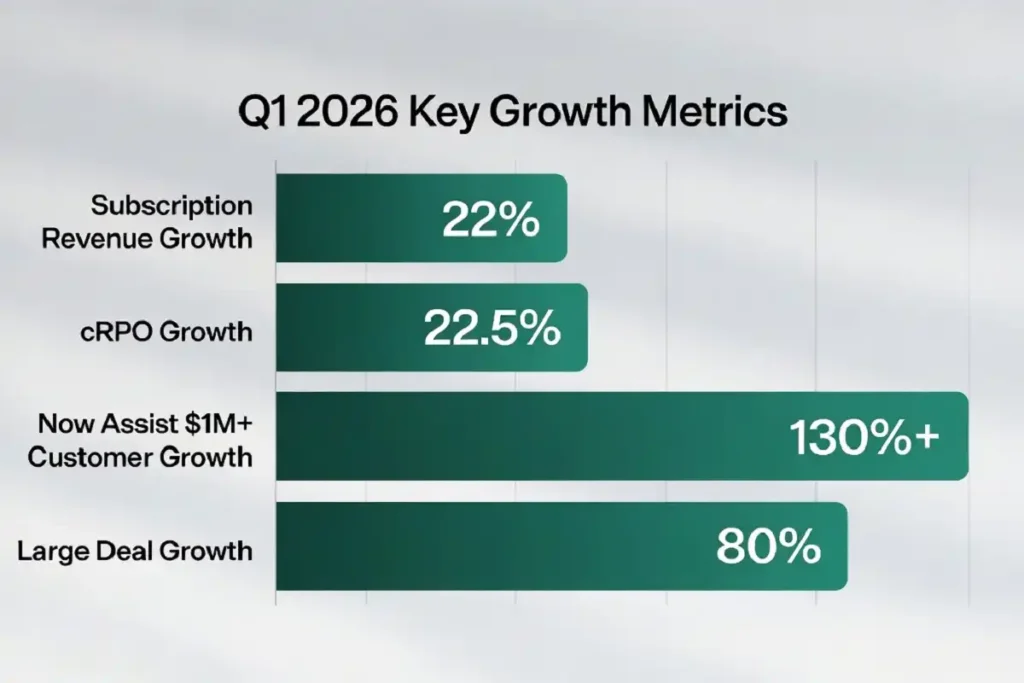
ServiceNow reported subscription revenues of $3,671 million in Q1 2026, up 22% year-over-year. That figure comes from the company’s April 22, 2026 earnings release. Total revenues reached $3,770 million for the quarter. Current remaining performance obligations, known as cRPO, hit $12.64 billion, up 22.5% year-over-year. These numbers beat the high end of ServiceNow’s own guidance. Management responded by raising the full-year subscription revenue outlook to $15,735 million to $15,775 million, representing 22% to 22.5% growth. Meeting ServiceNow AI targets this consistently is a major reason that outlook moved higher.
A more specific signal sits behind those topline numbers. Now Assist customers spending over $1 million in annual contract value grew more than 130% year-over-year in Q1 2026. That single metric is the clearest evidence that ServiceNow AI targets are translating into real spending, not just product announcements. CEO Bill McDermott said the company’s AI growth is “far exceeding even our own expectations.” The contract data backs that claim.
ServiceNow also closed the quarter with 630 customers carrying more than $5 million in annual contract value, a 22% year-over-year increase. Sixteen transactions exceeded $5 million in net new annual contract value during Q1 2026, up nearly 80% from the prior year. These large-deal patterns matter for one reason. AI-linked products, particularly Now Assist and the newer Autonomous Workforce line, are increasingly why enterprise buyers sign bigger contracts. That trend pushes ServiceNow AI targets higher each quarter.
What Are the Specific ServiceNow AI Targets for 2026?
The specific ServiceNow AI targets for 2026 combine subscription revenue growth, cRPO expansion, and continued scaling of Now Assist and agentic AI products. All of it spans across every commercial tier. For Q2 2026, the company guided subscription revenues of $3,815 million to $3,820 million, representing 22.5% year-over-year growth. Full-year 2026 cRPO growth guidance sits at 19% to 19.5% on a GAAP basis.
Two acquisitions factor into these numbers. ServiceNow closed its purchase of Armis Security on April 20, 2026. The deal was financed partly through a $4 billion term loan. ServiceNow also closed its acquisition of Veza on March 2, 2026. Armis is expected to add roughly 125 basis points of contribution to Q2 2026 and full-year subscription revenue growth. Management also flagged temporary margin headwinds tied to Armis integration costs, roughly 75 basis points to full-year operating margin. Every set of ServiceNow AI targets published this year now has to account for that acquisition math.
Geopolitical friction is part of the target-setting process too. ServiceNow disclosed an approximately 75 basis point headwind to Q1 2026 subscription revenue growth. The cause was delayed on-premise deal closings in the Middle East, linked to the ongoing regional conflict. The company built continued caution into its outlook for the rest of FY 2026. It did not assume the disruption clears quickly. That caution shows how ServiceNow AI targets get adjusted around real operating risk, not set in isolation.
How Is the Company Expanding Its AI Product Line to Hit These Targets?
ServiceNow is expanding its AI product line through new categories like Autonomous Workforce. It also redesigned its commercial model to bundle AI, data connectivity, and governance into every tier by default. In April 2026, the company introduced Context Engine. This is the organizational intelligence layer that grounds AI decisions in live enterprise context. It shows which approval chain applies to a given process, or which regulated asset a request touches. This kind of platform work makes ambitious ServiceNow AI targets achievable rather than aspirational.
Autonomous Workforce represents a push into a new AI category. These are specialists that execute enterprise jobs end-to-end, with governance and human oversight built in. The first out-of-the-box specialist is a Level 1 Service Desk AI Specialist. It autonomously diagnoses and resolves common IT support requests. This marks a meaningful shift from earlier Now Assist copilot functions. Instead of assisting a human worker through a task, this AI completes it. That shift is now central to how the company measures its own ServiceNow AI targets.
ServiceNow also announced EmployeeWorks, built using technology from its Moveworks acquisition. EmployeeWorks combines Moveworks’ AI-powered enterprise search with ServiceNow’s workflow automation. Together, they turn plain-language employee requests into completed actions across connected systems. This product sits at the center of how companies are approaching AI adoption in the workplace. The goal has shifted from simple chatbots to systems that finish tasks without repeated human handoffs.

Which Partnerships Support These Goals?
Google Cloud and NVIDIA are the two partnerships most directly tied to current ServiceNow AI targets. ServiceNow and Google Cloud unveiled AI solutions spanning 5G networks, retail operations, and IT operations in Q1 2026. Google Cloud also named ServiceNow its 2026 Partner of the Year for Global Business Applications and Agentic Innovation.
ServiceNow and NVIDIA advanced their partnership at NVIDIA GTC in March 2026. They announced that Autonomous Workforce can run on NVIDIA’s latest AI infrastructure. The two companies previewed an integration between NVIDIA Enterprise AI Factory and ServiceNow’s AI Control Tower. They also unveiled a joint benchmarking framework for voice and multimodal AI deployment. Separately, ServiceNow, NTT DOCOMO, and StarHub introduced an inter-carrier autonomous roaming resolution model. It uses ServiceNow CRM to detect and resolve faults across carrier boundaries in real time.
These partnerships matter for ServiceNow AI targets because enterprise AI adoption depends heavily on infrastructure and model access. A company setting ambitious internal goals needs partners that supply compute, cloud reach, and integration depth. ServiceNow connects to any model or cloud rather than building a closed AI stack. Management points to that openness when explaining why AI-linked contract value keeps growing faster than the overall subscription base.
Which Companies Are Already Hitting These Targets?
Several named customers already show measurable results tied to ServiceNow AI targets. These cases give the company proof points behind its published numbers. TridentCare deployed the ServiceNow AI Platform across 5.4 million annual patient visits. The company replaced manual coordination with autonomous processes, achieving 96% scheduling automation and a 57% reduction in patient wait times.
Bell, Canada’s largest telecommunications provider, reported a 25% improvement in customer response time after deploying ServiceNow AI Agents in Telecom. It also saw 90% positive feedback on AI accuracy. That product runs on ServiceNow’s Autonomous CRM. ServiceNow also debuted Healthcare Operations in Q1 2026. This solution embeds an operational system of record directly into electronic medical record systems. It connects care teams, facility staff, and IT support on one platform.

Industrial Connected Workforce, another Q1 2026 release, addresses a different problem. It replaces paper-based quality, warranty, and quoting processes in manufacturing with a single digital view. ServiceNow frames this as preserving institutional knowledge as experienced factory workers retire. That use case links ServiceNow AI targets to a labor and workforce trend playing out well beyond its own customer base. It echoes broader shifts in how AI is affecting workplace productivity.
Why Do These AI Targets Matter for Enterprise Buyers?
ServiceNow AI targets matter for enterprise buyers for a simple reason. They signal where the platform is investing engineering resources, and where pricing, integration depth, and support are likely to improve fastest. A buyer evaluating IT service management, security operations, or HR automation software benefits from knowing this. Now Assist and Autonomous Workforce sit at the center of the roadmap, not on its periphery.
Buyers should also weigh the acquisition-driven complexity behind these numbers. Armis, Veza, and Moveworks each bring separate technology stacks that ServiceNow is integrating into one platform. Termination-for-convenience provisions in some Armis customer contracts limit how much of that acquired value shows up in cRPO figures. ServiceNow disclosed this detail directly in its Q1 2026 filing rather than smoothing over it. That disclosure is useful for procurement teams modeling contract renewal risk against stated ServiceNow AI targets.
Internally, ServiceNow says AI efficiencies from its own “Now on Now” deployment should help normalize operating and free cash flow margins in FY 2027. Some near-term margin pressure from acquisition integration is expected first in 2026. For enterprise buyers, this points to a vendor betting its own internal operations on the same AI products it sells. That pattern is worth tracking as ServiceNow AI targets evolve through the rest of the year. It sits alongside the broader group of AI-related stocks investors are tracking this cycle.
What to Watch Next
The next major checkpoint is Q2 2026 earnings, expected in late July. That report will show whether Now Assist and Autonomous Workforce adoption keep outpacing the 130% year-over-year growth rate posted in Q1. Watch cRPO growth against the 19% to 19.5% full-year guidance band. Also watch how quickly Armis and Veza integration costs ease as 2026 progresses.
The bigger signal to track is whether large enterprise deals keep skewing toward AI-specific products rather than traditional workflow modules. The $5 million-plus ACV customer count and enterprise AI adoption are both climbing right now. If they keep climbing together, ServiceNow’s current growth targets will likely prove conservative rather than aggressive.