Mobile App Age Verification: The Complete 2026 Guide
Downloading an app used to take one tap. In 2026, that changed. Mobile app age verification is now a legal requirement in several US states, and it affects almost every app, not just ones built for kids.
Mobile app age verification means app stores must confirm a user’s age category and get parental consent for minors before certain downloads. As of 2026, Texas enforces this by law. Apple and Google supply the tools. Developers must act on the signals.
What Is Mobile App Age Verification?
Mobile app age verification is the process of confirming how old an app user is before they download an app or make a purchase. The app store checks age at account creation. It then sorts users into age categories and shares that status with developers.
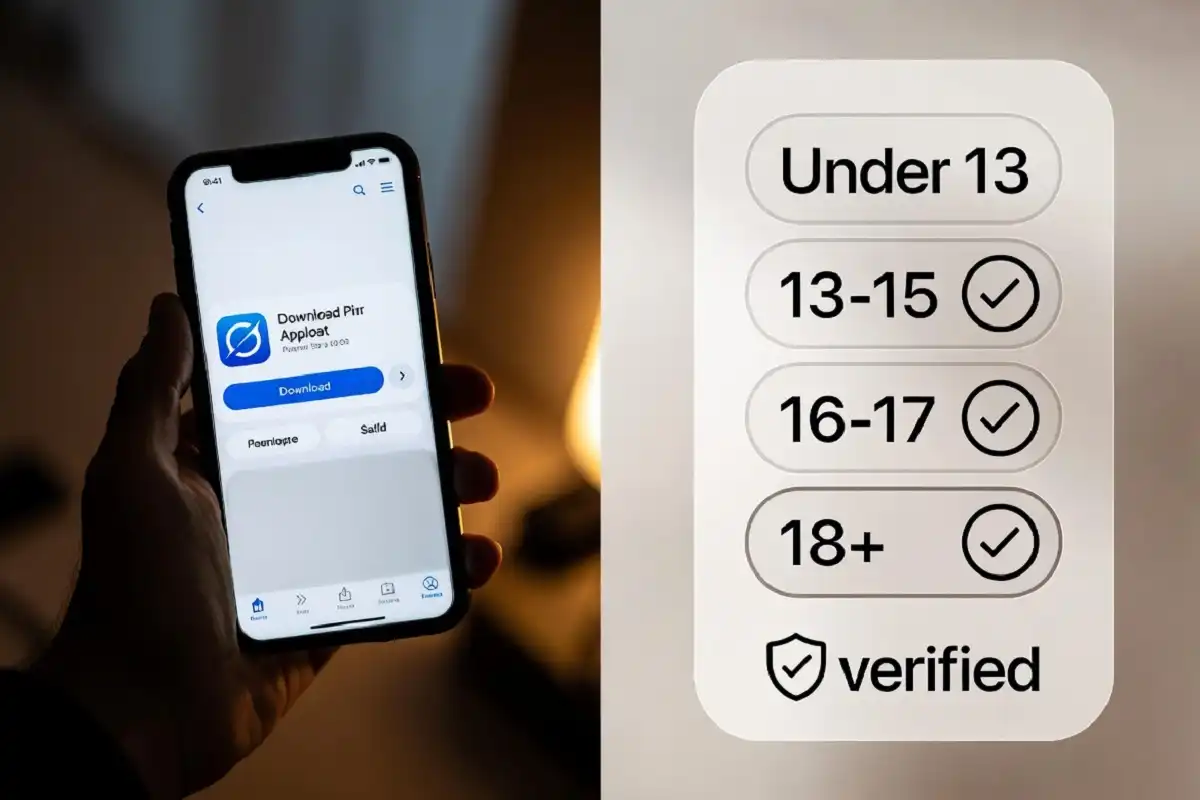
The system sorts people into four buckets: children under 13, teens 13 to 15, older teens 16 to 17, and adults 18 or older. The law also requires app developers to say whether their apps are appropriate for people in four categories: children under 13, teens aged 13-15, older teens aged 16-17 or adults 18 or older.
This goes further than older rules. The federal COPPA law only covered apps aimed at kids under 13. The new state laws reach much wider. These laws are aimed at expanding online age-gating and applying parental consent requirements even to apps that are not “directed” to children under 13 under federal privacy law. That means your app gets pulled in even if you never intended kids to use it.
Why Did Mobile App Age Verification Become Law in 2026?
Lawmakers passed these rules to protect minors online. The concern centers on social media, harmful content, and in-app spending by children without a parent’s knowledge.
Several states acted at once. Four states, Texas, Utah, Louisiana, and California, have passed app store age verification laws. Each version carries its own name, usually an “App Store Accountability Act,” and its own deadline. Supporters see it as basic child safety. Critics see a free-speech problem. Its supporters say the law is needed to protect children as they navigate social media and online spaces, while critics say it would violate free speech rights.
Which States Require Mobile App Age Verification?
Texas leads, and its law is live. Below is the current state-by-state picture as of July 2026.
Texas moved first into active enforcement. Senate Bill 2420, which was supposed to activate on Jan. 1, establishes age verification requirements and mandates parental consent before a person under the age of 18 is allowed to download or make purchases within apps. A court briefly blocked it. Then that block was lifted. A federal appeals court allowed Texas to require app stores to verify users’ ages and seek parental consent before a minor can download apps.
Louisiana is next in line. Louisiana’s ASAA will become effective and enforceable on July 1, 2026.
Utah was actually the first to pass such a law, but its timeline slipped. After a legal challenge and an amendment, the effective date for the key provisions of the act has been pushed until May 6, 2027. Utah also stripped out state enforcement. HB 498 delayed the Utah ASAA’s effective date by one year, to May 6, 2027, and significantly revised its enforcement framework. Most notably, HB 498 eliminated the Utah AG’s authority to enforce the law.
California and Alabama come later. Alabama’s ASAA will become effective on January 1, 2027. California’s operating-system approach starts Jan. 1, 2027.
The direction is clear. What starts in a few states rarely stays there. This shift mirrors the broader push around minors and platforms, similar to the debate over restricting younger users on social platforms, which is worth watching as these rules spread.
How Does Mobile App Age Verification Actually Work?
The app store checks the user’s age at signup, then passes an age category to the developer through an API. The developer reads that signal and adjusts the app.
Apple and Google built the plumbing. Apple uses its Declared Age Range API. Developers can request age category data for these Apple Accounts through the Declared Age Range API. For significant changes, developers should use the Significant Change API under the PermissionKit framework.
Google took a slightly different route. For eligible users in these states, your app is able to receive users’ age verification or supervision status, age ranges, and other applicable signals using the Play Age Signals API (beta). Google has already switched this on for Texas. We have begun rolling out these signals as well as the Play Store age verification flow for new users in Texas who created their accounts after May 28, 2026.
The two systems report different things. Google’s “Play Age Signals” API will show account statuses for age data (unlike Apple’s which details the method used for age assurances). Developers who build for both platforms have to integrate two separate APIs and keep them in sync.
What Methods Confirm a User’s Age?
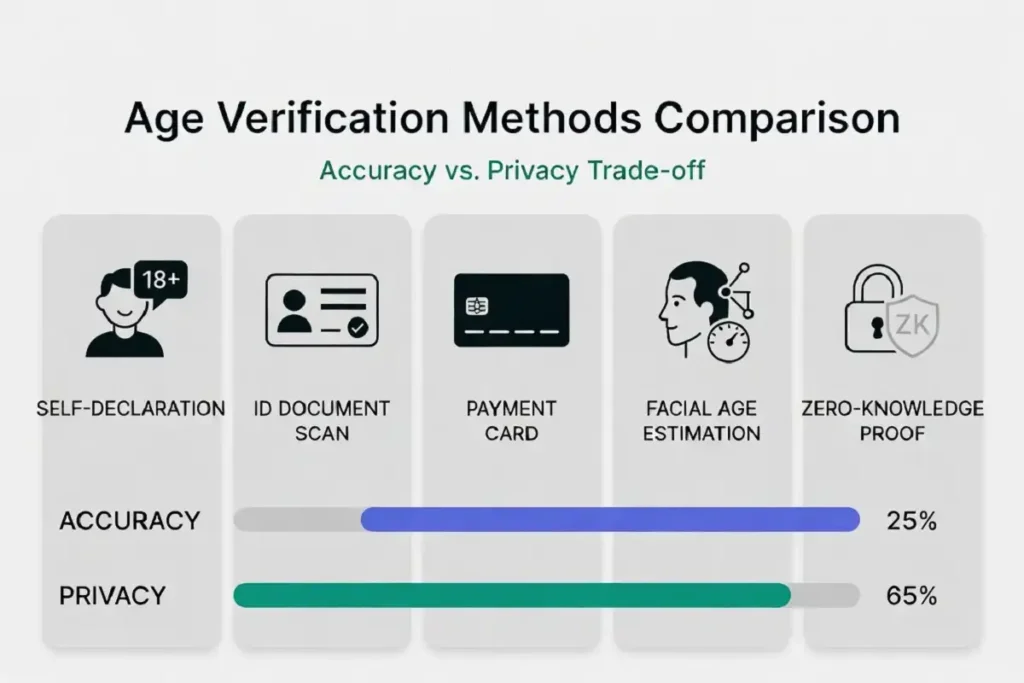
There is no single method. App stores and platforms pick from a range of age-assurance tools, each with its own tradeoff between accuracy and privacy.
The main options in use during 2026 include self-declaration, ID document checks, payment-card verification, facial age estimation, and behavioral AI inference. They include, among others, email age inference, social connections age inference, facial age estimation, ID verification, payment card verification, and AI-based age inference.
Facial age estimation is spreading fast. One of the most visible trends in online age verification for 2026 is the growing adoption of AI-powered biometric age estimation. These systems use facial analysis to estimate whether a user meets an age threshold, often without requiring document uploads or persistent storage of biometric data. Big platforms already run it. Roblox and Instagram use facial age-estimation systems to segment users and limit inappropriate interactions.
Each method trades privacy against certainty. Strict age verification can provide increased accuracy by requiring users to submit hard identifiers, such as a government-issued ID or biometric data. Access to such sensitive and identifying personal information can compromise an individual’s ability to remain anonymous online.
Is Mobile App Age Verification a Privacy Risk?
Yes, it can be, and that is the central tension. Collecting IDs and face scans creates data that hackers want. Every stored record is a target.
The breach history proves the point. Age verification system data breaches have included AU10TIX (2024), Discord/Zendesk (2025) and Persona (2026). More data collected means more data exposed.
This is why privacy-preserving methods are gaining ground. The leading idea is the zero-knowledge proof. Techniques such as zero-knowledge proofs allow users to demonstrate age eligibility without disclosing their identity or exact date of birth, addressing long-standing concerns about over-collection of personal data. The system gets a plain yes or no, and nothing else.
Regulators like this direction. Regulators in several regions are signaling support for privacy-preserving designs, reinforcing the idea that effective child protection does not require intrusive identity checks. Google has open-sourced tools here, and the EU is building a similar framework into its digital identity system. While the EUID solution is set to be released by the end of 2026, the EU launched an interim age verification app in the meantime.
What Developers Must Do to Comply
Developers cannot ignore this, even if their app has no kid-focused features. The obligations are independent of the app store’s own duties.
Start with these core steps. Assign an age rating to your app and its in-app products. Integrate the Apple and Google APIs. Read the age-category signal before download and before purchase. Confirm parental consent status for any minor. Then flag and report significant changes.
The “significant change” rule matters. As a reminder, it’s the developer’s responsibility to determine when there’s a significant change to their app. A significant change usually means new data practices, a shift in age rating, or newly added purchases or ads. When one happens, the app store may need fresh parental consent.
Data handling is strict too. Developers must also ensure that the information received from app stores for age verification and consent is only used for compliance purposes, transmitted securely using industry-standard encryption, and deleted after use (in Texas). Use the age data for compliance, then let it go.
One useful new option exists for apps that do not want minors at all. Developers may now affirmatively request that app stores block minor accounts from downloading or purchasing their apps, a new opt-in tool for developers who want to self-restrict access. That can cut your compliance burden sharply.
What Happens If You Ignore the Rules?
The penalties vary by state, and some let private citizens sue. This raises the stakes well beyond a regulator’s fine.
Enforcement differs across jurisdictions. Utah’s law includes an explicit PRA, exposing developers to potential lawsuits for certain violations. The Texas law defines a violation as a “deceptive trade practice,” which raises the possibility of private litigation. Government action is possible everywhere these laws are live. In all three jurisdictions, violations can be pursued by the State Attorney General and carry the risk of substantial civil penalties.
There is one bit of relief. Texas and Utah offer a safe harbor. Texas and Utah grant developers a safe harbor based on reasonable reliance on information provided by an app store. Louisiana does not. Louisiana’s law explicitly rejects this kind of safe harbor for developers. So a one-size approach across states will not work.
What Parents Should Know
Parents gain real control under these rules. If your child is a minor, the app store links their account to yours and asks you to approve downloads and purchases.
You can also change your mind. Parents or guardians will also be able to revoke their consent for any app they previously approved for their child. Denial does not always delete an app, though. On Google, for example, Google Play will not revoke app access or disable the app based on significant change approvals. So review new permission requests carefully when they arrive.
Mobile App Age Verification Beyond the US
This is not only an American story. Several countries now enforce their own age checks at the store level, and Apple applies them by region.
Apple already blocks adult-rated downloads in some markets. Users in Australia, Brazil, and Singapore will be blocked from downloading applications rated 18+, unless the users are confirmed to be adults through “reasonable methods.” The store handles the check itself. The App Store will perform this confirmation automatically. However, developers may have separate obligations to independently confirm that their users are adults.
The pace of these changes tracks the wider surge in AI-driven identity and safety tools, and it connects to the fast-moving world of mobile app development that businesses are watching closely in 2026. Expect more countries to follow.
What to Watch Next
Mobile app age verification is here to stay, but the rules are still moving. Texas is live now. Louisiana turns on July 1, 2026. Utah waits until May 2027, and California and Alabama arrive in 2027.
For developers, the smart play is to build once and build flexibly, since the strictest state law tends to set the bar. For parents, the tools give you a real say over what your kids download. And for everyone, the big open question is privacy: whether facial scans and ID checks win out, or whether zero-knowledge proofs make intrusive data collection unnecessary. Watch the Texas court fight and the EU’s identity rollout. Both will shape what age checks look like next.