Flexible Artificial Intelligence in 2026: What It Is and Why It Wins
Flexible artificial intelligence is the reason some AI systems keep performing when conditions change while others quietly fall apart. I have tracked this shift across earnings calls, analyst reports, and product launches since Q1, and the gap between static AI and adaptive AI is now a budget line, not a theory.
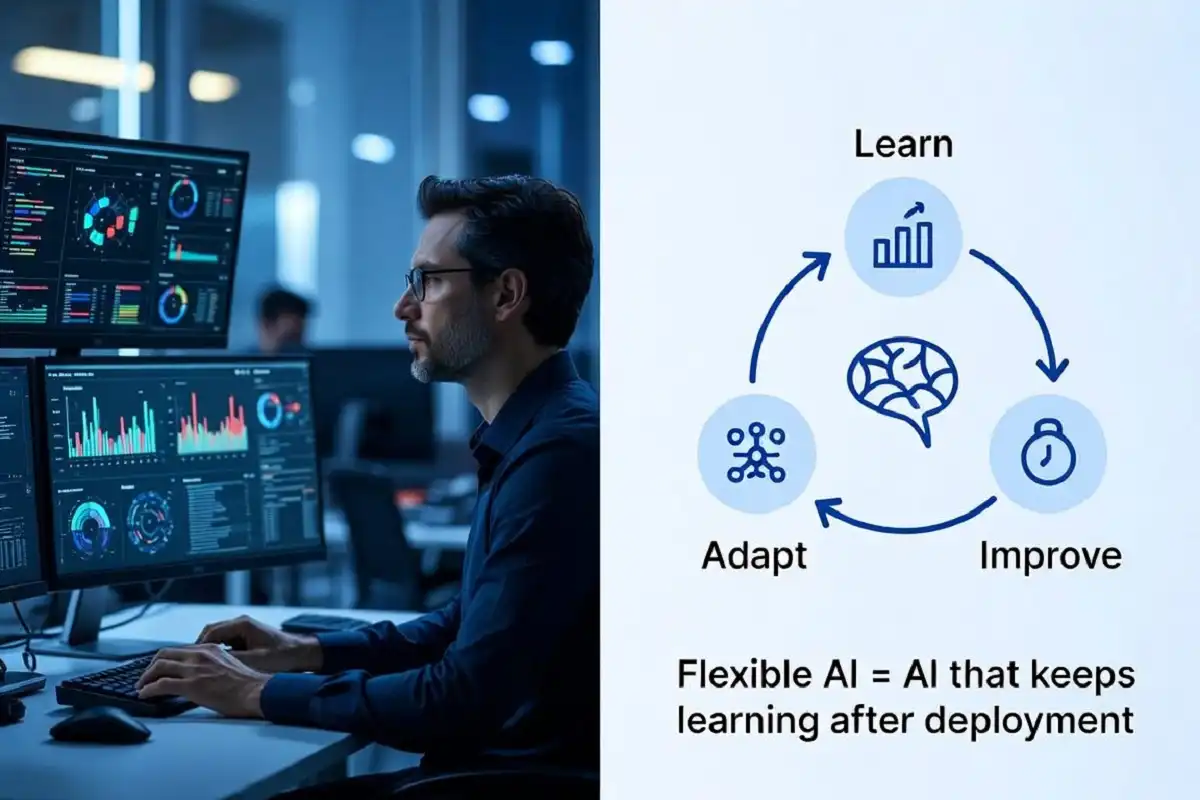
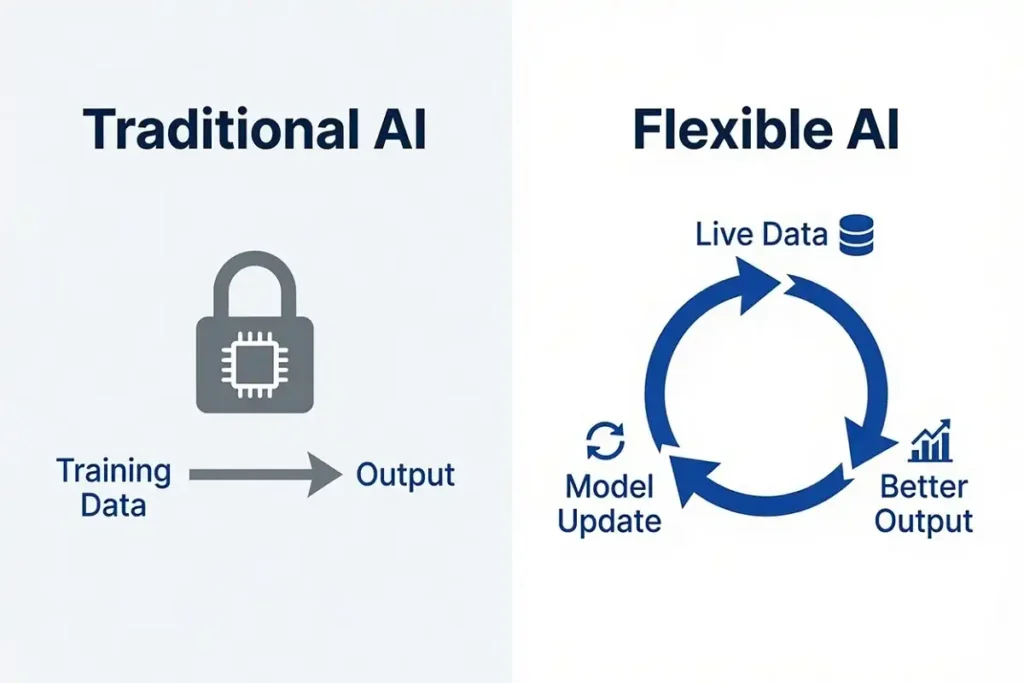
Flexible artificial intelligence describes AI systems that keep learning after deployment. They adjust to new data, user behavior, and changing conditions in real time. Traditional AI stays frozen at training. Flexible AI updates itself continuously.
What Is Flexible Artificial Intelligence?
Flexible artificial intelligence is AI that modifies its own behavior based on real-time data instead of relying only on its original training. The industry also calls it adaptive AI. Both terms point to the same capability: continuous learning after deployment.
Here is the practical difference. A traditional fraud model learns from last year’s fraud patterns. It stays accurate until criminals change tactics. A flexible system retrains on live transaction streams, so it catches new attack patterns within hours instead of waiting for the next manual model update.
The research community treats this as a distinct field. The IEEE Conference on Evolving and Adaptive Intelligent Systems (EAIS 2026), held in Pisa, Italy, focuses entirely on systems that evolve and learn after deployment in non-stationary environments. That academic backbone matters. It means flexible AI is an engineering discipline with defined methods, not a marketing label.
How Is Flexible AI Different From Traditional AI?
The core difference is what happens after launch. Traditional AI is trained once, deployed, and left alone until engineers retrain it. Flexible artificial intelligence treats deployment as the starting line, not the finish line.
Four differences matter most in practice:
- Learning cycle. Traditional models learn from a fixed historical dataset. Flexible systems learn from live data streams and user feedback, so their accuracy improves with use.
- Failure mode. Static models degrade silently when the world changes, a problem engineers call concept drift. Adaptive systems detect drift and correct for it.
- Maintenance cost. Static AI needs scheduled retraining projects. Flexible systems reduce that manual overhead, though they demand stronger monitoring instead.
- Decision speed. Because flexible systems update in real time, they support autonomous decision loops such as instant fraud blocking or dynamic pricing.
Gartner flagged flexible artificial intelligence early under the adaptive AI label. The firm named it a top strategic technology trend and predicted that organizations adopting it would outperform competitors by 25% by 2026. In my coverage this year, that prediction holds up best in finance and logistics, where conditions shift daily and static models age fastest.
How Big Is the Flexible AI Market in 2026?
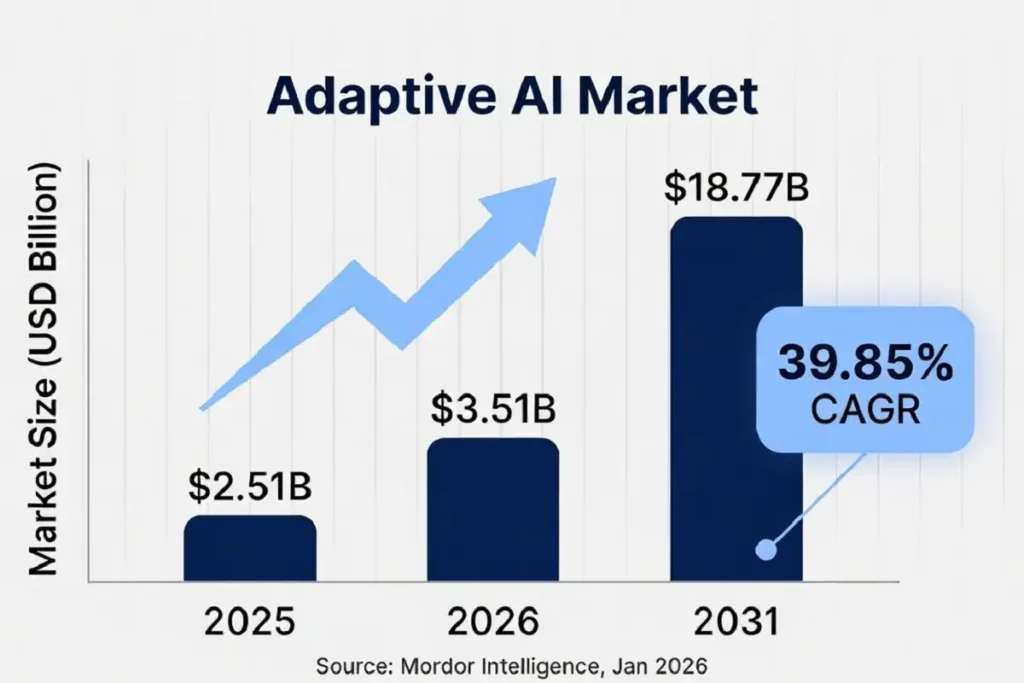
The flexible artificial intelligence market, which analysts track under the adaptive AI label, stands at an estimated $3.51 billion in 2026, up from $2.51 billion in 2025, according to Mordor Intelligence data published in January 2026. The same report projects $18.77 billion by 2031, a 39.85% compound annual growth rate.
The segment detail tells you where the money goes. Fraud and risk detection held 21.1% of 2025 revenue, the largest application slice. Autonomous systems are the fastest-growing application, projected at a 51.8% CAGR through 2031. By vertical, healthcare and life sciences lead future growth at a projected 44.2% CAGR, driven by autonomous diagnostics and personalized treatment engines.
Infrastructure spending backs the demand side. Microsoft pledged $80 billion for AI-focused data centers, and Google committed $75 billion to AI infrastructure in 2025. Cheaper compute and bundled cloud services push adaptive capability down-market. Microsoft’s Azure AI now serves more than 53,000 organizations, which means smaller firms can rent continuous-learning pipelines instead of building them. I covered a related capital story earlier this year in my report on the $5 billion AI infrastructure deal between Google and Blackstone, and the pattern is consistent: capacity is being built specifically for systems that train and retrain constantly.
How Does Flexible Artificial Intelligence Work?
Flexible artificial intelligence works through a continuous feedback loop: ingest live data, measure performance, update the model, then deploy the update automatically. Four techniques power that loop.
Online and Continual Learning
Instead of batch retraining every quarter, the model updates incrementally as new data arrives. This is how a recommendation engine adjusts to your behavior within a single session rather than next month.
Reinforcement Learning
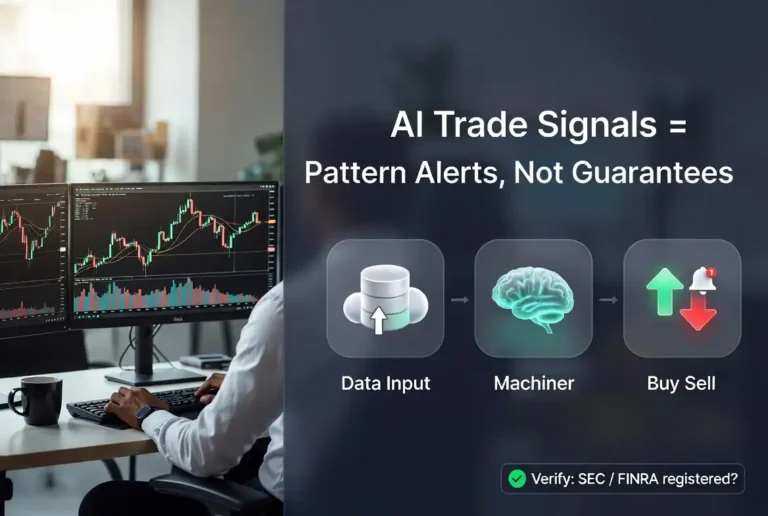
The system learns from outcomes. Each decision gets scored, and the model shifts toward actions that produce better results. Algorithmic trading systems use this to adjust to market volatility without human intervention.
Drift Detection
Monitoring tools watch for gaps between predicted and actual outcomes. When accuracy slips past a threshold, the system triggers retraining automatically. This is the safety net that static AI lacks.
Agentic Orchestration
The newest layer is multi-agent coordination, where specialized AI agents hand tasks to each other and adjust workflows on the fly. Gartner predicts 40% of enterprise applications will embed task-specific AI agents by the end of 2026, up from under 5% in 2025. Model vendors are racing to supply this layer, a trend I examined when reporting on Anthropic’s push into stronger agentic model capabilities earlier this year.
Where Is Flexible AI Used in 2026?
Flexible artificial intelligence shows up first wherever conditions change faster than humans can retrain models. Five sectors lead adoption right now.
Banking and fintech. Real-time behavioral fraud models reach 99.2% detection accuracy with 60% fewer false positives than static rule sets, per Mordor Intelligence’s 2026 industry analysis. Banks also use adaptive engines for personalized lending and investment recommendations that shift with customer behavior.
Healthcare. Adaptive diagnostic systems refine their outputs as patient data accumulates. This is why healthcare carries the fastest projected vertical growth through 2031.
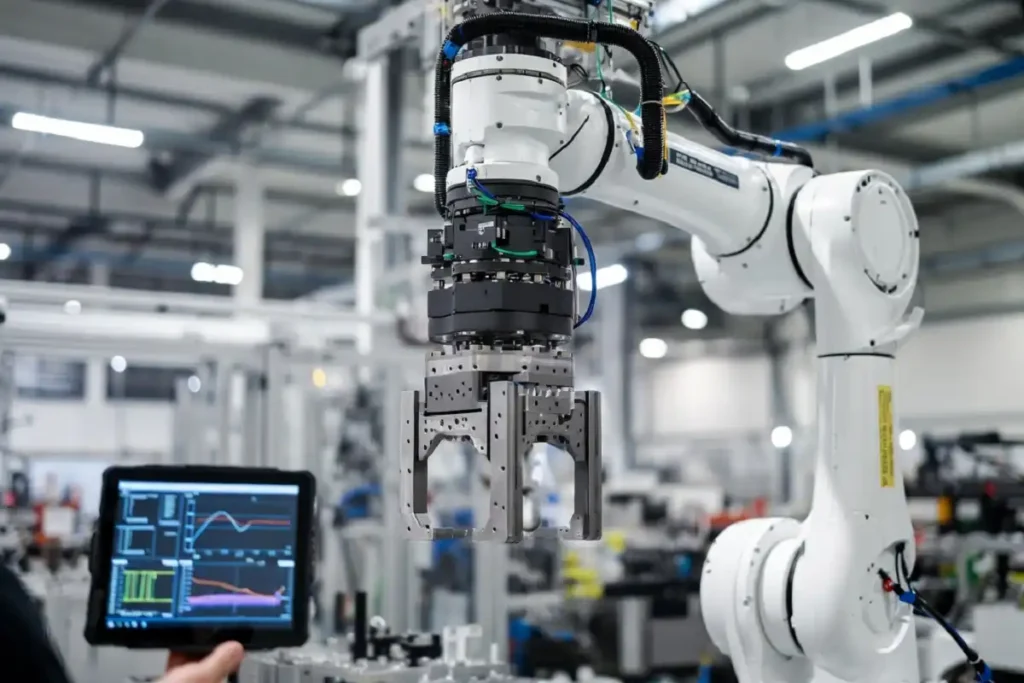
Manufacturing and robotics. At the Automate 2026 show in Chicago this June, Flexiv launched its Enlight and MICO platforms. Enlight is a seven-axis adaptive robotic arm with whole-body touch sensitivity through force-torque sensors in every joint. Flexiv demonstrated GPU assembly, autonomous polishing with Saint-Gobain, and automotive wiring assembly with Kurabo. Physical flexibility and software flexibility are converging into what the industry now calls physical AI.
Cybersecurity. Adaptive security frameworks update defenses as attack patterns evolve, replacing static rule sets that attackers learn to route around.
Enterprise software. Task-specific agents inside business applications adjust to each company’s workflows. That adoption curve connects directly to hiring and operations, a shift I broke down in my piece on how companies are rolling out AI across their teams.
What Are the Risks of Flexible Artificial Intelligence?
The biggest risk is losing control of a system that changes itself. A model that updates continuously can drift into biased or unsafe behavior without anyone approving the change. Three problems come up repeatedly in the deployments I have reviewed.
Governance gaps. Gartner expects over 40% of agentic AI projects to face cancellation risk, and the common thread is governance built too late. Continuous-learning systems need real-time monitoring, audit trails, kill switches, and human-in-the-loop checkpoints from day one.
Data quality. A flexible system trained on live data inherits every flaw in that data instantly. Gartner’s 2026 research identifies poor data quality as the single biggest barrier to AI return on investment. Bad inputs do not just produce one bad output; they retrain the model badly.
Cost creep. Continuous inference and retraining consume more compute than static models. Hybrid deployments, which mix on-premises hardware with cloud GPU clusters, are gaining share in 2026 partly to control those escalating cloud costs.
None of these risks argues against flexible artificial intelligence. They argue for sequencing: governance and data hygiene first, autonomy second.
How Should a Business Start With Flexible AI in 2026?
Start flexible artificial intelligence adoption with one high-frequency decision where conditions change weekly and outcomes are measurable. Fraud screening, demand forecasting, customer support routing, and dynamic pricing are the proven entry points with the clearest near-term returns.
Then follow this sequence:
- Fix the data pipeline first. Continuous learning on messy data compounds errors. Clean, labeled, real-time data feeds come before any model work.
- Buy before you build. Platform offerings held 57.55% of 2025 adaptive AI revenue for a reason. Cloud vendors bundle AutoML, vector databases, and pre-trained models on pay-as-you-train pricing, which cuts the skills barrier for smaller teams.
- Set drift thresholds and kill switches. Define exactly how much the model can change before a human reviews it. Write that policy before deployment, not after an incident.
- Measure against a static baseline. Run the adaptive system next to your existing model for one quarter. If it does not beat the baseline on accuracy and cost, fix the pipeline before scaling.
- Expand only after governance holds. Add use cases once monitoring, audit trails, and review workflows survive their first real incident.
What to Watch Next
Flexible artificial intelligence is moving from competitive edge to baseline expectation. The numbers I am watching through the rest of 2026: whether enterprise agent adoption actually hits Gartner’s 40% mark by December, whether healthcare’s projected 44.2% growth rate survives regulatory scrutiny, and how fast hybrid deployments eat into cloud-only spending. The direction is settled. Systems that stop learning at deployment are aging assets. Flexible artificial intelligence is now the standard the rest of the market gets measured against.