

WebMCP Lands in Chrome 149: Google’s Bid to Rewire How AI Agents Use the Web
Google’s WebMCP standard hits its public origin trial in Chrome 149 on June 2, 2026. Here is what it does, why Microsoft co-signed it, and what changes for anyone who runs a website once browser AI agents can call your tools directly instead of guessing.
WebMCP is a proposed open web standard that lets websites expose structured tools to in-browser AI agents. It enters a public origin trial in Chrome 149 on June 2, 2026, replacing fragile screen scraping with direct, declared tool calls.
What Is WebMCP, in Plain Terms?
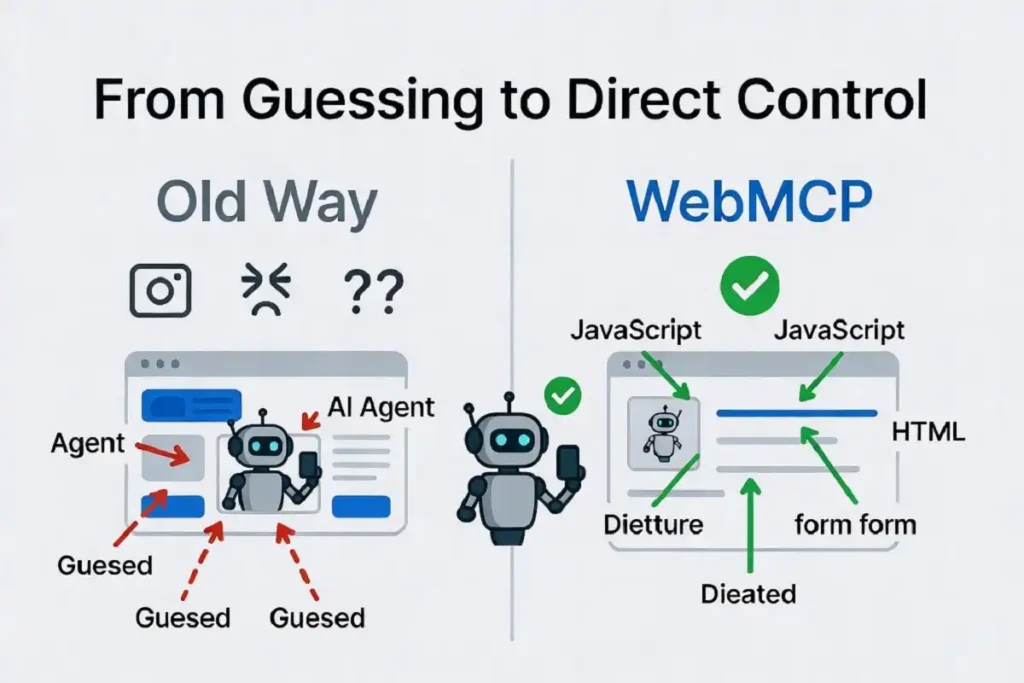
WebMCP lets a website hand an AI agent a set of ready-made tools instead of forcing the agent to scrape the page. The full name is Web Model Context Protocol. Think of a labeled control panel a browser agent can operate directly.
Today’s browser agents work the hard way. They take a screenshot, ask a model to find the “Add to cart” button, click, wait, and screenshot again. That loop is slow, costly, and breaks the second a designer renames a CSS class.
WebMCP swaps the guessing for a stable contract. Your site declares what it can do. The agent calls those functions with user permission. No pixel hunting required.
Why Google Made This Move at I/O 2026
Google announced WebMCP at its I/O 2026 developer keynote on May 19, with the companion documentation posted the day before by Chrome’s Alexandra Klepper. The announcement marks the first time the proposed web standard has been made testable on production traffic.
The timing is not random. Google framed the whole event around what it calls the agentic web, where AI agents act as first-class users of the internet. WebMCP is the plumbing that makes that vision work without breaking existing sites. It sits alongside Google’s broader push into agent tooling, the same direction driving its multi-billion-dollar AI infrastructure spending over the past year.
Gemini in Chrome will support WebMCP APIs, with Gemini Spark, Google’s cloud-based personal agent, expected to be among the first to call these tools. That puts a real consumer agent behind the standard, not just a spec on paper.
How WebMCP Actually Works
WebMCP gives developers two ways to expose tools. Both are thin layers on patterns the web already supports.
The Declarative Surface
You annotate existing HTML forms. A search box, a checkout form, a booking field. The agent reads those annotations and knows exactly what each input expects. No new framework needed.
The Imperative Surface
You register JavaScript functions as callable tools. An agent can invoke a function like or and get a structured result back. This handles the logic that a plain form cannot.
Right now the feature lives in Chrome 146 Canary behind a “WebMCP for testing” flag. The origin trial opens with Chrome 149 on June 2. Developers can register a domain and ship WebMCP support to real users during the trial window.
Microsoft Co-Wrote It, but Apple and Mozilla Are Quiet
Microsoft co-authored the WebMCP spec and shipped Edge 147 support back in March 2026. That matters. Chrome holds roughly 65% browser market share, and Edge adds another 5%, so a pattern backed by both Google and Microsoft covers around 70% of browsers.
The gap is on the other side. Firefox and Safari have made no commitments, and Anthropic’s 2026 MCP roadmap does not mention WebMCP. The spec currently sits in the W3C Web Machine Learning Community Group, not on the official W3C Standards Track. So this is a strong proposal with heavy backing, not a ratified standard yet.
That distinction is fair to keep in mind. A Chromium-preferred pattern is not the same as a universal web standard. Still, 70% browser support out of the gate is a serious starting position.
The agent-tooling space has been crowded lately. Anthropic has pushed hard on the same theme with its agentic coding upgrades in Claude Opus 4.7, and the broader coding gains across the Claude 4 line show how fast this category is moving. WebMCP is Google’s answer at the browser layer.
What Site Owners Should Do Before June 2
Start by reading the spec and testing one tool on a staging branch. You do not need to rebuild your site. The smart first step is annotating a single high-value form, like search or checkout, and registering for the origin trial token.
The strategic shift is the real headline. For most of early 2026, site owners asked how to stop agents from breaking their pages. From Chrome 149 onward, the question flips to how to become the site an agent prefers to use. As more shoppers lean on the AI assistant apps now topping the charts, being agent-readable starts to look like basic SEO for a new era.
There is a security upside too. Structured tool calls with explicit user authorization beat blind automation that mimics clicks. After incidents like the GitHub breach tied to a compromised coding tool, a model where sites declare exactly what agents may do is a cleaner trust boundary.
You can follow the trial details on the official Chrome for Developers documentation and track the standardization status through the W3C community group.
My Read on This
Faster AI models ship every few months. That is a cadence, not a story. WebMCP is different because it is infrastructure. It changes how websites and agents talk to each other at the protocol level.
The June 2 origin trial will not flip the web overnight. Adoption depends on Gemini in Chrome actually calling these tools at scale, and on Safari and Firefox eventually showing up. But the direction is clear. Sites that get agent-readable early will be the ones agents reach for by default. The ones that wait may spend the back half of 2026 wondering why a competitor keeps getting recommended instead.